When you think of getting your eyes checked or picking out new glasses, you're thinking of an optical optician. They are the high-street professionals who serve as the first port of call for all things vision-related, blending health checks with practical solutions like spectacles and contact lenses.
Understanding Your Local Eye Care Team
It helps to think of your local optician's practice as a dedicated healthcare hub. Much like a GP's surgery has doctors and nurses with distinct roles, an optician's office is staffed by a team of specialists who work together to look after your eyes.
Each professional has a specific job, guiding you through the complete cycle of your eye care. It starts with the initial examination and ends with the perfect fitting of your new eyewear. This team-based approach means you get specialised expertise at every single step, making the whole process feel reassuring.
The Key Professionals You Will Meet
In most optical practices, you'll primarily interact with two types of qualified professionals: the optometrist and the dispensing optician. They work side-by-side, but their roles are quite distinct. The optometrist is focused on the health of your eyes, conducting the examination and providing you with a prescription.
The dispensing optician then takes that prescription and helps you turn it into a comfortable, stylish, and functional pair of glasses. They're the experts in frames, lenses, and getting the fit just right. Occasionally, your optometrist might refer you to an ophthalmologist—a hospital-based eye surgeon—for more complex medical issues.
The UK opticians industry is expanding to meet growing needs, with revenues expected to hit £5.8 billion in 2025. This growth is partly driven by the fact that the number of people aged 65 and over has now topped 12 million, highlighting the increasing importance of accessible eye care.
A simple way to remember the difference: the optometrist is the diagnostician who finds the problem and writes the prescription. The dispensing optician is the specialist who crafts and fits the solution.
Who Does What in Your Local Eye Care Practice
To make it even clearer, let's break down who is responsible for what. The table below gives you a quick snapshot of the main professionals you'll meet and what they do.
| Professional | Primary Responsibilities |
|---|---|
| Optometrist | Conducts eye examinations to test your vision and check for underlying health conditions. They diagnose sight problems and issue prescriptions for glasses or contact lenses. |
| Dispensing Optician | Reads the optometrist's prescription to advise on, fit, and supply the best possible spectacles and lenses for your individual needs. |
| Ophthalmologist | A medically trained doctor, usually based in a hospital, who specialises in eye diseases and surgery. An optometrist would refer you to them for conditions like cataracts. |
Understanding these roles helps you know who you're talking to and why, so you feel confident and informed throughout your visit.
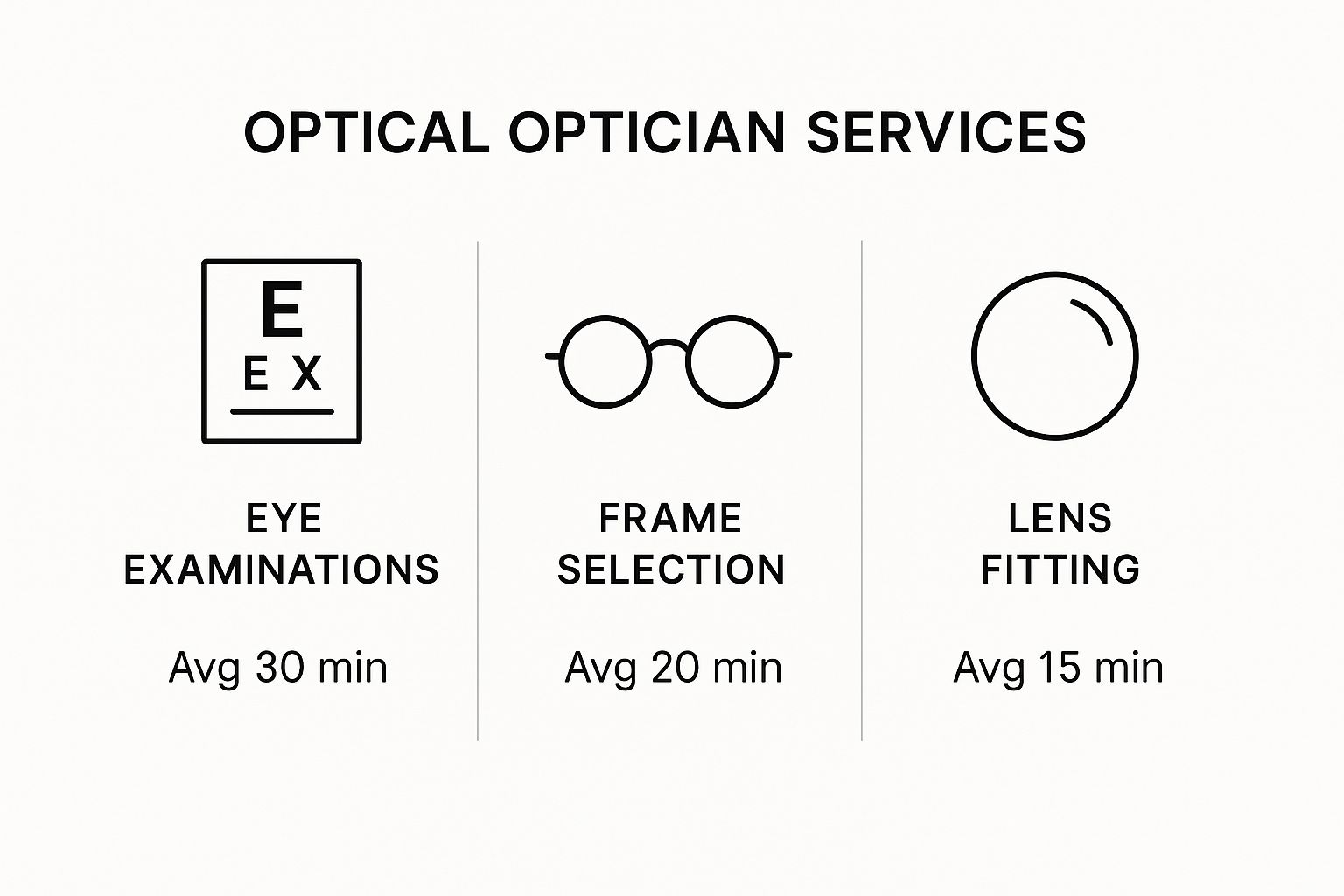
As the image shows, the eye examination itself rightly takes up the most time. It’s far more than a simple vision test; it's a comprehensive health check. To learn more about what's involved, have a look at our complete guide on the principles of Northern eye care.
What Happens During a Complete Eye Examination
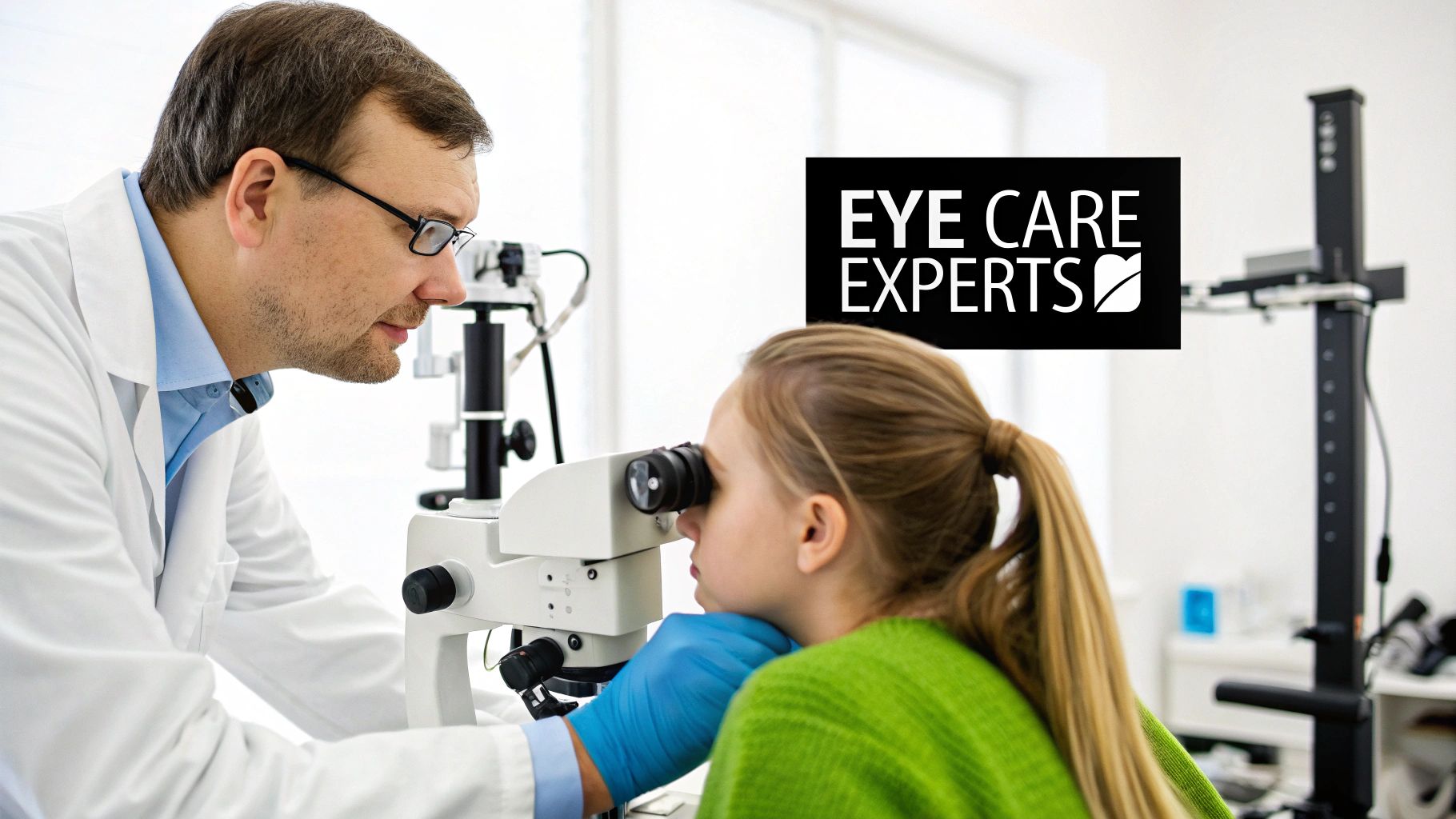
If you think an eye exam is just about reading letters off a chart, you might be surprised. A modern eye examination is a comprehensive health check for your eyes, revealing far more than just whether you need a new pair of specs. Think of it as an exploration of your vision and general wellbeing, broken down into a few key stages.
It all starts with a simple conversation. Your optometrist will want to know about your eyesight, your general health, and any worries you have. They'll likely ask about your family’s medical history and your day-to-day life, as your work and hobbies can all play a part. This friendly chat gives them the context they need for the more technical parts of the exam.
Next, you'll move on to some pre-screening tests. These are usually quick, automated checks that give the optometrist a baseline reading of your vision and eye pressure. They’re completely straightforward and provide a wealth of data to work from.
Initial Checks and Health Screening
One of the first things you'll probably experience is the non-contact tonometer—better known as the 'puff of air' test. It's a bit of a surprise the first time, but it's over in a second. This clever machine measures your intraocular pressure (IOP), which is the fluid pressure inside your eyes.
Why does this matter? Elevated IOP can be an early warning sign for glaucoma, a serious condition that can damage the optic nerve without you noticing any symptoms. Catching it early is absolutely critical for protecting your sight.
Another common tool is a digital retinal camera, which snaps a detailed photo of the back of your eye. This gives the optometrist a crystal-clear view of your retina, optic nerve, and blood vessels, creating a permanent record. It makes spotting tiny changes between appointments much easier. For many people, a thorough eye test in Newcastle is their first line of defence in preventative healthcare.
Determining Your Prescription
Now for the part you’re probably most familiar with: the refraction. This is where the optometrist fine-tunes your prescription. You'll be asked to look through a large piece of kit called a phoropter, which houses a whole range of different lenses.
As you read letters from the chart, the optometrist will flip between different lens combinations, asking you the classic question: "Which one looks clearer, one or two?". It's a collaborative process that helps pinpoint the exact lens power you need to correct any common refractive errors, such as:
- Myopia: Short-sightedness, where things in the distance look blurry.
- Hyperopia: Long-sightedness, which makes focusing on close-up objects a struggle.
- Astigmatism: Caused by an irregularly shaped cornea, this leads to blurred vision at any distance.
The optometrist guides you through every step, so even though it relies on your feedback, it's a very simple and effective process.
An eye examination isn't just a test of your sight; it's a window into your general health. Conditions like high blood pressure and diabetes can often be detected by looking at the blood vessels in the back of the eye.
Examining the Health of Your Eyes
Once your prescription is sorted, the optometrist will carry out a thorough health check. Using specialist tools like a slit lamp (a powerful microscope) or an ophthalmoscope, they'll get an up-close look at the internal and external structures of your eyes. This allows them to carefully assess the health of your cornea, iris, lens, and retina.
They’re searching for any tell-tale signs of common eye conditions, from cataracts and macular degeneration to retinal tears. This detailed inspection is precisely why an optometrist’s role is so valuable.
In fact, workforce projections for UK eye care highlight a growing demand for these diagnostic skills. The number of optometrists is expected to rise by 38.2% over the next decade. The number of dispensing opticians—who primarily fit eyewear—is predicted to fall. You can read more about these trends in UK eye care service planning on aop.org.uk.
To wrap things up, your optometrist will sit down with you and explain everything they’ve found. They'll go over your prescription, talk about your eye health, and recommend any eyewear you might need. It’s this complete picture that makes a visit to your local optical optician a key part of looking after yourself.
Looking Beyond the Standard Eye Test: Advanced and Specialised Care
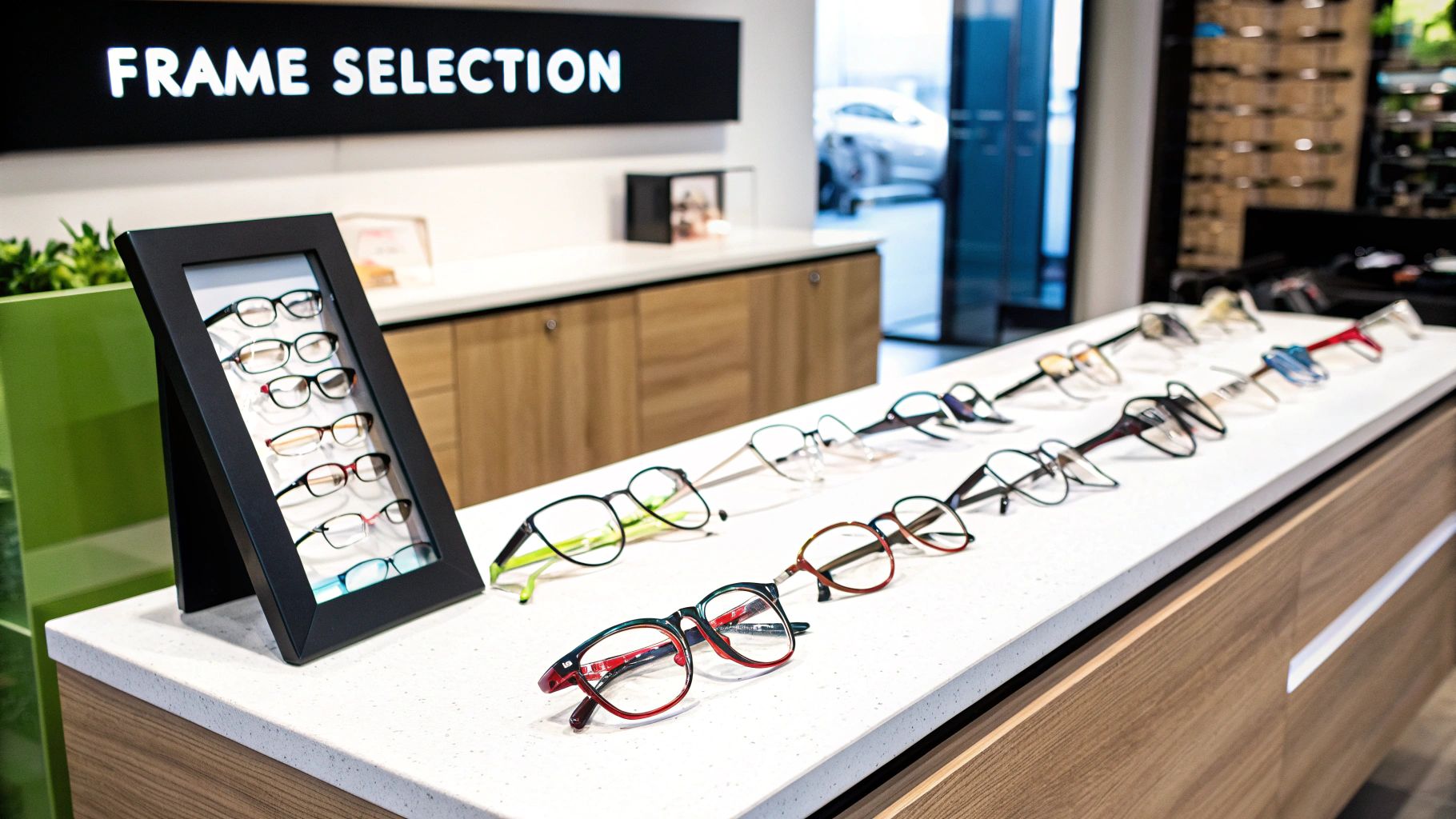
These days, a visit to the optician offers so much more than just a new prescription. Modern practices are hubs for proactive eye health, armed with technology that gives us a deep understanding of what's happening inside your eyes. These advanced services are all about catching potential problems early and managing more complex vision needs with pinpoint accuracy.
When you go beyond a standard sight test, you're allowing your optometrist to build a much richer, more detailed picture of your eye health. It’s a key step, especially for spotting the very first signs of conditions that haven't even started to show symptoms yet. Think of it as a shift in focus: from just correcting your vision today to actively protecting it for life.
Seeing Beneath the Surface with Retinal Imaging
One of the biggest advances in modern eye care is Optical Coherence Tomography, or OCT. An OCT scan is like an ultrasound for the eye. But instead of sound, it uses light to create a detailed, 3D map of your retina, letting an optometrist see each individual layer.
The level of detail is phenomenal. It means we can detect serious conditions like glaucoma, diabetic retinopathy, and age-related macular degeneration far earlier than with traditional methods—sometimes by several years. If you have a family history of eye disease or other risk factors, an OCT scan offers invaluable reassurance.
An OCT scan gives an optometrist a view beneath the surface of the retina. It’s like a doctor being able to see inside an organ without making a single cut—a completely non-invasive way to spot trouble before it gets serious.
These scans also create a digital baseline of your unique eye health. During future check-ups, your optician can overlay the new scan with the old one, making it incredibly easy to spot even the tiniest changes over time. This continuous monitoring is the cornerstone of great long-term care.
Specialised Services for All Walks of Life
The skills within a good optical practice cover a wide range of specialised areas. These services are there for anyone with specific needs, from a toddler needing their very first eye test to an adult managing a complex prescription.
This tailored approach means everyone gets the right care for their own circumstances and lifestyle.
-
Contact Lens Consultations: Thinking of making the switch from glasses? A proper consultation is the starting point. It's much more than just being given a box of lenses. It involves a careful assessment of your eye's surface health, precise corneal measurements, and a chat about your lifestyle to find the perfect lens type for you. Your practitioner will also show you the ropes—how to safely put them in, take them out, and look after them.
-
Paediatric Eye Care: A child's eye test is a world away from an adult's. We adapt them to be fun and engaging, often using pictures and shapes instead of the classic letter chart. Catching issues like amblyopia (a lazy eye) or strabismus (a squint) early is critical, as treatment is most effective when they're young.
-
Low Vision Services: For people whose vision can't be fully corrected with standard glasses or contact lenses, low vision services can be life-changing. Opticians can recommend and provide things like high-powered magnifiers and other visual aids that help people stay independent and carry on with their daily routines.
Expert Fittings for Complex Prescriptions
Not every prescription is straightforward. Some people have very high-power needs or conditions like keratoconus that demand more specialised solutions. This is where the technical skill of a dispensing optician really shines.
They can recommend things like ultra-thin, high-index lenses to make strong prescriptions feel much lighter and more comfortable. They're also experts in fitting specialist eyewear, from prescription sports goggles to industrial safety glasses, making certain your vision is both clear and protected. For anyone with multifaceted visual needs, that expert guidance is indispensable—it brings comfort, clarity, and real confidence in your eyewear.
How to Choose Your Perfect Pair of Glasses
Picking out new glasses isn't just about finding a frame you like. It’s a bit of an art and a science, a collaboration where your prescription, your lifestyle, and even your face shape all play a part. A skilled dispensing optician acts as your personal guide, turning that clinical prescription from the test room into a pair of glasses that gives you sharp, effortless vision.
The whole process kicks off with a simple chat about you. Do you spend your days staring at a computer screen? Are you an avid cyclist who needs something that stays put? Your day-to-day life heavily influences the right choice of materials and lenses, so your new glasses are a help, not a hindrance.
Finding Frames that Flatter and Fit
It's amazing what the right frame can do for your face. You've probably heard the general rules of thumb – angular frames for round faces, softer shapes for square faces – but the truth is, the only way to really know is to try them on. An experienced optician has a great eye for what will suit you and can help you find that perfect balance.
But while style is subjective, the fit is absolutely critical. A frame that’s too wide will constantly slide down your nose, and one that’s too tight will pinch your temples. It can be a real challenge to find the right size, especially for those with more delicate features. If that sounds like you, our guide to the best glasses for small faces is packed with useful tips.
Decoding Your Lens Options
Once you've settled on a frame, it's time to talk lenses. This is where a dispensing optician’s technical know-how really shines. They’ll take the prescription from your optometrist and recommend the ideal lens solution.
You’ll generally be looking at three main types:
- Single Vision Lenses: These have one single prescription power throughout the lens, designed to correct either your distance vision or your near vision for things like reading.
- Bifocal Lenses: A classic design with two parts. The top half is for seeing far away, while a small, visible segment at the bottom provides the power you need for close-up tasks.
- Varifocal Lenses: Often called progressive lenses, these are the modern all-in-one solution. They offer a smooth transition from distance to intermediate and near vision, with no lines to be seen.
Your optician will also walk you through different coatings. Think of them as upgrades for your lenses. An anti-scratch coating adds a layer of durability, while an anti-reflective coating is a must for cutting down annoying glare from screens or oncoming headlights at night.
Think of your prescription as the raw ingredients and your dispensing optician as the chef. They have the skill to combine those ingredients—the lens type, material, and coatings—to create the perfect final product for your visual needs.
The Importance of Professional Measurements
A great pair of glasses is built on precise measurements. One of the most important is your pupillary distance (PD) – the exact distance between the centres of your pupils. If this is off by even a millimetre, it can throw everything out of alignment, leading to eye strain, headaches, or blurry vision.
Recent trends in the UK optical market reveal a shift in consumer habits. Shoppers, often dubbed “Wiser Wallets,” are looking for real value, prioritising quality and durability over throwaway fashion. This makes a professional fitting, which confirms comfort and longevity, more important than ever. You can read more about consumer trends in the UK optical market on aop.org.uk.
The final, critical step is the fitting itself. Your optician will carefully adjust the frame, shaping the arms to sit comfortably behind your ears and setting the nose pads just right. This is what truly personalises your glasses, turning a simple frame into something that feels like it was made just for you.
The Case for Choosing a Local Independent Optician
When it's time for an eye test, you're faced with a familiar choice: head to a big high-street chain or visit your local independent optician. While the big names offer a certain convenience, the experience at an independent practice is built on something different—continuity, genuine personalisation, and a deep-rooted connection to the community.
Think about it. Visiting an independent optician isn't just a one-off appointment; it's the start of a long-term relationship. You’ll likely see the very same person year after year. They get to know you, your family, your job, and most importantly, the subtle, individual story of your eyesight.
This continuity is a big benefit for your eye health. Your optician builds up a detailed history, allowing them to spot tiny changes that might otherwise go unnoticed. It transforms eye care from a series of disconnected check-ups into a proactive, continuous health journey.
A More Personalised Experience
At an independent practice, you are the focus. Appointments are rarely rushed. Instead, there's ample time to sit down, have a proper chat about your vision, and discuss any worries you might have. It's a consultation, not a conveyor belt.
This means you get advice that’s actually shaped around your life. Do you spend hours in front of a screen? Or maybe you need glasses that can keep up with your weekend hiking trips? The recommendations you receive are based on your real-world needs. To see this philosophy in action, take a look at what visiting an independent optician in Newcastle is really like.
At its heart, an independent practice is a partnership. It’s where clinical expertise meets a genuine understanding of the person behind the eyes.
This personal touch runs through everything they do, from the warm welcome when you walk in to the expert fitting of your new frames. The team is genuinely invested in getting it right for you, creating an atmosphere that’s both supportive and reassuring.
Access to Unique Eyewear and Advanced Technology
One of the best things about independent opticians is their freedom. They aren't tied to corporate deals or a prescribed list of suppliers. This means they can hand-pick their frame collections, often sourcing incredible, high-quality eyewear from smaller, independent designers you simply won’t find elsewhere. If you want glasses that reflect your personality, this is where you'll find them.
Independents are also often passionate about investing in the very best clinical tools. It’s quite common to find advanced diagnostic equipment, like OCT scanners, in a local practice. Why? The owners are committed to offering the highest standard of care and giving their community access to the best technology for spotting eye conditions early.
Independent Opticians vs Chain Stores at a Glance
The two options offer very different experiences. Here's a quick breakdown of what you can generally expect.
| Feature | Independent Opticians | Chain Stores |
|---|---|---|
| Continuity of Care | Often see the same practitioner year after year, building a relationship. | High staff turnover can mean seeing a different person each visit. |
| Appointment Length | Generally longer, allowing for in-depth discussion and a relaxed pace. | Often shorter, more standardised appointment slots to maximise volume. |
| Eyewear Selection | Curated collections with unique and independent brands. | Limited to specific brands dictated by corporate agreements. |
| Service Approach | Highly personalised and relationship-focused. | Standardised service model focused on efficiency and sales targets. |
Choosing an independent optician is about more than just a pair of glasses. It's an investment in a local business, in a lasting professional relationship, and in the long-term health of your vision.
Your Optical Care Questions, Answered
Heading into the world of eye care can feel a bit like learning a new language. To make things simple, we've put together straightforward answers to the questions we hear most often. Think of this as a quick chat to clear up any last-minute queries before you pop in for a visit.
These answers pull everything we've talked about together, giving you the confidence to take control of your eye health. Let's tackle some of the things people are often curious about.
How Often Should I Get My Eyes Checked?
This is probably the number one question people ask, and for good reason. For most adults under 40 who aren't having any issues, a check-up every two years is a solid rule of thumb. It's the standard rhythm for keeping an eye on your vision and checking that everything is healthy.
But that's just a baseline. Life isn't one-size-fits-all, and neither is eye care. Certain factors mean you'll need to see us more often to stay on top of things.
Your optician will always recommend a schedule that’s right for you, but more frequent tests are generally a good idea for:
- Children: Their vision can change in the blink of an eye as they grow. We like to see them annually to confirm their eyes are developing as they should.
- Adults Over 70: As we get older, the risk of conditions like cataracts or macular degeneration naturally increases. An annual visit is a wise move.
- People with Certain Health Conditions: Things like diabetes or high blood pressure can impact the tiny blood vessels in your eyes, so a yearly check is critical.
- Those with a Family History: If glaucoma runs in your family, for example, your optometrist will want to monitor you more closely.
The best advice? Stick to the schedule your optical optician gives you. They’ll tell you exactly when they need to see you again to keep your vision sharp and your eyes healthy.
Can I Take My Prescription to Another Optician?
Yes, absolutely. Once your eye test is complete, your optometrist is legally required to hand you a copy of your prescription. It's your personal health document, and there’s no pressure whatsoever to buy your glasses from the same place.
This puts you in the driver's seat. You're free to have your eyes tested with an optometrist you trust and then find frames you adore at a different optical optician. It’s a completely normal part of the process, letting you find the perfect mix of expert care and personal style.
Your prescription is a set of instructions belonging to you. It gives any qualified dispensing optician all the technical data they need to craft your lenses perfectly, regardless of where you decide to buy them.
When you bring your prescription to a new practice, they will use it to make up your lenses. They’ll still need to take their own professional measurements, like the distance between your pupils and fitting heights, to make certain the new lenses sit perfectly in the frame you've chosen.
Are More Expensive Lenses Really Worth It?
The price tag on a pair of lenses usually reflects the technology and materials that have gone into them. While a basic lens will certainly do the job of correcting your vision, stepping up to a premium option can make a world of difference in how you see, feel, and look.
Think of it like buying a car. A standard model will get you from A to B just fine, but a higher-spec model offers a smoother, more comfortable ride. Whether the extra investment makes sense for you comes down to your prescription, your daily life, and what you value most. A good dispensing optician will talk you through it all, explaining the real-world benefits. Someone with a high prescription, for instance, will immediately appreciate the thinner, lighter high-index lenses that banish the old "coke bottle" look.
So, what are you paying for? Here’s a quick rundown:
- Better Materials: High-index materials make lenses noticeably thinner and lighter. For active people or kids, polycarbonate lenses are a fantastic, impact-resistant choice.
- Smarter Coatings: An anti-reflective coating is a major benefit for cutting down glare from computer screens and car headlights. Scratch-resistant coatings add a tough, protective layer to keep them pristine for longer.
- Superior Varifocals: More advanced varifocal designs give you a much wider field of vision, with less of that "swimmy" feeling at the edges. It makes for a far more natural and easy-to-adapt-to experience.
Your dispensing optician is your guide here. They’ll help you weigh the options and find the perfect balance between performance and price for your eyes.
At Northern Optical Company, we believe in clear, honest advice. Our friendly team is always here to answer your questions and guide you through every step of your eye care journey. To book an appointment or find out more, just visit us at https://northernopticalcompany.com.