When you look at a pair of glasses, you're looking at a small marvel of physics. Optical lenses work by bending light with incredible precision, correcting your vision in much the same way a camera lens focuses to capture a sharp, clear picture.
Think of it this way: sight happens when light travels from an object and lands perfectly on the retina at the back of your eye. When that process has a slight glitch, your vision becomes blurry. That's where lenses optical technology comes in, gently correcting light's path to bring your world back into focus. This guide will demystify the science behind your specs, making a complex topic simple.
How Optical Lenses Shape the World We See
At its heart, an optical lens is a carefully shaped piece of a transparent material, usually glass or high-tech plastic, that refracts—or bends—light. Imagine it as a traffic controller for light waves. In an eye with perfect vision, light entering it is focused squarely onto the retina. For millions of us, though, that focal point is a little off, causing blurriness.
This is exactly what prescription lenses are designed to fix. Each lens is custom-made to redirect incoming light rays, shifting the focal point just enough—either forwards or backwards—so it lands exactly on the retina. It is this precise correction that turns a fuzzy, out-of-focus scene into one that is crisp and clear. The exact curve and thickness of the lens give it its power, which is measured in dioptres.
The Science of Clear Sight
It all begins with a thorough eye exam. Your optician will pinpoint your specific refractive error, which is the technical term for how your eye bends light incorrectly. The most common issues that lenses optical solutions address are:
- Myopia (Nearsightedness): This is when distant objects look blurry because light is focusing in front of the retina. Concave lenses are used to push that focal point back.
- Hyperopia (Farsightedness): If you struggle to see things up close, it's often because light is trying to focus behind the retina. A convex lens brings that focal point forward.
- Astigmatism: This causes blurred vision at all distances and happens when the cornea or lens has an irregular, more football-like shape. It requires a special toric lens to correct.
A correctly prescribed lens becomes an external part of your eye's own focusing system. It does not just make things bigger; it reorganises the light before it even hits your eye, allowing your natural lens and retina to do their job properly.
Grasping this fundamental principle is the first step to choosing the right eyewear. All the different materials, lens types, and coatings we will explore in this guide are built on this one idea: managing light. Each feature is designed to refine how light is handled, giving you better comfort, improved clarity, and protection for your eyes. Knowing this helps you understand exactly what you're investing in.
Understanding the Building Blocks of Sight
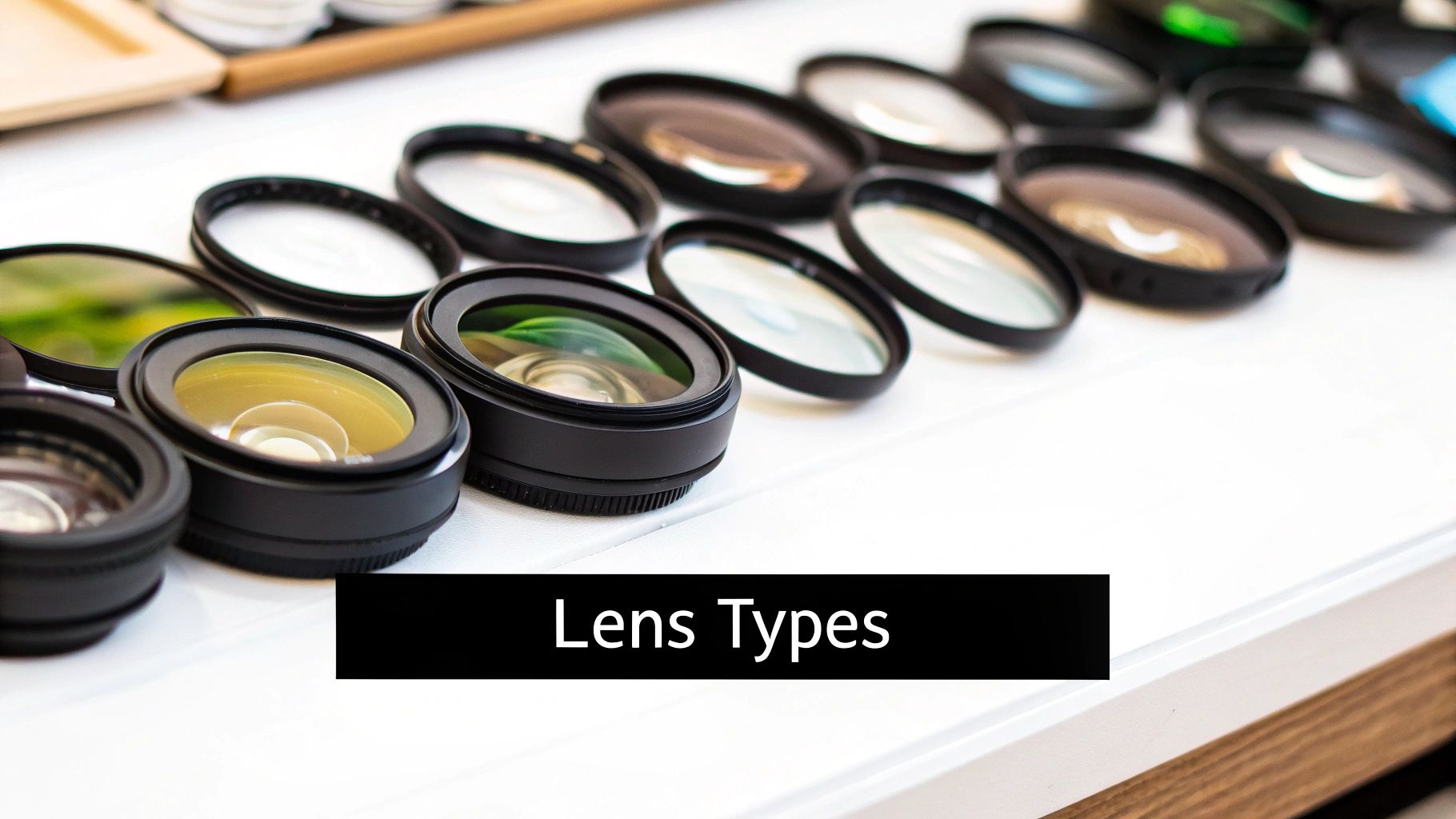
Think of lens material as the very foundation of your glasses. It is what determines how heavy they feel, how tough they are, and how clearly you see through them. For many years, traditional glass was the only real option, and it was valued for its incredible scratch resistance and optical purity.
Glass provides a fantastically crisp view of the world. This is because it has a high Abbe value, which is a measure of how much a material disperses light into its different colours. A higher value means less distracting colour fringing, especially around the edges of what you are looking at. The downsides? Glass is heavy, particularly for stronger prescriptions, and it can shatter if dropped.
The Rise of Modern Plastics
These days, plastic has largely taken over, offering a much lighter and safer alternative. The most common choice is a polymer called CR-39. It weighs about half as much as glass but still delivers excellent visual quality, making it a solid, dependable choice for most people.
When toughness is the top priority, polycarbonate is the champion. This material was first developed for things like astronaut helmet visors, so you know it is built to last. It is incredibly impact-resistant, which is why it's the standard for children's glasses, sports eyewear, and safety specs. That level of resilience is something other materials just can't offer, a fact often highlighted by skilled optical opticians.
The choice of lens material directly impacts not just your vision, but also your comfort and safety. Matching the material to your daily activities is a key step in creating the perfect pair of glasses.
High-Index Plastics for Stronger Prescriptions
If you have a strong prescription, high-index plastics are a great solution. These clever materials bend light more effectively, meaning the lens can be made much thinner and lighter while still providing the same level of correction.
This has a few brilliant benefits:
- They look better: Thinner lenses get rid of that "coke bottle" look that can come with powerful prescriptions.
- They feel more comfortable: Lighter glasses put less pressure on your nose and ears, so you can easily wear them all day.
- You have more frame options: A slimmer lens fits into a much wider variety of stylish, modern frames.
The technology behind optical materials is always moving forward. For example, the UK's soft contact lens market alone was worth USD 540.2 million in 2024. Within that market, silicone hydrogel—a highly breathable material—accounted for a massive 73.51% revenue share, showing just how much we prioritise comfort and performance in our vision correction.
Finding Your Focus with Different Lens Types
Once you've picked a material, the next big decision is the lens type that best fits your eyesight. The most straightforward and common option is the single-vision lens. Just as the name implies, this lens has one single prescription power across its entire surface, designed to correct your vision at one specific distance.
If you only need a hand seeing things far away (myopia) or up close (hyperopia), a single-vision lens is usually all you need. It gives you the widest, clearest field of view for that one distance, making it perfect for dedicated tasks like driving, reading a book, or focusing on a computer screen.
Lenses for Multiple Distances
Of course, many of us find our vision needs a bit of help at more than one distance. This is where multifocal lenses come in. The classic solutions are bifocal and trifocal lenses, which you can easily recognise by the visible lines separating the different prescription zones on the lens.
- Bifocals feature two viewing areas. The main part of the lens is for distance vision, with a small segment at the bottom for seeing things up close.
- Trifocals take it a step further, adding a third section in the middle for intermediate distances—perfect for looking at a computer screen or your car's dashboard.
While these lenses get the job done, the visible lines can create a "jump" in your vision as your eyes move from one section to another. They're a practical, no-fuss solution for correcting multiple ranges.
The Smooth Transition of Progressive Lenses
For a more modern and natural feel, there are progressive lenses. Unlike bifocals, progressives have no lines at all. Instead, the prescription power transitions smoothly and gradually from the top of the lens (for distance) down to the bottom (for near vision), covering all the in-between ranges without lines.
Progressive lenses offer a much more natural viewing experience. There are no abrupt shifts in focus as you glance from the road ahead to your satnav, or from a conference room screen back down to your notes.
This design without lines has made them incredibly popular for anyone needing correction for both far and near vision but who wants a cosmetically cleaner and more intuitive lens. They are particularly good for activities like driving, where you need to adapt your focus quickly. Our guide on specialist driving lenses offers more information on options built for this very purpose.
To help you quickly compare these options, here is a simple breakdown.
Comparison of Corrective Lens Types
| Lens Type | Primary Function | Key Advantage | Ideal User |
|---|---|---|---|
| Single-Vision | Corrects for one distance (near, intermediate, or far) | Widest field of clear vision | Someone who only needs glasses for one task, like driving or reading. |
| Bifocal | Corrects for two distances (typically far and near) | Clear, distinct zones for two specific focal points | Individuals who need a simple solution for both distance and reading tasks. |
| Progressive | Corrects for multiple distances with a smooth transition | No visible lines, more natural vision experience | Anyone who needs multifocal correction and prefers a modern lens without lines. |
Each type offers a distinct way to achieve clear vision, with the right choice depending entirely on your lifestyle and prescription needs.
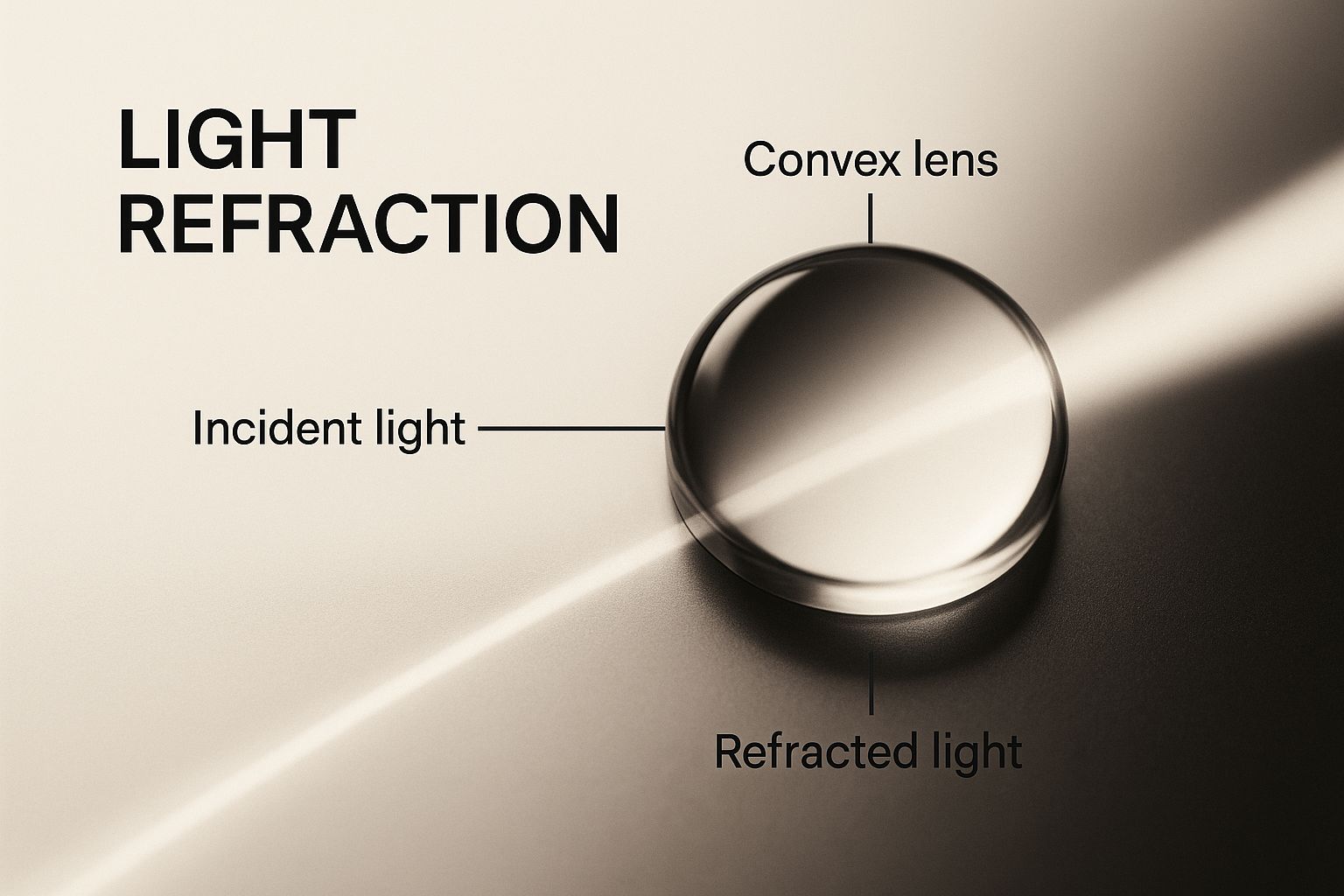
This image captures the fundamental principle behind every corrective lens: bending light just right so it lands perfectly on your retina. With how common vision issues are in the UK, it is a science many of us rely on. It is estimated that between 30% to 40% of UK adults need some kind of corrective eyewear, making these lenses a part of everyday life.
Upgrading Your Vision with Lens Coatings
Think of your basic lenses as the solid foundation of your glasses. The lens coatings are the high-tech upgrades that take them from simply functional to truly exceptional. They're not just fancy extras; they're incredibly thin, precisely engineered layers that solve everyday problems, protect your investment, and make wearing glasses a whole lot more comfortable.
Each coating is designed to tackle a specific challenge glasses-wearers know all too well. From cutting down on annoying glare to making your lenses tougher, these treatments are all about real-world benefits that you'll notice from the moment you put them on.
Anti-Reflective Coating for Clearer Vision
One of the most popular and game-changing options is an anti-reflective (AR) coating. Its job is simple but powerful: to stop light from bouncing off the front and back of your lenses.
The difference is night and day—literally. AR coating dramatically cuts down on distracting glare, which is a massive help when you're driving at night and faced with bright headlights. It also means people can see your eyes clearly in photos or during a video call, without a shiny reflection getting in the way.
Durability and Protection Coatings
Life happens. A scratch-resistant coating is your first line of defence against the inevitable bumps, drops, and cleanings that are part of daily wear. It is a tough, clear layer that makes the lens surface significantly more resilient. While nothing can make a lens completely scratch-proof, this treatment goes a long way in keeping your vision clear and extending the life of your glasses.
Just as important is a coating that offers UV protection. We're all taught to put sunscreen on our skin, but our eyes need that same protection from the sun's damaging ultraviolet rays. A UV-blocking treatment acts like a permanent shield for your eyes, filtering out harmful UVA and UVB radiation and helping to prevent serious, long-term eye health problems.
Coatings are functional layers that solve specific visual challenges. An anti-reflective treatment reduces glare, a scratch-resistant layer adds durability, and a UV filter protects your eye health.
When looking at premium coatings, it is interesting to see how they manage moisture and smudges. The science is similar to how experts view the differences between hydrophilic and hydrophobic glass, where some surfaces repel water and others attract it. Many advanced lens coatings use these principles to bead away water and resist oils, making them a breeze to keep clean.
Finally, we can't ignore our screens. With so much of our lives spent in front of computers and phones, blue light filtering coatings have become incredibly popular. These are designed to selectively filter out a portion of the high-energy blue light emitted from digital devices. Many people find this helps ease digital eye strain and makes those long hours in front of a screen feel much more comfortable.
Choosing Lenses That Fit Your Lifestyle
Choosing the right lenses is far less about technical specs and much more about your day-to-day life. The best pair of glasses will not just sharpen your vision; they will feel like they were made for how you live and work. Think of it like picking the right shoes for a specific activity—you wouldn't wear hiking boots to a dinner party.
Once you start thinking about your daily routine, your hobbies, and where you spend most of your time, the overwhelming number of lens options suddenly becomes much simpler. The process becomes a personal one, leading you straight to the perfect fit.
Lenses for the Desk Worker
If your day is spent in front of a computer, your eyes are working a marathon. Staring at screens for hours on end is a known cause of digital eye strain, leaving you with tired eyes, blurred vision, and even headaches.
For this kind of screen-heavy work, a combination of high-index lenses with a blue light filtering coating is a great solution. High-index plastic makes your lenses thinner and lighter for comfortable all-day wear, while the coating is designed to reduce your eyes’ exposure to the harsh light from digital devices. If you need multifocal correction, progressive lenses are ideal, giving you a smooth, line-free transition from your screen to paperwork on your desk and back up to see across the room.
Lenses for the Active Professional
For a builder, landscape gardener, or anyone working in a physically demanding job, eyewear needs to be about safety first. When you are on a busy site, durability is not just a bonus—it is a necessity.
Hands down, the best material for this job is polycarbonate. Its incredible impact resistance provides a shield against flying debris or accidental knocks. It is also a smart move to add a tough scratch-resistant coating to protect your investment from the daily grind. And for anyone working outside, UV protection is non-negotiable.
Your lifestyle is the blueprint for your perfect lenses. By identifying your main activities—whether that's hours at a screen, time spent outdoors, or a mix of both—you can build a lens combination that works for you.
Lenses for the Active Retiree
Retirement often means more time for everything you love, from hobbies and travel to simply enjoying the outdoors. This kind of varied, spontaneous lifestyle demands a pair of glasses that can keep up.
This is where lightweight progressive lenses truly shine, offering vision without lines whether you are reading a book, admiring the view, or watching a film. Adding a photochromic treatment is a brilliant upgrade, as the lenses automatically darken in the sun, turning into sunglasses the moment you step outside. Paired with a quality anti-reflective coating to cut down on annoying glare, you get crisp, comfortable vision in any light.
This all-in-one approach gives you a single pair of glasses that is ready for anything, whether you're a dedicated spectacles wearer or prefer an alternative from one of the many contact lens companies.
This global trend towards personalised vision is clear in the market itself. Projections show the optical products market is set to hit around $15.21 billion by 2025, pushed forward by new technology and people demanding lenses that truly fit their lives. You can find more data about the growing optical lens market.
Caring for Your Lenses for Lasting Clarity
You have invested in the perfect lenses, so it is worth taking a few simple steps to keep them in top condition. A little daily care goes a long way, helping your vision stay crisp and your glasses last for years.
The Right Way to Clean
Think of your lenses like a camera lens – they need gentle, specific care. The best approach is always a dedicated lens spray and a clean microfibre cloth.
It's tempting to just grab the corner of your t-shirt or a paper towel, but don't do it! These materials feel soft, but they often have rough fibres that can trap dust and grit, leading to tiny scratches. Over time, these micro-scratches build up and can create a permanent haze that affects your vision.
Smart Storage and What to Avoid
When you're not wearing your glasses, their home should be a sturdy, hard-shell case. Tossing them into a bag, a pocket, or onto a bedside table is a recipe for disaster, risking scratches, bending, or even crushing them.
A classic mistake we all make is putting our glasses lens-down on a surface. This is one of the fastest ways to scratch them. Get into the habit of always placing them with the temples open and the frame supporting them.
Always pick up your glasses by the frame, never by the lenses. This keeps fingerprints off and reduces stress on the delicate points where the lenses meet the frame, helping them stay perfectly aligned.
Be wary of extreme heat, too. Leaving your glasses on the dashboard of your car on a sunny day can warp the frame and damage the delicate coatings on your lenses. A few good habits can prevent a lot of unnecessary damage and help you see clearly for longer. It's also wise to recognise the impact of screen time on your eyes, a topic we cover in our guide to computer vision syndrome symptoms.
Your Optical Lens Questions, Answered
Even after getting to grips with materials, types, and coatings, a few specific questions tend to pop up when it comes time to choose and look after your glasses. Getting clear answers to these common queries is the final step to feeling totally confident in your new eyewear.
Think of this as a quick-fire round to tackle some of the most frequently asked questions, reinforcing the key ideas and giving you some practical advice.
How Often Should I Get My Eyes Checked for New Lenses?
As a general rule, it's a good idea to have a comprehensive eye examination every one to two years. Your prescription can change subtly without you even noticing, and regular check-ups help your lenses stay perfectly matched to your vision.
Sometimes you might need more frequent visits. You should book an earlier appointment if you:
- Are over the age of 60.
- Have a family history of eye conditions like glaucoma.
- Notice any sudden changes in your vision, like things getting blurrier or seeing new floaters.
- Have a health condition that can affect your eyes, such as diabetes.
What’s the Real Difference Between Polycarbonate and High-Index Lenses?
This is a classic point of confusion, and it is easy to see why. Both options are lighter and thinner than standard plastic lenses, but they excel in different areas and are designed for different people.
Polycarbonate is all about toughness. Its incredible impact resistance makes it the number one choice for children's glasses, sports eyewear, and safety frames—any situation where durability is paramount.
High-index plastics are focused on being as slim and lightweight as possible. Because they bend light more efficiently, we can use less material to correct stronger prescriptions. This makes them a great solution for anyone with a high prescription who dreads the idea of thick, heavy "coke bottle" lenses.
Here's a simple way to think about it: Polycarbonate is your lens bodyguard, built for toughness. High-index is the sleek specialist, engineered for high-powered prescriptions without the bulk.
Are Lens Coatings Really Worth the Extra Money?
Whether a lens coating is worth it comes down to your lifestyle. For most people, the practical, day-to-day benefits make them a fantastic investment in both comfort and the lifespan of your glasses.
For example, an anti-reflective coating is a must-have for anyone who drives at night or spends hours on video calls, as it cuts down on that annoying glare from headlights and screens. A scratch-resistant coating is almost always a smart move; it is a simple protective layer that helps your lenses stand up to everyday life. The right coatings can turn a standard pair of lenses into a truly customised tool for your vision.
For personalised advice on the best lenses and coatings for your needs, trust the experts at Northern Optical Company. We combine clinical excellence with friendly, honest support to help you see clearly and look your best. Visit us online to book your eye test today.