

Driving lenses are essential for enhancing vision while on the road. In the UK, over 70% of adults aged 40 to 60 drive daily, making clear vision a crucial component of road safety. Yet surprisingly, many drivers overlook the importance of specialized eyewear designed specifically for driving. Unlike regular glasses, these lenses tackle unique visual challenges drivers face, such as glare and varying light conditions, making every journey safer and more comfortable. Imagine being able to see potential hazards earlier and react more quickly – that’s the transformative power of driving lenses.
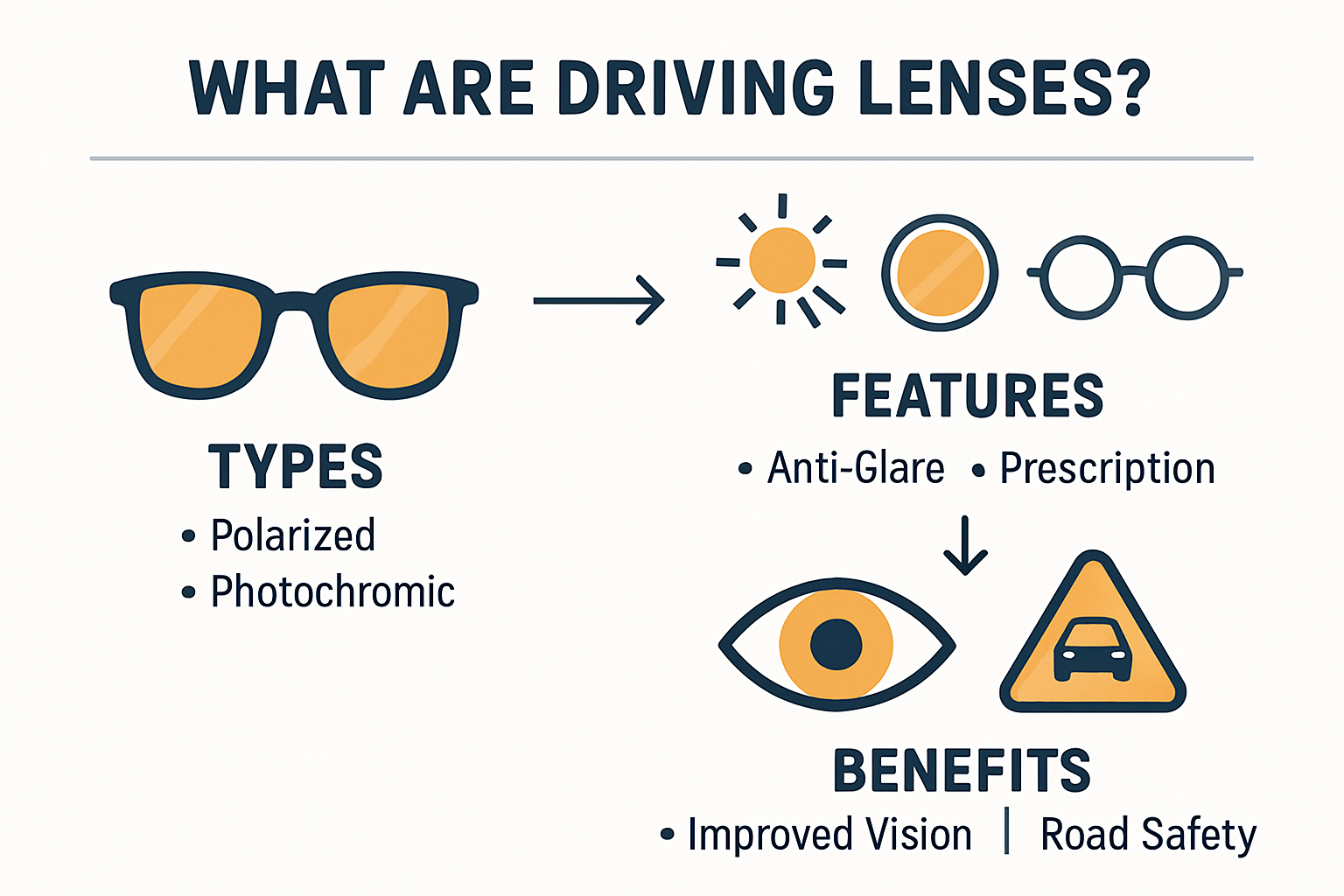
Table of Contents
- Driving Lenses Definition And Role
- How Driving Lenses Enhance Vision
- Benefits For Safe Road Driving
- Choosing And Caring For Lenses
Quick Summary
| Takeaway | Explanation |
|---|---|
| Driving lenses enhance vision safety | Designed specifically for driving, these lenses improve clarity, reduce glare, and provide better contrast, making it easier to detect hazards on the road. |
| Legal compliance is critical | Drivers in the UK must meet specific vision standards, ensuring they can read number plates from 20 metres. Specialized driving lenses can help achieve this requirement. |
| Regular maintenance is essential | Keeping driving lenses clean and free from scratches is crucial for optimal performance. Regular optometrist check-ups can ensure prescriptions remain current and effective. |
| Consider your driving habits when choosing lenses | Tailor your lens selection based on when and where you drive. For example, consider polarised lenses for daytime driving and anti-glare features for night driving. |
| Older drivers benefit significantly | As vision changes with age, older drivers can enhance their driving confidence and safety with specialized lenses designed to reduce glare and improve visibility. |
Driving Lenses: Definition & Role
Driving lenses are specialised optical solutions designed specifically to enhance visual clarity, comfort and safety while operating a vehicle. Unlike regular prescription glasses, driving lenses address the unique visual challenges that drivers face on the road. From managing changing light conditions to providing optimal field of vision, these specialised lenses play a crucial role in ensuring road safety.
What Are Driving Lenses?
Driving lenses are prescription or non-prescription eyewear that incorporate specific features to improve visual performance while driving. These lenses are engineered to address common visual challenges that drivers encounter, such as glare from oncoming headlights, changing light conditions, and the need for clear vision at various distances.
Unlike standard eyeglasses, driving lenses typically include special coatings and tints that help reduce glare and enhance contrast. They may also have progressive or bifocal designs that allow drivers to see clearly at different distances without having to move their heads significantly – a critical safety feature when you need to maintain focus on the road ahead while occasionally glancing at your dashboard instruments.
Many driving lenses incorporate anti-reflective coatings that minimise internal reflections within the lens itself, reducing visual distractions and improving clarity. Some advanced driving lenses also feature polarised technology to cut through glare from reflective surfaces like wet roads or the bonnets of other vehicles.
Benefits for Different Driving Conditions
Driving lenses provide specific advantages depending on when and where you drive:
-
Daytime driving: Lenses designed for daytime driving often include a slight tint that reduces brightness and enhances contrast, making it easier to distinguish objects on bright, sunny days.
-
Night-time driving: Special night driving lenses reduce the intensity of headlight glare from oncoming traffic while enhancing contrast in low-light conditions. This helps drivers see pedestrians, road signs, and potential hazards more clearly.
-
All-weather driving: Some driving lenses adapt to changing light conditions, darkening in bright sunlight and lightening in overcast or darker conditions, providing versatility for variable weather conditions.
For drivers who frequently transition between indoor and outdoor environments, photochromic driving lenses offer a convenient solution. These lenses automatically adjust their tint based on UV exposure, though it’s worth noting that standard photochromic lenses may not darken effectively inside vehicles since most car windscreens block UV rays that trigger the darkening process. Specialised driving photochromic lenses are designed to address this limitation.
Legal Requirements and Safety Considerations
In the UK, the Driver and Vehicle Licensing Agency (DVLA) maintains strict vision standards that all drivers must meet. Legally, drivers must be able to read a number plate from 20 metres away with glasses or contact lenses if needed. Additionally, the DVLA requires that drivers have an adequate field of vision and sufficient visual acuity.
Driving lenses can help ensure compliance with these requirements by providing optimal vision correction tailored to driving tasks. For those with specific visual challenges such as astigmatism or presbyopia, properly prescribed driving lenses can make the difference between safe, confident driving and potentially dangerous visual limitations.
Many eye care professionals recommend having a dedicated pair of glasses specifically optimised for driving, particularly for older adults or those with complex prescriptions. These specialised lenses account for the various distances a driver needs to focus on – from the road ahead to the dashboard and mirrors – while minimising the head movements required to access different parts of the prescription.
When considering driving lenses, consult with an experienced optometrist who can assess your specific visual needs for driving and recommend the most appropriate lens designs, coatings, and features to enhance your driving experience and ensure you meet all legal requirements for vision while behind the wheel.
How Driving Lenses Enhance Vision
Driving lenses employ several advanced technologies to significantly enhance visual performance behind the wheel. These specially designed lenses don’t just correct vision; they actively improve how we perceive our surroundings while driving, creating a safer and more comfortable experience on the road.
Combating Visual Challenges on the Road
When driving, our eyes face unique challenges that regular eyewear doesn’t adequately address. Driving lenses tackle these issues through specific design elements. The most immediate benefit comes from glare reduction technology. Headlights from oncoming vehicles, sunlight reflecting off wet roads, and harsh daylight can all create dangerous visual situations that driving lenses help mitigate.
Contrast enhancement is another crucial feature. Driving lenses improve our ability to distinguish between objects with similar colours or brightness levels. This makes it easier to spot potential hazards like pedestrians crossing the road at dusk or debris on the motorway. The improved contrast sensitivity allows drivers to react more quickly to changing road conditions.
Many driving lenses also incorporate edge-to-edge clarity. Unlike standard lenses which may have distortion at the periphery, quality driving lenses provide clear vision across the entire lens surface. This expanded field of clear vision is particularly valuable when checking mirrors or monitoring your surroundings at junctions.
According to research by HOYA, compared to regular lenses, driving-specific lenses can maintain and improve visual functions, significantly enhancing vision for motorists. This scientific validation confirms what many drivers report anecdotally – that specialised driving lenses make a noticeable difference in visual comfort and performance on the road HOYA Vision.
Advanced Technologies in Modern Driving Lenses
Modern driving lenses incorporate several sophisticated technologies that work together to enhance vision. Anti-reflective coatings eliminate internal reflections within the lens itself, reducing distractions and improving clarity. This is particularly beneficial for night driving when reflections from streetlights and headlights can create confusing visual noise.
Selective light filtering is another advanced feature. These lenses are designed to filter out specific wavelengths of light that contribute to glare while allowing beneficial light to pass through. This selective approach means that driving lenses don’t simply darken everything (like regular sunglasses might) but instead create a more balanced visual experience.
Polarisation technology in driving lenses works by blocking horizontal light waves – the ones that create glare when light bounces off flat surfaces like roads or car bonnets. By only allowing vertical light waves to reach your eyes, polarised driving lenses dramatically reduce glare while maintaining excellent visibility.
A 2024 study published in JMIR Formative Research examined associations between visual function and driving performance using high-fidelity driving simulators among drivers aged 60 and older. The research highlighted the importance of specialized vision correction for driving, particularly as we age and our visual needs become more complex JMIR Formative Research.
Real-World Benefits for Different Drivers
The advantages of driving lenses extend to various groups of road users. For daily commuters, driving lenses reduce eye fatigue and strain during long periods behind the wheel. The reduced glare and enhanced contrast mean eyes work less hard to interpret visual information, leading to less tiredness at the end of a journey.
Older drivers particularly benefit from driving lenses. As we age, our eyes become more sensitive to glare and take longer to recover from bright light exposure. Driving lenses help compensate for these age-related changes, extending driving confidence and independence for many older adults.
Professional drivers who spend many hours on the road find that specialised driving lenses provide significant comfort benefits. The reduction in eye strain can translate to less overall fatigue, making long-distance driving safer and more comfortable.
Research conducted across Germany, Spain, and the UK reveals that more than 70% of adults aged 40-60 drive daily. Interestingly, 55% of participants showed strong interest in specialized driving lenses after learning about their potential to relieve visual distress while driving HOYA Vision.
The science behind driving lenses continues to evolve, with manufacturers developing increasingly sophisticated solutions that address the specific visual challenges of driving. From adaptive tints that respond to changing light conditions to lenses designed specifically for the unique demands of night driving, the technology continues to advance, making driving not just safer but more comfortable for millions of road users.
Benefits for Safe Road Driving
The relationship between vision quality and driving safety is stronger than many realise. Driving lenses provide specific benefits that directly contribute to safer road experiences for all road users. Their importance extends beyond simple vision correction to actively improving how we interact with our driving environment.
Enhanced Hazard Detection and Response Time
One of the most significant safety benefits of driving lenses is improved hazard detection. When driving, the ability to quickly spot potential dangers can make the difference between a safe journey and an accident. Specialised driving lenses enhance contrast sensitivity, allowing drivers to better distinguish objects against their backgrounds.
This enhanced perception is particularly valuable in challenging visibility conditions. During twilight hours, when many accidents occur, the improved contrast helps drivers spot pedestrians, cyclists, and road obstacles more easily. Similarly, in foggy or rainy conditions, the right driving lenses can cut through visual noise to highlight potential hazards.
Research supports this safety benefit. A 2012 Australian study demonstrated that impaired vision significantly reduces drivers’ ability to detect pedestrians at night. The research showed that normal vision allowed detection at 3.6 times longer distances than blurred vision, highlighting the critical importance of proper vision correction for driving safety RoSPA.
Improved reaction time is another crucial benefit. By providing clearer vision with reduced glare and enhanced contrast, driving lenses allow drivers to process visual information more quickly. This can provide precious extra seconds to respond to sudden road events like a vehicle braking sharply or debris in the road.
Reduced Visual Fatigue and Stress
Long periods behind the wheel can lead to visual fatigue, which manifests as eye strain, difficulty focusing, and even temporary blurred vision. These symptoms not only create discomfort but can significantly impair driving performance and safety.
Driving lenses help reduce visual fatigue through several mechanisms. Their anti-reflective properties minimise distracting reflections that cause eyes to work harder. The selective filtering of harsh light reduces the strain caused by squinting against glare. For many drivers, this results in more comfortable driving experiences, particularly during lengthy journeys.
This reduction in visual stress has direct safety implications. Drivers experiencing less eye fatigue maintain better concentration and alertness. This is particularly important for professional drivers who spend many hours on the road, as well as for older drivers whose eyes may be more susceptible to fatigue.
Research by Hoya has shown that specialized driving lenses can maintain and improve key visual functions compared to regular lenses, particularly mesopic visual acuity, visual acuity under glare, and contrast sensitivity. These benefits are attributed to the reduction of intraocular light scattering, which explains why many drivers report feeling less fatigued after switching to specialized driving lenses Hoya Vision.
Accident Prevention Through Better Vision
The correlation between vision quality and accident rates is supported by robust research. A study of Spanish drivers found significant differences in accident risk based on visual acuity (p < 0.001). The researchers concluded that vision plays a key role in driving and recommended good visual assessment for early detection of problems that may affect road safety PMC.
Driving lenses address several specific visual challenges that contribute to accidents. Night driving, for example, presents particular difficulties due to the combination of low light and intense glare from oncoming headlights. Specialised night driving lenses reduce the intensity of headlight glare while simultaneously enhancing available light, creating safer visual conditions.
Drivers with specific vision conditions like astigmatism or presbyopia benefit particularly from driving lenses tailored to their needs. These conditions can cause visual distortions or limitations that standard eyewear might not fully address in the driving context. Custom driving lenses can compensate for these specific challenges, bringing these drivers’ visual performance closer to optimal levels.
Weather-related visual challenges also benefit from driving lens technology. Rain, fog, and snow create complex visual environments that can confuse the eye and brain. The right driving lenses cut through these conditions by enhancing contrast and reducing glare from wet surfaces, providing clearer perception of the road environment.
The cumulative effect of these benefits is significant accident prevention potential. While no eyewear can eliminate all visual challenges of driving, specialised driving lenses address many of the most common visual factors that contribute to accidents. For many drivers, they represent an important investment in personal and public road safety that goes beyond what standard prescription eyewear can provide.
Choosing and Caring for Lenses
Selecting the right driving lenses and maintaining them properly ensures you get the maximum benefit from your investment. Driving lenses are specialised optical tools that require thoughtful selection and regular care to perform optimally. Let’s explore how to choose the most suitable driving lenses for your needs and how to keep them in top condition.
Finding the Right Driving Lenses for Your Needs
The process of choosing driving lenses should start with a comprehensive eye examination. An optometrist can assess your visual needs specifically for driving scenarios, taking into account any existing conditions like astigmatism or presbyopia that might affect your vision behind the wheel.
When discussing options with your eye care professional, consider your typical driving habits. Do you primarily drive during daylight hours, or do you frequently drive at night? Do you drive mainly in urban environments with lots of artificial lighting, or on country roads where lighting conditions vary more dramatically? The answers to these questions will help determine which lens features will benefit you most.
For those who drive primarily during the day, lenses with a mild tint and good polarisation properties might be ideal. If you do significant night driving, look for lenses that specifically address low-light conditions and headlight glare without darkening your overall vision.
Consider your age as well. As we get older, our eyes become more sensitive to glare and take longer to adapt to changing light conditions. If you’re over 40, you might benefit from progressive lenses designed specifically for driving, which provide clear vision at the various distances needed while driving without requiring significant head movements.
It’s worth noting that to meet UK legal standards, drivers must wear their glasses or contact lenses every time they drive if needed to achieve the minimum eyesight requirements. These include being able to read a number plate at 20 metres and maintaining a visual acuity of at least 0.5 (6/12) on the Snellen scale Arthur Hayes. Ensuring your driving lenses meet these requirements is not just a matter of comfort, but of legal compliance and safety.
Lens Features Worth Considering
When selecting driving lenses, several specific features merit consideration:
-
Anti-reflective coatings: These reduce internal reflections within the lens itself, minimising distractions and improving clarity, especially at night when reflections from streetlights and headlights can be particularly problematic.
-
Polarisation: Polarised lenses significantly reduce glare from reflective surfaces like wet roads. However, be aware that some polarised lenses may make it slightly harder to read certain LCD displays on dashboards, so discuss this potential trade-off with your optometrist.
-
Photochromic properties: Some driving lenses can adapt to changing light conditions, darkening in bright light and lightening in dim conditions. Standard photochromic lenses typically don’t darken well inside vehicles because car windscreens block the UV light that triggers the darkening process, but some newer technologies are designed to overcome this limitation.
-
Lens material: Consider the durability and weight of different lens materials. Polycarbonate and Trivex lenses offer excellent impact resistance, which provides an added safety benefit, while high-index materials can provide thinner, lighter lenses for stronger prescriptions.
The frame choice also matters significantly for driving glasses. Look for frames that don’t obstruct your peripheral vision, sit comfortably for long periods, and hold the lenses in the optimal position for your visual needs while driving.
Proper Care and Maintenance
Maintaining your driving lenses in optimal condition is essential for safe driving. Proper care for driving lenses is crucial: lenses should be kept clean and free of scratches, as clarity and sufficient light transmission are essential for safe driving. Dirty or abraded lenses can impair both comfort and visual performance behind the wheel Which?.
Clean your lenses daily using appropriate cleaning solutions and microfibre cloths designed specifically for eyewear. Avoid using tissues, paper towels, or your shirt, as these can scratch the lens surface or leave lint behind. When not wearing your driving glasses, store them in a protective case to prevent damage.
Be particularly vigilant about keeping your lenses free from smudges, fingerprints, and dust, as these can cause distracting reflections or reduce clarity, especially in challenging light conditions like night driving or bright sunlight.
Even with excellent care, driving lenses will eventually need replacement. Scratches that affect your vision, damaged coatings, or outdated prescriptions all signal it’s time for new lenses. The Association of Optometrists recommends regular, comprehensive sight tests for all drivers and emphasizes that even minor vision changes should prompt a review of eyewear to ensure continued compliance and safety, especially as age-related visual changes can affect driving ability over time Association of Optometrists.
Regular check-ups with your optometrist—typically every one to two years—ensure your prescription remains current and your driving lenses continue to meet your needs. These appointments also provide an opportunity to discuss any changes in your driving habits or visual comfort that might warrant adjustments to your eyewear.
Frequently Asked Questions
What are driving lenses?
Driving lenses are specialised eyewear designed to enhance visual clarity, comfort, and safety when operating a vehicle. They address common challenges faced by drivers, such as glare and the need for clear vision across different distances.
How do driving lenses improve road safety?
Driving lenses improve road safety by enhancing hazard detection capabilities, reducing visual fatigue, and minimising glare from headlights and reflective surfaces, allowing drivers to respond more quickly and accurately to potential dangers.
Are driving lenses required by law in the UK?
Yes, in the UK, drivers must meet specific vision standards, including being able to read a number plate from 20 metres away. Driving lenses can help ensure compliance with these legal requirements for optimal vision while driving.
How should I care for my driving lenses?
To maintain your driving lenses, clean them daily with appropriate cleaning solutions and a microfibre cloth. Store them in a protective case when not in use and have them checked regularly by an optometrist to ensure they remain effective.
See the Road Clearly with Driving Lenses from Northern Optical Company
Are you tired of straining your eyes while driving? Experience the confidence of clear, comfortable vision on every journey. As highlighted in our comprehensive guide on driving lenses, specialised eyewear can dramatically reduce glare, combat visual fatigue, and enhance contrast—making driving a safer, more enjoyable experience for everyone.

At Northern Optical Company, we’re committed to helping you meet DVLA vision standards. Our range of driving lenses is expertly crafted to address specific driving challenges, ensuring unrivalled clarity and safety in all driving conditions. Whether you’re a daily commuter, an older driver seeking more comfort, or someone who frequently drives at night, we provide tailored solutions that fit your individual needs.
Don’t compromise your vision— Book your appointment today at Northern Optical Company and let our experienced team guide you toward the perfect driving lenses for your lifestyle! Ensure that clear vision is always on your side with every twist and turn of the road!