


Reading your contact lens prescription is more than just decoding numbers; it is essential for preserving your vision and eye health. Over half of contact lens wearers report not understanding their prescriptions, which can lead to serious complications. But here’s the kicker – the numbers on your prescription contain vital details that could transform your eye care experience. Knowing how to interpret this information helps you ensure comfort and clarity in your lens choice, setting you up for success in vision management.
Table of Contents
- Why Reading Your Prescription Matters
- Decoding Your Contact Lens Prescription
- Understanding Different Prescription Terms
- Where To Get Contact Lenses
Quick Summary
| Takeaway | Explanation |
|---|---|
| Understanding Your Prescription Is Crucial | Accurately reading your contact lens prescription is essential for maintaining eye health and avoiding complications due to incorrect lens usage. |
| Know Your Prescription Components | Each aspect of your prescription, including power, base curve, and diameter, is tailored to your unique vision needs, impacting comfort and clarity. |
| Your Legal Rights | You are entitled to receive a copy of your prescription after a fitting, allowing you to purchase lenses from any supplier, which promotes transparency and choice. |
| Consider Professional Consultation | Purchasing from a qualified optician ensures personalised advice and immediate assessments, which is vital for optimal lens fitting and eye health. |
| Beware of Online Purchases | While convenient, ensure your prescription is current and thoroughly verify lens details with the supplier to safeguard your eye health. |
Why Reading Your Prescription Matters
Understanding your contact lens prescription isn’t just about reading numbers – it’s a critical aspect of maintaining your eye health and ensuring optimal vision correction. Many people overlook the importance of carefully reviewing their prescription, which can lead to potentially serious consequences for their eye care.
The Hidden Risks of Prescription Misunderstandings
Failure to accurately interpret your contact lens prescription can result in significant health risks. Research published in the National Center for Biotechnology Information reveals that prescription noncompliance is a major concern, particularly with lens replacement schedules. Patients who do not fully understand their prescription details are more likely to:
- Wear lenses beyond their recommended usage period
- Use incorrectly sized or powered lenses
- Misinterpret critical measurement parameters
These mistakes can lead to serious eye health complications, including corneal damage, infections, and reduced vision quality. Your prescription contains more than just a simple strength measurement – it’s a comprehensive guide to safe and effective vision correction.
Decoding the Critical Details
Each element of your contact lens prescription carries significant meaning. Base curve, diameter, and power are not just random numbers, but precise measurements that ensure your lenses fit comfortably and correct your vision accurately. NHS guidelines emphasize the critical nature of prescription accuracy, highlighting that even minor errors can compromise eye health.
For instance, the diameter (DIA) measurement determines how the lens sits on your eye, while the base curve ensures proper fit and comfort. Wearing lenses with incorrect measurements can cause discomfort, potential corneal abrasions, and reduced visual clarity. Professional optometrists spend considerable time calculating these precise measurements to match your unique eye characteristics.
Empowering Yourself Through Understanding
Reading and understanding your prescription is an act of personal healthcare responsibility. Acuvue recommends carefully verifying prescription details to ensure you receive the correct lenses. This means checking not just the power, but every single specification – from lens type to replacement schedule.
Take time to discuss your prescription with your eye care professional. Ask questions about what each number means, how to properly care for your lenses, and understand the specific recommendations for your unique vision needs. Remember, your prescription is a personalised document designed specifically for your eyes – treat it with the importance it deserves.
By investing a few moments to thoroughly understand your contact lens prescription, you’re taking a proactive step in protecting your eye health and ensuring optimal vision correction. Knowledge truly is the best form of eye care protection.
Decoding Your Contact Lens Prescription
Navigating the complex world of contact lens prescriptions can feel like deciphering a mysterious code. Each seemingly cryptic number and abbreviation represents crucial information about your unique vision correction needs. Understanding these details empowers you to make informed decisions about your eye health and lens selection.
The Essential Prescription Components
Your contact lens prescription is a precise document containing multiple critical measurements. The General Optical Council (GOC) recommends professionals meticulously verify each specification to ensure patient safety. The key components typically include:
- Power (Sphere): Indicates the lens strength needed to correct vision, measured in diopters
- Base Curve: Determines how the lens fits the curvature of your eye
- Diameter: Specifies the width of the contact lens
- Cylinder and Axis: Additional measurements for individuals with astigmatism
Each of these measurements is tailored specifically to your eye’s unique characteristics, making your prescription a personalised vision correction blueprint.
Understanding Prescription Measurements

The power measurement, often abbreviated as SPH (sphere), tells you the lens strength required to correct your vision. Negative numbers indicate myopia (short-sightedness), while positive numbers represent hyperopia (long-sightedness). For instance, -2.50 means you need a lens that helps you see distant objects more clearly.
The base curve (BC) is equally important. According to UK eye care guidelines, this measurement ensures the lens sits comfortably on your eye’s surface. A poorly fitted lens can cause discomfort, potential corneal abrasions, and reduced visual clarity.
Legal Rights and Prescription Management
In the United Kingdom, you have specific legal entitlements regarding your contact lens prescription. You are legally entitled to receive a copy of your prescription after a lens fitting appointment, which allows you to purchase lenses from any provider you choose.
The NHS recommends having an eye exam at least once every two years, or more frequently if advised by your optician. This ensures your prescription remains current and accurately reflects your vision needs. Regular check-ups allow eye care professionals to monitor changes in your vision and adjust your prescription accordingly.
Remember, your contact lens prescription is more than just a piece of paper – it’s a vital document that represents your eye health and vision correction strategy. Take time to understand its details, ask questions, and work closely with your eye care professional to maintain optimal vision and eye comfort.
Understanding Different Prescription Terms
Contact lens prescriptions are filled with specialised terminology that can seem bewildering to the uninitiated. Learning to navigate these terms is crucial for understanding your personal vision correction needs and ensuring you select the most appropriate lenses.
Deciphering Eye-Specific Abbreviations
Optical experts use specific Latin-based abbreviations to denote different aspects of your eye health and vision correction. The most common abbreviations include:
- OD (Oculus Dexter): Refers to your right eye
- OS (Oculus Sinister): Represents your left eye
- OU (Oculus Uterque): Indicates both eyes
These traditional Latin terms help eye care professionals communicate precisely about each eye’s specific characteristics. Understanding these abbreviations can help you better comprehend your prescription and discuss your vision needs more effectively.
Critical Prescription Measurements
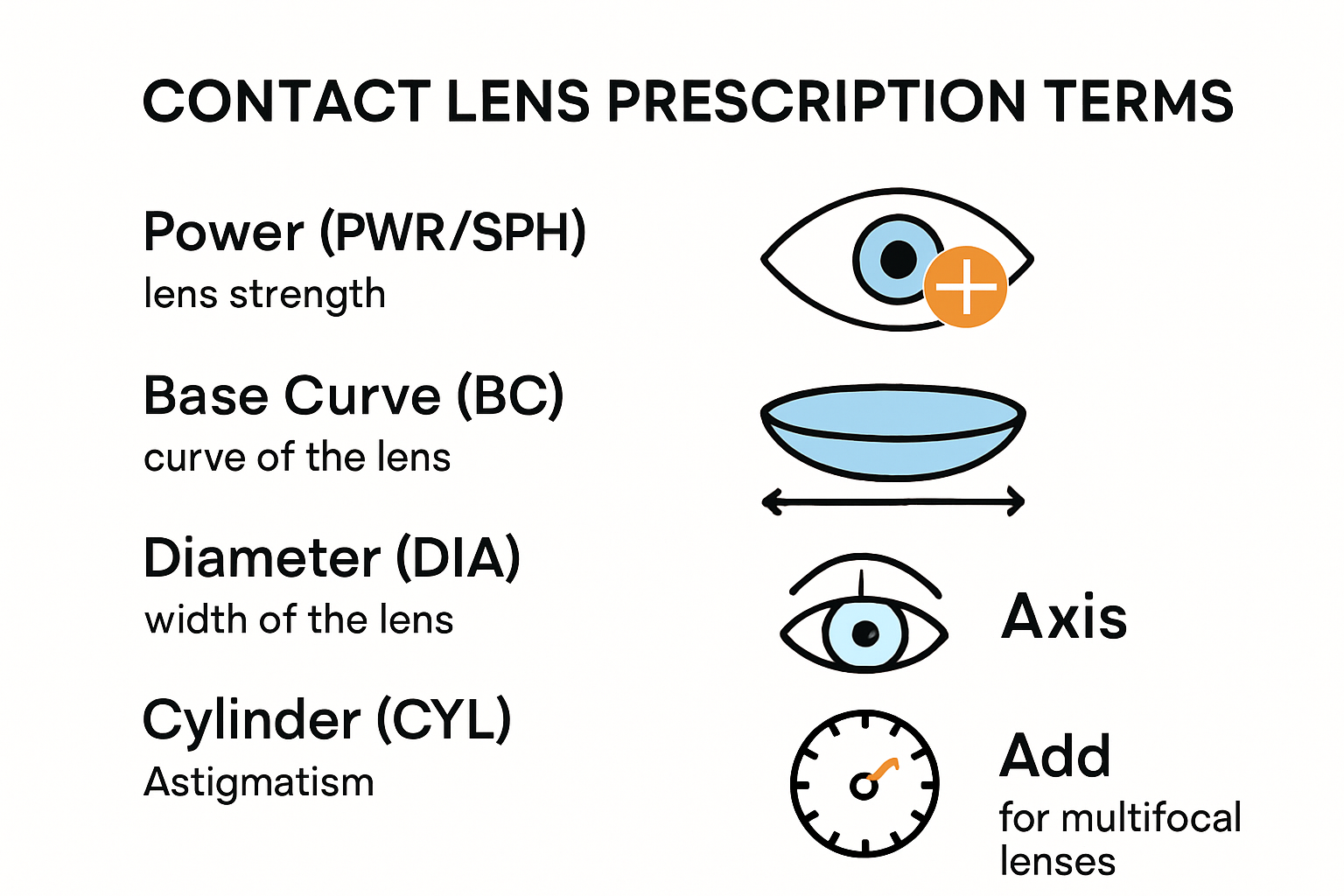
According to Specsavers’ eye care guidelines, contact lens prescriptions include several critical measurements beyond simple vision correction:
- Power (PWR/SPH): Measures lens strength in diopters
- Base Curve (BC): Indicates the curvature of your cornea
- Diameter (DIA): Specifies the lens width
- Cylinder (CYL): Measures astigmatism correction
- Axis: Provides additional astigmatism details
Each measurement plays a unique role in ensuring your contact lenses provide optimal comfort and vision correction. The base curve, for instance, is particularly crucial as it determines how perfectly the lens fits your eye’s unique shape.
Advanced Prescription Considerations
Comprehensive eye care professionals from Feel Good Contacts emphasise that some prescriptions include additional complex measurements. Multifocal or bifocal lens prescriptions might include an Add power, which represents the additional magnification needed for close-up vision.
For individuals with astigmatism, the prescription becomes more intricate. The cylinder value indicates the degree of astigmatism, while the axis specifies the orientation of the astigmatism correction. These nuanced measurements ensure that people with irregular corneal shapes receive precisely tailored vision correction.
Remember, your contact lens prescription is a personalised document. Each number and abbreviation represents a carefully calculated specification designed to provide you with the clearest, most comfortable vision possible. When in doubt, always consult your eye care professional to fully understand your unique prescription details.
Where to Get Contact Lenses
Obtaining contact lenses involves multiple purchasing channels, each with unique advantages and considerations. Understanding your options can help you make informed decisions about where and how to acquire your vision correction solution.
Traditional Optician Purchases
According to UK optical regulations, opticians remain the primary and most reliable source for contact lens procurement. Purchasing directly from an optician offers several critical benefits:
- Direct professional consultation and fitting
- Immediate assessment of lens suitability
- Personalised advice on lens care and maintenance
- Ability to address any immediate vision or comfort concerns
Professional opticians provide comprehensive eye examinations and can recommend the most appropriate lenses based on your specific vision requirements. Their expertise ensures you receive lenses that match your precise prescription and eye health needs.
Online Purchasing Options
The Opticians Act 1989 legally permits patients to purchase contact lenses from multiple suppliers once they have a valid prescription. Online purchasing has become increasingly popular due to several advantages:
- Competitive pricing
- Convenient home delivery
- Wider product range
- 24/7 accessibility
- Potential bulk purchase discounts
However, online purchases require a current, valid prescription. UK regulations stipulate that contact lens prescriptions are typically valid for up to two years, unless your optician specifies an earlier expiry date for clinical reasons.
Prescription Verification and Safety Considerations
Regardless of your purchasing method, certain critical steps ensure safe contact lens acquisition. The Association of British Dispensing Opticians recommends the following guidelines:
- Always obtain a signed, written prescription from a qualified professional
- Verify the prescription contains all necessary specifications
- Ensure the prescription is current and not expired
- Cross-check prescription details with your chosen supplier
- Maintain regular eye health check-ups
While online and high street purchases offer convenience, your eye health remains paramount. Professional guidance, regular check-ups, and adherence to prescription details are crucial in maintaining optimal vision and eye health.
Remember, contact lenses are medical devices, not mere fashion accessories. Prioritise professional advice, safety, and proper fitting over convenience or cost savings. Your vision is a precious asset that deserves careful, informed management.
Frequently Asked Questions
What does my contact lens prescription mean?
Your contact lens prescription outlines the specific measurements and specifications needed for your lenses, including power (sphere), base curve, and diameter. Each of these components is tailored to your unique vision requirements, ensuring optimal comfort and clarity.
How can I interpret the numbers on my contact lens prescription?
The numbers on your prescription include values like power (SPH), base curve (BC), and diameter (DIA), which indicate the strength, fit, and size of the lens, respectively. Understanding these components is essential for selecting the right lenses.
Am I legally entitled to a copy of my contact lens prescription?
Yes, in the UK, you are legally entitled to receive a copy of your contact lens prescription after a fitting. This allows you to purchase lenses from any supplier, promoting greater choice and transparency.
What should I do if I don’t understand my contact lens prescription?
If you don’t understand your prescription, consult with your eye care professional. They can explain each component, ensure your understanding, and answer any questions regarding your vision needs or lens care.
Unlocking Your Vision with Northern Optical Company
Navigating the complexity of your contact lens prescription can be daunting, especially when over half of lens wearers struggle to understand their prescribed measurements. At Northern Optical Company, we recognise that your eye health is not just about vision correction; it’s about comfort and lifestyle too. Knowing how to read your prescription is crucial for avoiding complications—and we’re here to help you every step of the way.
Our dedicated team in the heart of Newcastle is ready to offer personalised consultations and in-depth explanations of your prescription details. From standard NHS tests to enhanced examinations and home visits, our expansive range of services ensures that eye care is accessible and tailored to your unique needs. Don’t wait for discomfort or confusion to creep in—take charge of your eyesight today! Book an appointment on our website at northernopticalcompany.com to gain clarity on your prescription and discover eyewear that harmonises style with functionality.