
Imagine driving, but you can only see the road directly ahead. You have no idea what is happening in your side mirrors or at the edges of your windscreen. This is what life would be like without your peripheral vision, and a visual field test is the key to protecting it.
This test is not about reading letters on a chart to see how sharp your focus is. It is a clever way to map out your entire field of vision, including the side vision that gives you the full picture.
What a Visual Field Test Shows Doctors
For an ophthalmologist or optometrist, a visual field test is a fundamental part of their toolkit. Its primary job is to find any blind spots, which we call scotomas, in your vision. These can be sneaky, often developing without you realising because your brain is brilliant at filling in the gaps.
Think of your vision as a big, detailed painting. The main subject in the centre is your central vision—what you use to read this text or recognise a friend's face. Everything else, the background and all the details at the edges, is your peripheral vision. A visual field test meticulously checks the entire canvas for any missing or faded patches.
Detecting and Monitoring Eye Conditions
This examination is critical for spotting and managing eye diseases that creep in from the sides first. The classic example is glaucoma, a condition notorious for causing gradual sight loss that starts in the periphery.
The image below shows a typical printout from a visual field test, sometimes called a 'grey-scale map'.
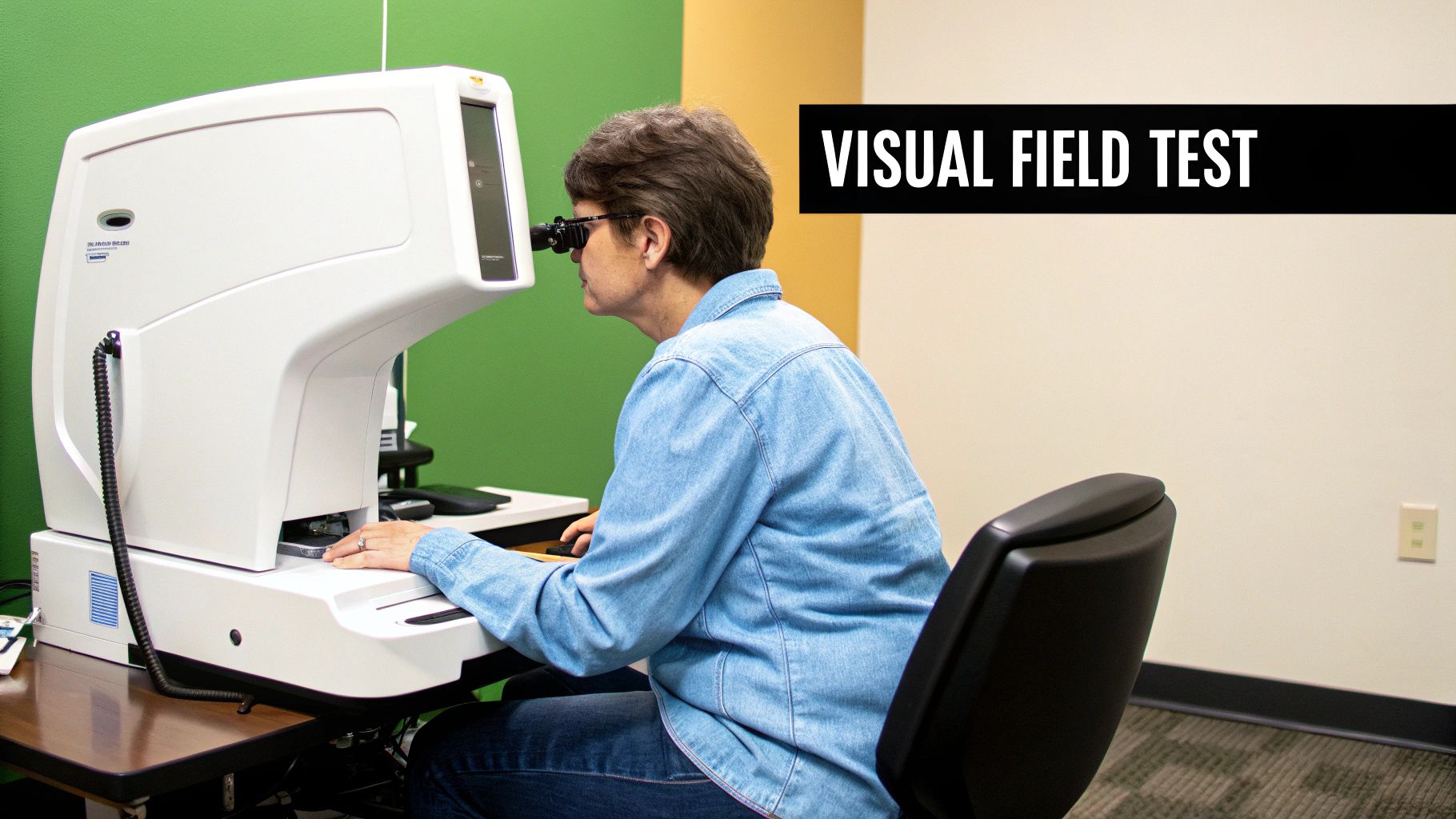
On this map, the darker patches highlight areas where the patient's vision is less sensitive, flagging potential blind spots. By performing these tests regularly, your eye specialist can track how your vision is changing over time and adjust your treatment accordingly.
The Importance of Regular Monitoring
Regular monitoring is the cornerstone of good eye health management, especially if you are in a high-risk group. In the UK, glaucoma affects around 2% of people over 40, making regular visual field screening important for catching it early.
Most of these tests are funded by the NHS and carried out at local opticians, though home visits are available for those unable to travel. If you are interested in the data, you can explore the NHS ophthalmic activity statistics to see how these services are tracked and delivered.
A visual field test creates a precise map of your sight. It allows your doctor to find problems long before you would notice them yourself, opening the door to early treatment and safeguarding your long-term eye health.
Common Types of Visual Field Tests
Not all visual field tests are created equal. Your eye specialist will pick the method that makes the most sense for what they need to investigate, ranging from a quick in-room screening to a very detailed, computerised analysis. Knowing the main types can take the mystery out of the process and make it clear why one test might be chosen over another.
The simplest one you might encounter is the confrontation visual field test. This is a quick, manual check that often happens during a routine eye exam. You will cover one eye and focus straight ahead while the optometrist brings their hand into your side vision from different directions. Your job is just to say “now” the moment you spot it. Think of it as a first-pass screening to catch any large or glaring blind spots.
Automated Perimetry: The Gold Standard
For a much more precise and repeatable measurement, clinics rely on automated perimetry. This is the computerised test that gives us a detailed map of your vision.
The most common machine you will see is the Humphrey Visual Field Analyser. For this test, you will sit comfortably and look into a large, white, bowl-shaped instrument. While you focus on a light in the very centre, tiny flashes of light will pop up in different spots. All you have to do is press a button every time you see one.
What makes this test so powerful is its intelligence. The machine varies the brightness of the lights, trying to find the absolute dimmest flash you can perceive in each location. This builds an incredibly detailed, quantitative map of your visual sensitivity across your entire field of view.
An automated perimetry test is a bit like a hearing test, but for your eyesight. It does not just ask if you can see something, but how well you see it in dozens of different spots. This allows us to find subtle changes long before you would ever notice them in your day-to-day life.
Specialised Visual Field Testing
While automated perimetry is the go-to for most situations, other methods have their place. A great example is Goldmann kinetic perimetry.
Unlike the static flashes of a Humphrey test, the Goldmann test uses a moving target. A trained technician will move a small light from the edge of your peripheral vision in towards the centre. You simply signal the exact moment it comes into view. This is then repeated from all sorts of different angles.
This approach is particularly useful when we are:
- Assessing very poor vision, where someone might not be able to see the faint, static lights.
- Looking into specific neurological conditions.
- Testing people who find it difficult to use automated machines, like young children or patients with certain physical limitations.
The choice of test comes down to the clinical question your doctor needs to answer. Whether it is a quick confrontation check or a detailed Goldmann map, they all share the same fundamental goal: to get a complete picture of your vision so we can protect it.
How to Prepare for Your Eye Exam

Heading into a visual field test can feel a little daunting, especially if it is your first time. Do not worry – a bit of simple preparation can make the whole process smoother and help the results we get be as reliable as possible. Knowing what to expect is half the battle.
The steps are common sense, designed to help you feel comfortable and focused. Your physical and mental state can genuinely influence the quality of the data, so it is worth taking a few minutes to get ready.
Before Your Appointment
A few simple things you can do before leaving home will set you up for a successful test. The main goal is to arrive feeling calm, well-rested, and ready to concentrate for a short period.
First off, try to get a good night's sleep. The test demands your full attention, and being tired can make it tricky to keep your eyes fixed on the central target, which is the most important part of the task.
Here are a couple of key things to bring along:
- Your current eyeglasses or contact lenses: For the results to be accurate, we need to test your vision as you see day-to-day. Popping in your usual contacts or bringing your specs is a must.
- A list of your medications: It is always helpful for your eye specialist to know what medications you are taking, as some can have surprising effects on your vision.
For more general tips that apply to any visit, check out our guide on how to prepare for an eye test.
During the Test Itself
It is completely normal to feel a bit of anxiety before any new medical test. The first thing most people want to know is: does it hurt? The answer is a firm no. A visual field test is entirely painless – no sudden puffs of air, no uncomfortable sensations, and no blinding lights.
Remember, you are not expected to see every single flash of light. The machine is designed to find the very edge of your perception, so it is normal to miss some of the fainter lights. This is not a test you can "fail".
Your only job is to relax, keep your gaze steady on the central light, and click the button whenever you notice a flash in your peripheral vision. There is no need to actively search for the lights; just let them come to you and respond naturally. This simple focus is what allows us to build an accurate map of your sight.
What to Expect During Your Visual Field Test
https://www.youtube.com/embed/g11hC2HuApg
Knowing what is coming can make any medical test feel less intimidating, and a visual field test is no different. The good news is that it is a completely painless and straightforward process. Think of it as mapping out your vision. Let's walk through what you can expect on the day, from the moment you sit down to the final click of the button.
First, you will be led to the testing room and introduced to a large, bowl-shaped instrument called a perimeter. A friendly technician will get you settled in comfortably, explaining everything as they go. They will have you place your chin in a chin rest and your forehead against a bar. This sounds a bit odd, but it is simply to keep your head perfectly still, which is needed for getting accurate results.
The Test, Step by Step
To start, one of your eyes will be covered with a patch. We test one eye at a time to get a clear picture for each. You will be handed a small button to hold.
Your main job is simple, but it does require focus. You need to stare at a fixed light in the centre of the bowl and keep looking at it for the whole test. Do not let your eyes wander!
As you focus on that central target, tiny lights will start to flash at random spots inside the bowl. Your task is to press the button every single time you see a flash appear in your peripheral (side) vision. It is perfectly normal not to see all of them; the machine is designed to test the very limits of your perception, including lights that are incredibly dim.
This image neatly lays out the flow of the test, showing how your responses create a map of your vision.
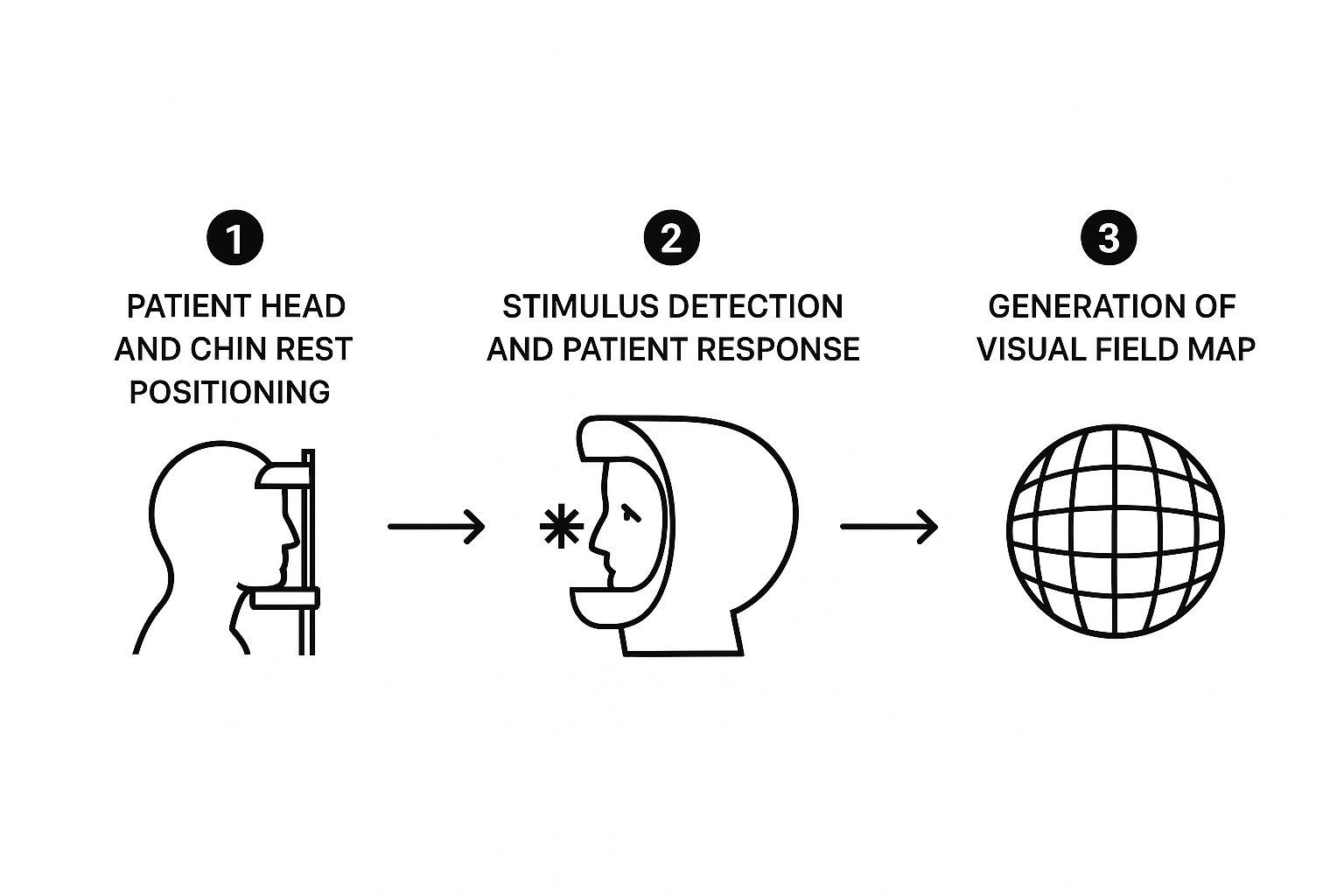
As you can see, each click you make helps to build a detailed picture of your visual field, highlighting its every strength and weakness.
The lights will vary in brightness and location. Some will be bright and obvious, while others will be so faint you might question if you saw them at all. This is all part of how the machine carefully charts the sensitivity of your retina.
Remember, this is not a reaction speed test. The most important thing is to keep your gaze locked on the central light and only press the button when you are genuinely sure you saw a flash.
How Long Does It Take?
Each eye usually takes about five to ten minutes to test. The technician will be there the whole time and can pause the test if you feel you need a quick break.
Once the first eye is done, you will simply switch the patch to the other eye and run through the same process again. The whole appointment is usually over and done with quite quickly.
This test is a key part of many comprehensive eye exams, offering valuable insight into your eye health without any discomfort. After both eyes are tested, the procedure is finished, and your results are ready for the ophthalmologist to analyse.
How to Read Your Visual Field Test Results
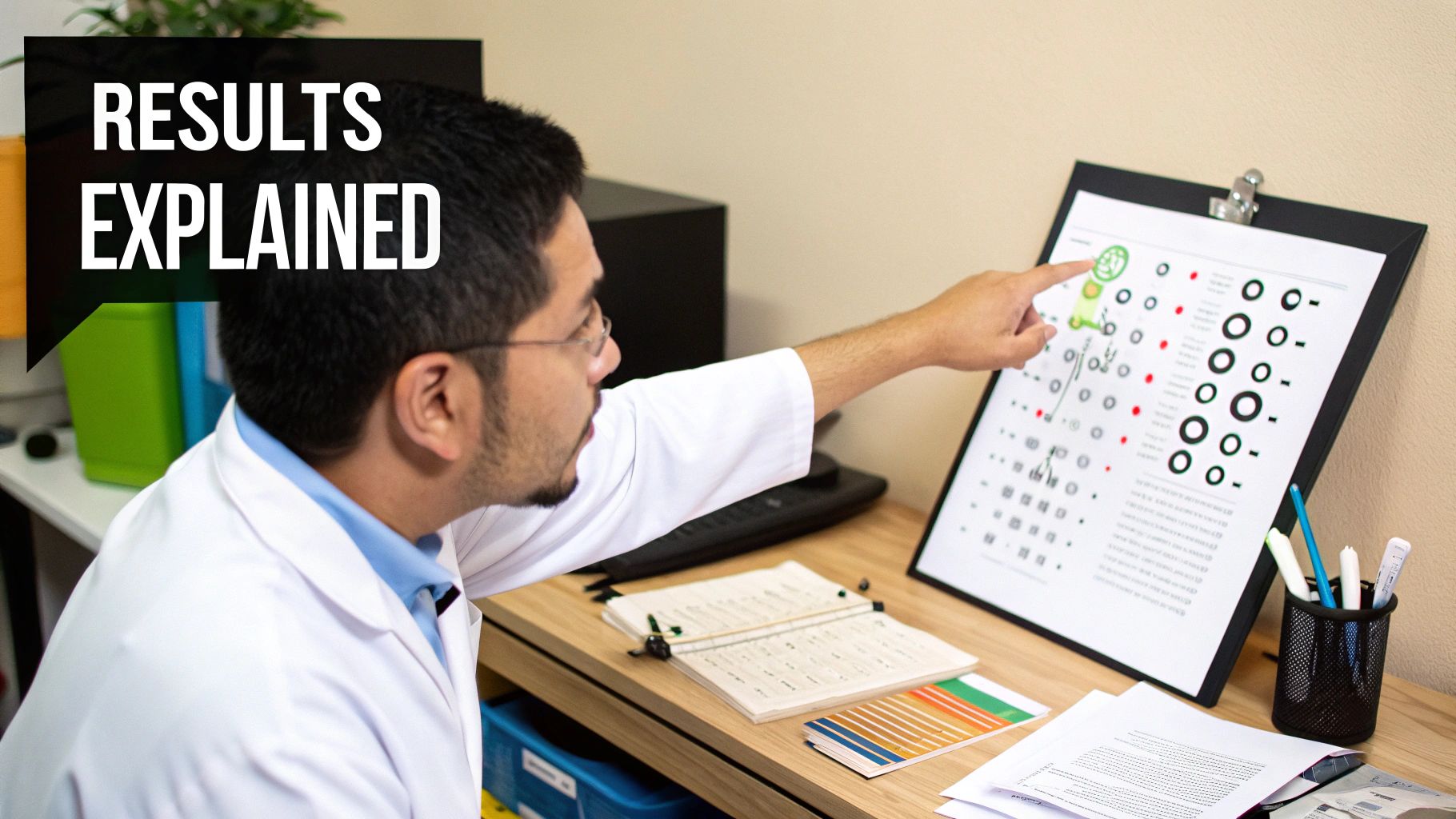
After your visual field test, you will be handed a printout that can look a bit like a complex weather map. At first glance, the jumble of numbers, symbols, and shaded boxes can seem intimidating, but learning the basics can empower you to have a much more productive chat with your ophthalmologist.
The first thing most people notice is the grey-scale map. The easiest way to think of this is as a contour map of your "island of vision." Lighter areas are like the high ground, representing spots where your vision is sharp and sensitive. The darker patches, clinically known as scotomas, are the valleys or dips where your sensitivity to light is reduced. A completely black area signals a blind spot where you could not see the light stimulus at all.
Understanding the Key Numbers
Beyond the visual map, your report contains several crucial numbers that provide a statistical snapshot of your results. These figures give your eye specialist a quick, objective way to assess your vision and, most importantly, track how it changes over time.
You will almost always see two main metrics:
- Mean Deviation (MD): This is an overall score comparing your vision to what is expected for a healthy eye of your age. A value close to zero is considered normal. A negative number, such as -5.00 dB, indicates a generalised loss of sensitivity across your entire field of vision.
- Pattern Standard Deviation (PSD): This metric looks for localised blind spots. A high PSD value suggests that while some parts of your vision might be perfectly fine, other distinct areas have significant defects. This is a classic pattern seen in conditions like early glaucoma.
Once the test is done, doctors often use specialised medical imaging software to dig into the finer details of the results. This technology helps them interpret the complex data and accurately compare it to previous tests, which is key for monitoring any progression of your condition.
You cannot diagnose a condition from these results on your own. Only a qualified ophthalmologist can interpret the printout correctly, taking into account your overall eye health, medical history, and other diagnostic tests.
The Importance of Regular and Accurate Testing
Getting a grip on your results also makes it clear why consistent, high-quality testing is so important for managing eye health. How you feel and perform during the test has a huge impact on how reliable the results are.
A UK audit revealed a concerning gap: while newly diagnosed glaucoma patients are recommended to have three tests per year for the first two years, the real-world average is closer to just one. The study found that patients' dislike for the test, combined with worries about the testing environment and instructions, created significant hurdles.
This highlights that feeling comfortable and well-prepared for your visual field test is not just about easing your own anxiety. It directly contributes to the quality of the information your doctor gets, which is required for protecting your sight for years to come.
The Role of Visual Field Testing in UK Healthcare
In the United Kingdom, a visual field test is not just another part of an eye exam. It is a cornerstone of our national eye health strategy, deeply integrated into the NHS to manage serious conditions and protect sight on a massive scale. Its most critical role is in the fight against glaucoma, one of the leading causes of irreversible blindness in the country.
This test is a key part of the General Ophthalmic Services (GOS) contract. This is the system that allows your local high-street optician to provide NHS-funded eye care, putting diagnostics like visual field testing right at the heart of our communities. It is this decentralised approach that makes early detection possible for millions of people.
The Scale of NHS Eye Care
To grasp the importance of this test, you have to consider the sheer scale of NHS eye care. In the 2019/20 period alone, an incredible 13.4 million NHS sight tests were carried out in England. This figure, from the NHS Business Services Authority's analysis of ophthalmic services, gives you an idea of the vast infrastructure in place for routine eye health.
The NHS Business Services Authority (NHSBSA) keeps a close watch on all this activity, making sure services are delivered correctly and standards are met everywhere. Thanks to this system, a visual field test, when medically needed, becomes a part of the comprehensive eye tests available in the UK.
Glaucoma Management: Guidelines vs. Reality
For conditions like glaucoma, regular visual field testing is not just recommended; it is fundamental for tracking progression. Clinical guidelines set out clear frequencies for testing to catch any changes early. The reality of clinical practice can sometimes differ, often because of patient numbers and resource constraints.
The table below shows the recommended testing frequency according to established guidelines, contrasted with what a UK-based audit of glaucoma services actually found.
Visual Field Testing Frequency Guidelines vs Reality in the UK
| Parameter | Clinical Guideline | Observed Practice (UK Audit) |
|---|---|---|
| Frequency for Stable Glaucoma | Annually | 45% of patients received annual tests |
| Frequency for Progressing Glaucoma | Every 6 months | 29% of patients received 6-monthly tests |
| Initial Diagnosis Baseline | 2-3 tests within the first year | Often reduced to 1-2 tests because of clinic capacity |
This data highlights a significant challenge within the NHS: balancing ideal clinical pathways with the practical demands of a high-volume healthcare system. While the structure for excellent care exists, making sure every patient receives it at the recommended interval remains an ongoing goal.
A visual field test within the NHS is not just about one patient. It is part of a large-scale, preventative health strategy, using data and accessible local services to catch and manage conditions like glaucoma before they cause significant, irreversible harm to vision.
This public health function elevates the test far beyond an individual diagnostic tool. It stands as a crucial pillar in a nationwide effort to preserve sight, carefully managed and monitored to serve the people who need it most.
It is completely normal to have questions before any kind of eye test. When it comes to a visual field test, we find that many people have similar queries about what to expect and what it all means.
Let’s walk through some of the most common ones we hear in our practice.
Can I Fail a Visual Field Test?
This is probably the number one question people ask, and the simple answer is no. You cannot 'pass' or 'fail' this test. Think of it less like a school exam and more like having your measurements taken. It is a diagnostic tool that maps out your entire range of vision.
The whole point is to find the very edges of your perception. You are not supposed to see every single light flash, especially the really faint ones. The machine is designed to pinpoint exactly where your vision becomes less sensitive. The outcome is a detailed map for your optometrist, not a score.
How Often Will I Need This Test?
How often you will need a visual field test comes down to your individual eye health. If we are keeping an eye on a progressive condition like glaucoma, we might schedule a test every six to twelve months. This regular check-in is critical because it allows us to spot any subtle changes early on and adjust your treatment accordingly.
If you are at low risk or you are just getting a baseline test done, you might not need another one for several years. Your eye specialist will work out a personalised schedule that makes the most sense for you.
Is the Test Covered by the NHS?
Yes, when a visual field test is considered clinically necessary, it is covered by the NHS. This is the case when we need it to diagnose or monitor a condition that affects your peripheral vision, like glaucoma, or to get to the bottom of any unexplained symptoms you are experiencing.
While routine eye exams have their own eligibility criteria, a visual field test ordered as a specific part of your medical care is generally included. You can find out more about what is covered by reading about NHS sight tests on our dedicated page.
At Northern Optical Company, our friendly and experienced team is always here to answer your questions and make sure you feel completely comfortable and informed. If you have any concerns about your vision or it is time for an examination, please get in touch with our Newcastle-based practice.