
When you're trying to figure out how to choose glasses frames, it often boils down to one simple thing: your face shape. It’s a classic trick of the trade for a reason. Matching your frames to your facial structure is a brilliant way to create balance and highlight your best features. Thinking about it this way can transform the whole process from overwhelming to genuinely exciting.
Matching Frames to Your Face Shape

The journey to finding that perfect pair of glasses really begins with a good look in the mirror. While there are no hard-and-fast rules—style is personal, after all—certain frame shapes just naturally complement specific facial structures, creating a look that feels harmonious and flattering. The goal is to find a frame that provides a gentle contrast to your face shape, adding balance where you need it most.
Figuring out your face shape is easier than you might think. Just pull your hair back, stand in front of a mirror, and take a moment to trace the outline of your face. Look at the proportions of your forehead, cheekbones, and jaw. Is your face generally round, angular and square, wider at the top like a heart, or a balanced oval?
Frames for Different Face Shapes
Square Faces
A square face typically features a strong jawline and a broad forehead, with the face's width and length being quite similar. To soften these defined angles, you should look for frames with curves. Round or oval frames are your best friend here, as their soft lines create a lovely contrast. A classic aviator or a subtly rounded cat-eye style also works wonders.
Round Faces
If you have a round face, you'll notice soft curves and a similar width and length, but with less defined angles than a square face. The trick here is to add a bit of definition. Angular, rectangular, or geometric frames will introduce sharper lines, helping to visually lengthen and slim the face. Think of a classic wayfarer; its clean, strong lines are a fantastic choice.
The core principle is contrast. If your face has strong angles, go for softer, curvier frames. If your face is soft and curved, choose frames with sharper angles.
Heart-Shaped Faces
A heart-shaped face is characteristically wider at the forehead and tapers down to a narrower chin. To bring a sense of balance, look for frames that are wider at the bottom or have more delicate, thin lines.
Here are a few great options:
- Oval frames can soften the wider forehead.
- Light-coloured rectangular frames add width to the lower half of your face without being overpowering.
- A subtle cat-eye that sweeps upwards can also be very flattering, drawing attention away from the forehead's width.
Oval Faces
Often considered the most versatile shape, an oval face is nicely balanced and slightly longer than it is wide. The great news? Almost any frame shape will look fantastic. This gives you the freedom to be adventurous and experiment with bolder styles. From oversized square frames to timeless round designs, you can really have fun and let your personal style shine through.
Considering Your Daily Life When Choosing Frames
Once you’ve thought about your face shape, the next logical step is to think about your actual life. What do you do all day? Your glasses need to work for you, not get in the way. They're a tool, after all. So, take a moment to think about where you’ll be wearing them most—behind a desk, on a building site, or out on the open road.
Your job is a huge piece of the puzzle. If you're in a physically demanding role, like construction or landscaping, you can't be worrying about fragile frames. You need something that can take a knock or two.
That’s where durability and flexibility become key. Materials like titanium are brilliant because they’re incredibly strong but don't feel heavy on your face. Another great option is TR-90, a thermoplastic that’s so flexible you can practically bend it in half without it snapping.
If you spend your days in an office, your priorities shift. Staring at a screen for hours on end is a one-way ticket to digital eye strain.
Finding Frames for Work, Play, and Everything In-Between
For the 9-to-5 desk job, lightweight frames are your best friend. They prevent that annoying pressure build-up on your nose and behind your ears as the day wears on. It is also smart to pick a frame that’s a good size for blue-light filtering lenses. This can make a real difference in reducing eye fatigue and might even help you sleep better.
But it’s not all about work, is it? Your hobbies play a big part, too.
- For the sporty types: If you’re often on a bike or a tennis court, you need frames that won’t slide off when you start to sweat. Look for wrap-around styles or frames with rubber on the temple tips and nose pads for that extra grip.
- For the bookworms: Love curling up with a good book? Larger lenses will give you a much wider field of vision, which means you can read comfortably for longer without constantly moving your head.
- For frequent drivers: When you're behind the wheel, nothing is more important than a clear, wide view of the road. We’ve got a whole guide on how to choose driving glasses that goes into more detail.
When you match your frames to what you actually do, you end up with glasses that don't just look the part—they genuinely make your life easier.
Finding the Right Frame Material and Colour
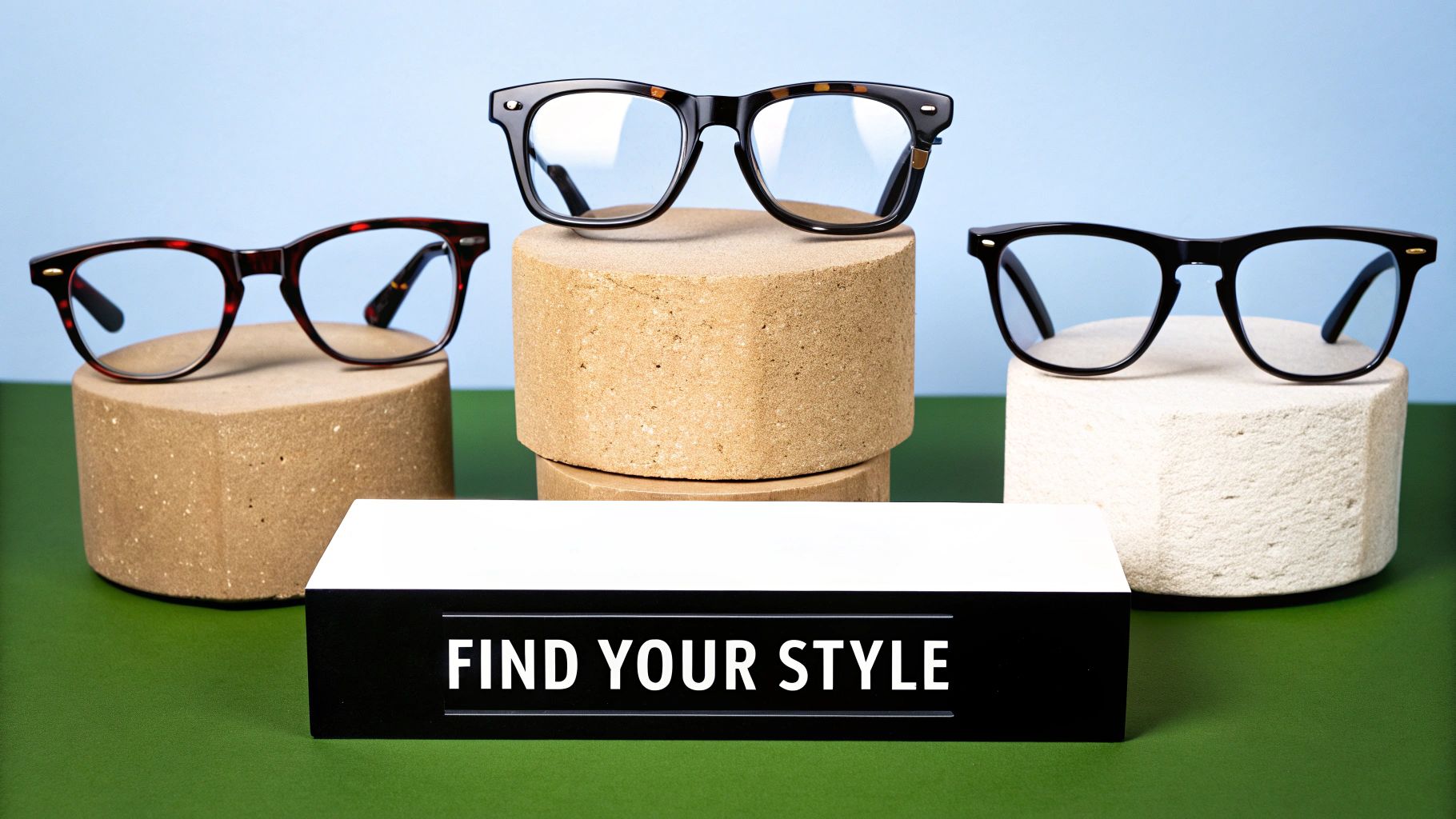
The shape of your frames is a great starting point, but the material and colour are what truly bring them to life. Once you’ve settled on a style, the next question is what they're made of. This decision influences everything—their weight, durability, and even how comfortable they feel after a long day.
You'll come across a few common materials, each with its own personality. Acetate, a plant-based plastic, is a classic for a reason; it’s brilliant for showcasing rich, deep colours and timeless patterns like tortoiseshell. If you need something incredibly light yet tough, titanium is a fantastic choice. It is also hypoallergenic, which is a lifesaver for anyone with sensitive skin. Sleek, minimalist metals are also popular for a more modern, understated look.
Your lifestyle and budget are your best guides here. Think about how you’ll wear your glasses. Do you need something strong for everyday knocks? Is feather-light comfort a priority? A great pair of frames is an investment in both your style and your daily comfort.
It’s clear that people are thinking more carefully about these choices. Recent consumer trends in the UK reveal a group of shoppers, dubbed "Wiser Wallets," who meticulously balance cost with practical features and sustainability. This means people are looking for real value, whether it’s in the frame's durability or comfort features like adjustable nose pads.
Matching Colours to Your Complexion
Now for the fun part—colour. The right shade can make your eyes pop and complement your hair and skin tone, tying your whole look together beautifully.
The trick is to start with your skin's undertone. Don't worry, it's simpler than it sounds. Just have a look at the veins on the inside of your wrist in natural daylight.
- Warm Undertones: If your veins have a greenish tint, you have warm undertones. Think earthy tones, golds, honey, and olive greens.
- Cool Undertones: Veins that appear blue or purplish mean you have cool undertones. You'll look amazing in jewel tones like sapphire and emerald, with silver, black, and grey.
- Neutral Undertones: Seeing a bit of both? You’ve hit the jackpot with neutral undertones, which means you can pull off almost any colour.
For more information, check out this guide on finding the best colors for your skin tone. Getting this right makes a massive difference in how your glasses look and feel on you.
So, to recap: warm complexions pair wonderfully with frames in shades like gold, copper, and tortoiseshell. Cool complexions are flattered by silver, black, deep purples, and blues. Following this simple rule of thumb is one of the best ways to find new glasses that highlight your best features.
Getting the Perfect Fit for All-Day Comfort
While it’s easy to get carried away with style, comfort is what truly makes or breaks a pair of glasses. We've all been there – frames that constantly slide down your nose, pinch behind your ears, or just feel heavy. The right fit is everything, and thankfully, it's not a secret art. It is about understanding a few key details.
Take a look inside the arm of any pair of glasses. You'll spot a sequence of three numbers, something like 52-18-140. These aren't random; they're the precise measurements that act as your guide to a comfortable fit.
- Eye Size (52): This is the horizontal width of one lens in millimetres.
- Bridge Width (18): This measures the gap between the lenses, right where they sit on your nose.
- Temple Length (140): This is the full length of the arm, from the hinge right to the tip that tucks behind your ear.
Once you find a pair that feels great, jot down these numbers. They become an invaluable reference point for shopping online or quickly narrowing down options in-store.
How to Check the Fit Yourself
When you're trying on frames, you don't need to be an optician to spot a good fit. Run through a few quick checks. The total width of the frames should be about the same as the width of your face at the temples. A little wider is okay, but they shouldn't overhang dramatically. Your pupils should look like they're right in the centre of each lens.
The bridge is where comfort is won or lost. Your glasses need to sit comfortably and securely on your nose. If you nod, smile, or look down, they shouldn’t slide. They also shouldn’t pinch or leave those tell-tale red marks after just a few minutes of wear.
When you're ready to pick your lenses and any extra coatings, this visual guide can help you navigate the options.
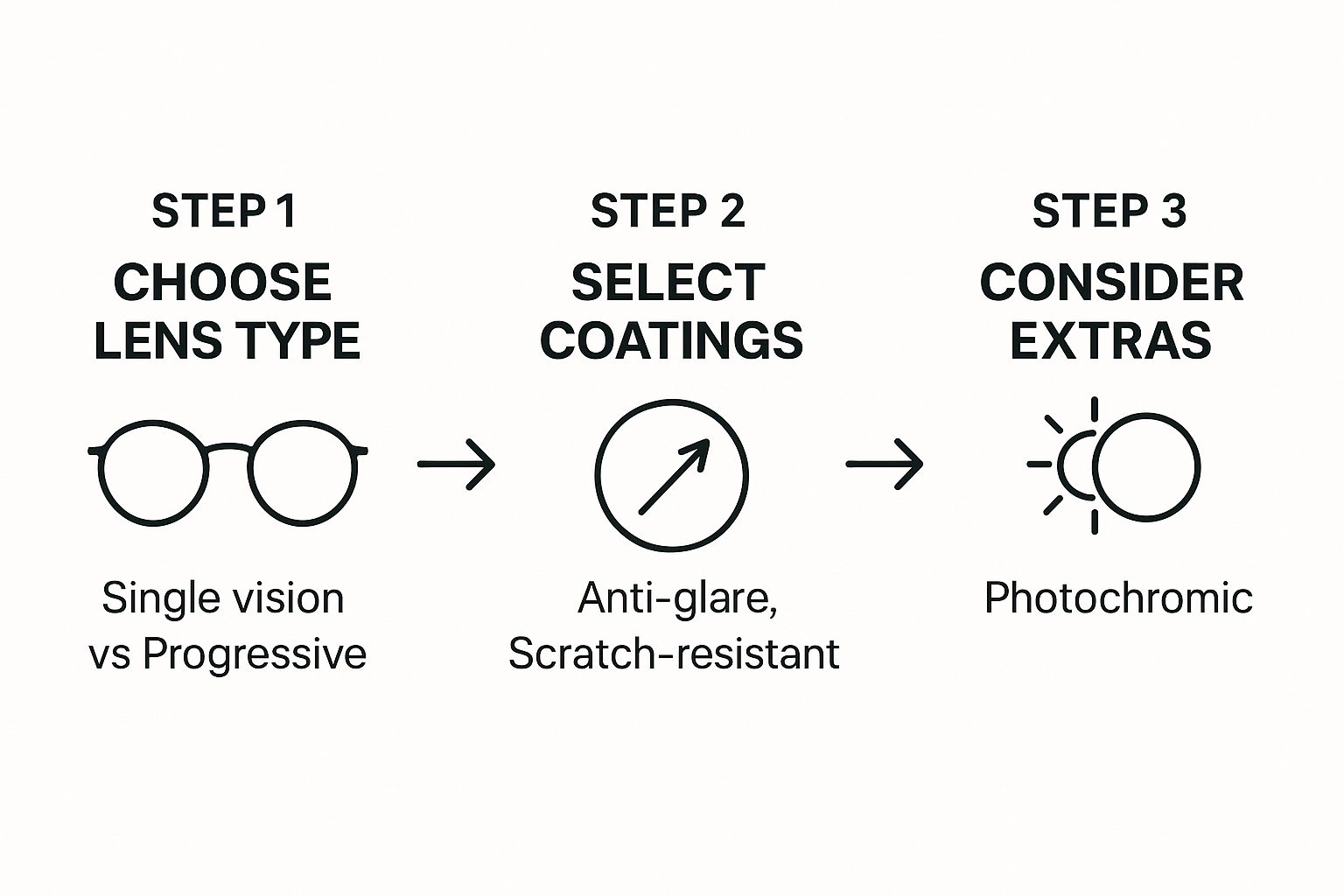
As you can see, choosing coatings is a key step after you’ve decided on the lens material itself, adding protection and clarity.
The Frame Fit Checklist
To make it even easier, here is a simple checklist. Use this when you're trying on a new pair to assess the fit like a pro.
| Frame Fit Checklist |
| :— | :— | :— |
| Fit Checkpoint | What to Look For | Why It Matters |
| Overall Width | Frames should align with the width of your face, not extending far past your temples. | Frames that are too wide can look unbalanced and feel unstable. Too narrow, and they'll pinch. |
| Eye Position | Your pupils should appear to be centred in the lens area. | Proper centring makes your prescription work as intended, giving you the clearest vision. |
| Bridge Comfort | No pinching, and no significant gaps between the frame and your nose. | A poor bridge fit causes slipping and can leave uncomfortable pressure marks. |
| Temple Arms | The arms should curve gently over your ears without pressing too tightly. | Arms that are too short won't secure the glasses; too long, and they'll slip forward. |
| The Smile Test | Smile widely. Do the frames lift off your cheeks? | If your glasses move when you smile, the fit isn't quite right and will be a constant annoyance. |
Getting this right is about more than just avoiding irritation; it affects your vision correction.
This growing focus on both comfort and function is a major driver in the industry. The UK eyewear market is projected to hit around £4.1 billion by 2030, partly because people are prioritising durable, well-fitting glasses that last. You can read more about these UK eyewear market findings on grandviewresearch.com.
A perfectly fitted pair of glasses should feel almost weightless and stay put all day. Once you've found them, keeping them pristine is the next step. If you're curious, we have a great guide with some easy tips on how to clean glasses.
Using Eyewear to Express Your Personal Style
Your glasses are much more than a tool to help you see; they are the most important accessory you'll ever own. They sit right on your face, so they have a massive impact on how you present yourself to the world. The right pair of frames can instantly communicate your personality, whether you're classic and professional, bold and creative, or more of a sleek minimalist.
So, what’s your vibe? A vintage-inspired round frame in a classic tortoiseshell can perfectly finish a retro look. If your wardrobe is built on clean lines and modern simplicity, you’ll likely feel more at home in thin metal designs or barely-there rimless frames.
Aligning Frames with Your Fashion Sense
Ever thought about building an eyewear wardrobe? It’s a great idea. You wouldn't wear your gym trainers to a wedding, so why stick with just one pair of glasses for every single occasion? Having a few options makes life so much easier. Think a sturdy, sophisticated pair for the office and something a bit more fun and colourful for weekends or a night out.
When you start seeing your glasses as a key part of your identity, not just a medical device, a whole new world of style opens up. It’s about adapting your look to any setting while always feeling authentically you.
Recent data from the UK eyewear market reveals just how much style influences our choices. Women often lean towards more fashion-forward frames with diverse shapes and colours, while many men still gravitate towards classic, functional designs. For a closer look at these trends, you can explore the UK eyewear market report on researchandmarkets.com.
Building a Cohesive Look
Matching your glasses to your outfits isn't as daunting as it sounds. We've got some fantastic starting points in our guide on tips for stylish eyewear. If you're ready to really get into it, you can learn how to master matching clothes and developing your personal style.
Picking frames that showcase your personality is all about confidence. When your glasses feel like a true extension of you, you’ll wear them with pride. Don’t be afraid to step outside your comfort zone and try something new—it might just be the perfect way to express yourself.
Common Questions About Choosing Glasses

When you’re trying to figure out how to choose glasses frames, the same few questions tend to pop up time and again. Let's tackle them head-on, because getting these sorted can make your final decision a whole lot easier.
Can I Put New Lenses in My Old Frames?
Yes. If your current frames are still in good shape and you love how they look, reglazing them with your new prescription is a fantastic, sustainable choice. It’s often much kinder on your wallet, too.
Before you get your heart set on it, an optician will need to give your frames a quick once-over. They'll check their condition to verify they're sturdy enough to handle new lenses, especially if your prescription is complex or requires thicker glass.
Is It Better to Buy Glasses Online or In-Store?
This is the classic debate, and there’s no single right answer. Each has its perks.
Shopping in-store gives you that hands-on experience. You can feel the weight of different materials, see how the colour looks against your skin tone, and get an expert to adjust the fit perfectly. I always recommend this route for first-time glasses wearers or anyone with a tricky prescription.
Online shops can offer an incredible range of styles at very competitive prices. Many now have virtual try-on tools, which are surprisingly good. A smart approach is to get your prescription and pupillary distance measured professionally, then you’re free to browse both online and on the high street.
While we're talking frames and style, don't forget the most important part: your prescription. Glasses are a medical device first and a fashion accessory second. For some, glasses are the clear winner, but others might find the freedom of contacts a better fit for their lifestyle. We break it all down in our guide on how to choose contact lenses.
Picking the right frames is a personal journey—a balance of function, comfort, and your unique style.
Ready to find your perfect pair? Visit Northern Optical Company for a curated selection of stylish frames and expert, friendly advice. Explore our eyewear collections today.