
When getting a new pair of glasses, your pupillary distance (PD) is one of the most critical measurements. It’s the distance between the centres of your pupils, measured in millimetres, and it tells the lab where the optical sweet spot of your lenses should be.
Getting this right means your eyes will look through the clearest part of the lens, giving you sharp vision without unnecessary strain.
Why Your Pupillary Distance Is So Important
Picture your spectacle lenses as tiny, perfectly engineered windows. The very centre of that window provides the most accurate vision. If your pupils don't align with that central point, things can start to look a bit off, sometimes blurry or distorted.
Knowing your pupillary distance helps you avoid common problems with new glasses. An incorrect PD is a frequent reason for headaches, dizziness, and eye fatigue, as your eyes work overtime to compensate for the misalignment. It's a key piece of the puzzle when you're learning how to choose eyeglasses for a perfect fit.
Single PD vs. Dual PD: What’s the Difference?
You'll likely see two different ways of measuring PD.
- Single PD: This is the total distance from the centre of one pupil straight across to the centre of the other. For many standard prescriptions, this single number works perfectly well.
- Dual PD: Also known as monocular PD, this measurement is more exact. It measures from the bridge of your nose to the centre of each pupil separately. You’ll see it written as two numbers, for example, 32/33.
The dual PD method is far more precise because it accounts for any slight facial asymmetry, which is completely normal. For anyone with a more complex prescription, like varifocal or progressive lenses, a dual PD isn't just nice to have—it's necessary for the lenses to work correctly.
Before showing how you can measure your own PD, here’s a quick overview of the key concepts.
PD Measurement at a Glance
| Concept | Description | Importance for Glasses |
|---|---|---|
| Pupillary Distance (PD) | The distance in millimetres between the centres of your pupils. | Helps align your pupils with the optical centre of your lenses. |
| Single PD | The total distance from one pupil to the other (e.g., 63 mm). | Suitable for many standard, single-vision prescriptions. |
| Dual PD | Measures from the bridge of the nose to each pupil individually (e.g., 31/32 mm). | More precise and needed for varifocals and high prescriptions. |
This table helps show why a simple number holds so much importance for your visual comfort.
Key Takeaway: A precise PD is non-negotiable for comfortable vision. Without it, even a perfect prescription can feel "off," causing visual strain as your eyes struggle to adapt.
In the UK, most adults have a pupillary distance somewhere between 58 mm and 68 mm. On average, women are around 62 mm and men are closer to 64 mm, but don't worry if your measurement falls outside of this range—everyone is different. An incorrect measurement is one of the leading reasons people feel eyestrain with new glasses, so taking the time to get it right is well worth it.
Getting Ready for an Accurate Measurement
Before you measure your pupillary distance, a little bit of preparation can make a world of difference. Getting this right makes your measurement as accurate as possible, and you only need a couple of common items to do it.
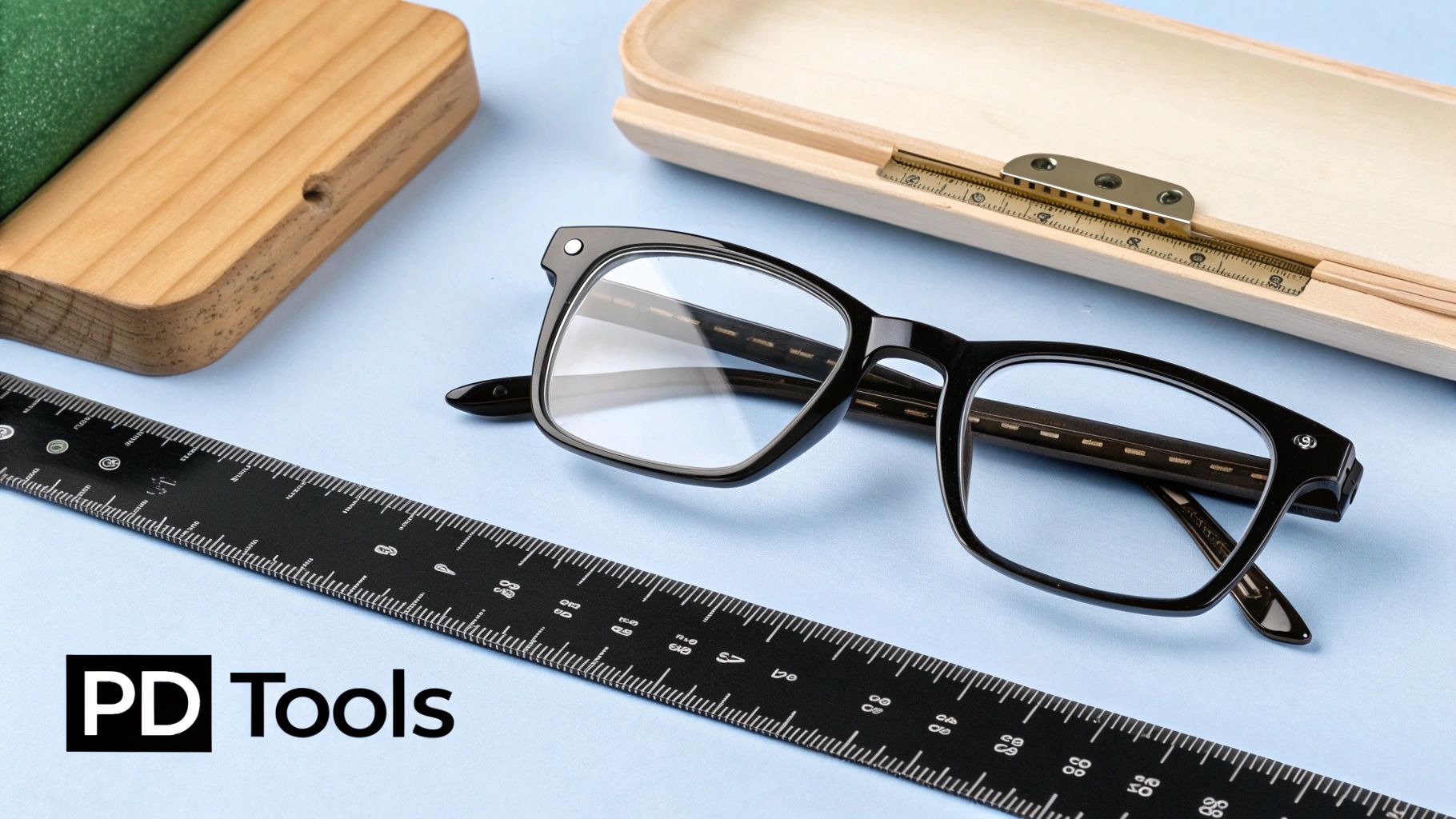
What do you need? For the classic at-home method, you'll just need a mirror and a straight ruler that has millimetre markings. If you're going the digital route with an app or online tool, have a standard-sized card ready—something like a credit card or a supermarket loyalty card works perfectly, as the tool uses it to get the scale right.
Finding the Right Environment
Where you take the measurement matters more than you might think. You'll want to find a spot with good, even lighting. The goal is to avoid any harsh shadows falling across your face, which can make it tricky to see the centre of your pupils clearly.
Be sure you're sitting or standing in a relaxed, natural position. Keep your head level and look straight ahead, trying not to tilt it up, down, or to either side.
Here’s a tip for keeping the ruler steady: gently rest it against your brow bone. This simple trick stops it from slipping and helps you get a much more reliable reading.
If you're using a mirror, stand about 8 inches (or 20 cm) away. This is a good spot—close enough to read the tiny millimetre marks but far enough that your eyes aren't straining or converging, which can throw off the final number.
The Classic Ruler and Mirror Technique
One of the most reliable ways to find your pupillary distance at home requires nothing more than a ruler and a mirror. It’s a classic for a reason. This method is surprisingly accurate, as long as you’re precise and take your time. Getting this number right is critical for making your new glasses work perfectly for you.
Stand about 8 inches (or 20 cm) away from a mirror. You'll want good lighting so you can clearly see your pupils. Hold a millimetre ruler straight across your brow line.
Now, close your right eye and look directly into your left eye in the reflection. Carefully line up the '0' mark of the ruler with the very centre of your left pupil. Try to keep the ruler perfectly still.
Once you have that starting point locked in, open your right eye and close your left. Look straight ahead, not at the ruler itself. The mark on the ruler that lines up with the centre of your right pupil is your PD measurement. Most adults have a PD between 54 and 74 millimetres.
This visual guide gives you a quick look at how it's done.
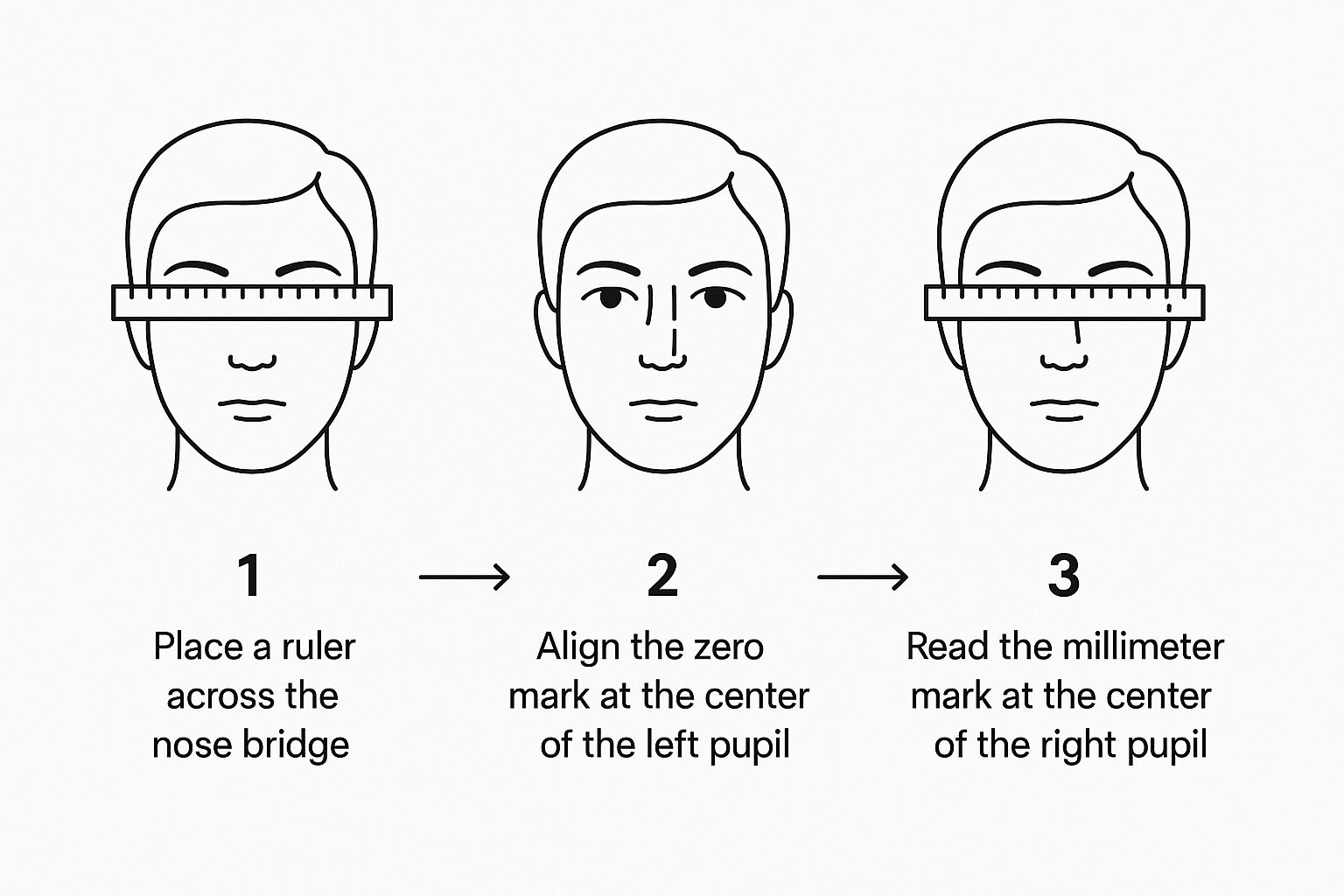
As you can see, it's all about aligning the ruler, holding steady, and then taking the final reading.
Getting a More Accurate Result
For an even more precise measurement, it's a great idea to ask a friend for help. This removes the parallax error that can happen when you're trying to read the ruler yourself.
Here's how to do it with a helper:
- Have your friend sit or stand in front of you, about an arm’s length away.
- Keep your eyes open and look straight ahead at an object roughly 10-20 feet (3-6 metres) in the distance. Do not look at your friend.
- Your friend will then hold the ruler against your brow and measure the distance between the centre of your pupils.
My Pro Tip: Measure it two or three times. If you get the same number (or within a millimetre) each time, you can feel confident you’ve nailed it. A small slip of the ruler or a slight shift in your gaze can throw the number off, so double-checking is key.
Even a tiny variation matters for your vision, so confirming the number gives you peace of mind that your new eyewear will be spot on.
A few things can go wrong when you're doing this for the first time. Here are some of the most common hiccups and how to fix them.
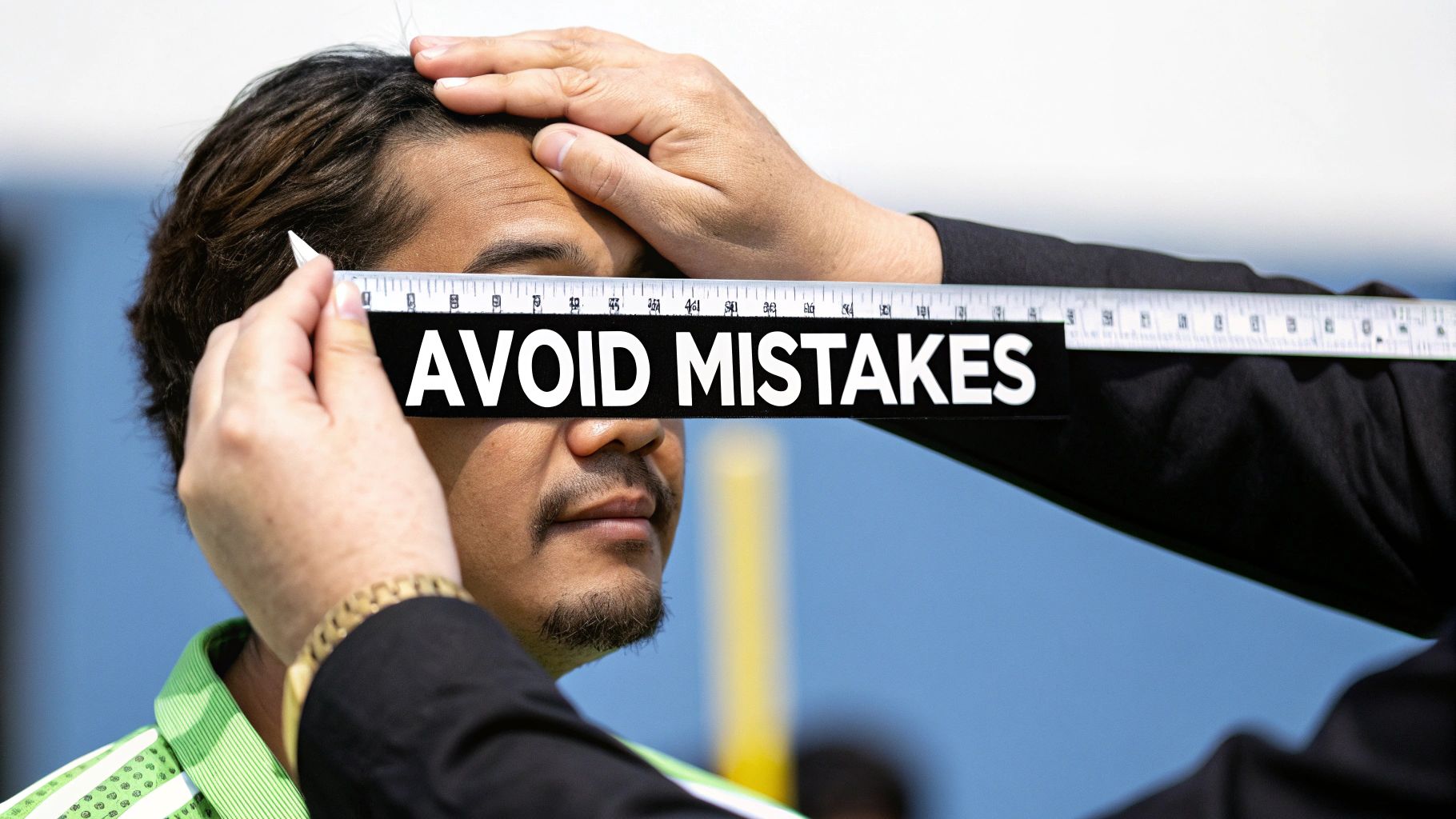
Common Mistakes and How to Correct Them
| Mistake | What Happens | How to Fix It |
|---|---|---|
| Moving the Ruler | The measurement becomes inaccurate because the starting point shifts. | Rest the ruler firmly on your brow bone or the bridge of your nose to keep it from slipping. |
| Looking at the Ruler | Your eyes naturally converge (turn inwards), which will give you a shorter, incorrect PD measurement. | Keep your focus on your own reflection in the mirror or a distant object if a friend is helping. |
| Tilting Your Head | This can slightly alter the distance between your pupils from the ruler's perspective. | Keep your head level and as still as possible throughout the entire process. |
Paying attention to these small details makes all the difference between a fuzzy pair of specs and a perfectly clear view.
Using Digital Tools to Find Your PD
If you're not keen on fiddling with a ruler, you're in luck. Modern technology offers a simpler way to get your PD measurement. Dozens of digital tools and smartphone apps are designed to do the hard work for you.
Most of these apps use your phone's camera and some clever facial recognition to find the exact centre of your pupils. The process is usually quite simple: you’ll snap a quick selfie while holding a standard-sized card (like a credit card or library card) against your forehead. The app uses the card as a reference to calculate the distance accurately.
The great thing about this method is that it practically removes parallax error, which is the main reason for inaccurate home measurements. You get a precise reading in just a few seconds. Their accuracy is often on par with manual methods, usually within ±0.5 mm. A good 82% of users get the same consistent measurement after trying it just three times.
Finding an App You Can Trust
With so many options out there, how do you pick the right one? Look for a few key things.
- Check the reviews: See what other users are saying about the app's accuracy and how easy it is to use. Consistent positive feedback is a good sign.
- Prioritise your privacy: Look for an app that processes the image directly on your phone rather than uploading it to a server. Your facial data should stay with you.
- Understand the process: The best apps will walk you through each step, explaining how they're getting the measurement.
Once you’ve chosen an app, the process is straightforward. Launch it and follow the on-screen instructions to get set up. Then, hold your phone at eye level, place the reference card on your forehead or just below your nose, and take the picture. Always take at least two or three measurements to get a consistent result.
"I’ve found that a well-designed digital PD tool can be just as accurate as what we use in the lab, often getting within half a millimetre of the true value."
A Few Pro Tips for Getting It Right
The first time you use one of these apps, it helps to do a quick practice run just to get comfortable with how it works.
For the best results, have your face evenly lit from the front, and try to avoid any strong light coming from behind you.
- Keep your phone’s camera perfectly level with your eyes. Don't tilt it up or down.
- Be sure the reference card is held flat against your skin so the scale is accurate.
- It's always a good idea to save a few of your readings to compare them.
Getting your PD right is a critical step, but it’s just one part of finding the perfect glasses. The right lenses are just as important for getting that crystal-clear vision you’re after.
Home Measurement vs. a Professional Optician
You're looking at measuring your pupillary distance. The big question is, how does a DIY measurement at home stack up against one from a professional optician? For many people, a careful home measurement does the job just fine, especially for simple single-vision glasses.
The real difference is the equipment. In an optician's practice, they use highly specialised tools, most often a digital pupillometer. Think of it as the gold standard for precision. This isn't just guesswork; research has shown a consistent, if small, difference between methods. One study found that manual measurements averaged 60.69 mm, while a pupillometer gave a more precise average of 59.14 mm. That 1 to 1.5 mm difference might not sound like much, but it shows the accuracy you get in a clinical setting.
When a Home Measurement Is Fine
For many of us, a self-measured PD will work perfectly well. If your prescription is straightforward and you only need single-vision lenses, the tiny potential for error is unlikely to cause any noticeable issues with your new specs.
You can feel confident with a home measurement if:
- Your prescription strength is relatively low (usually under +/- 2.00).
- You're just ordering a backup pair or some non-essential fashion glasses.
- You trust yourself to follow the steps carefully and, critically, you’ve measured it a couple of times to get a consistent result.
A well-executed home measurement can be a surprisingly reliable option. The key is to be meticulous and repeat the process to confirm your number.
When to See an Optician
While measuring at home is convenient, there are times when you shouldn't cut corners. For certain prescriptions and lens types, the precision of a professional is needed. Booking professional eye tests is always the safest bet when accuracy is paramount.
You should always leave it to the professionals if:
- You have a high prescription strength. Even tiny errors in PD can have a huge impact on your vision with stronger lenses.
- You need varifocal, bifocal, or progressive lenses. These complex lenses require exact measurements for different viewing zones to work correctly.
- You have a history of headaches, eye strain, or trouble getting used to new glasses.
- You simply want the complete peace of mind that your measurement is spot-on.
Your PD Questions, Answered
Getting your head around pupillary distance often brings up a few common questions. It’s a small measurement, but getting it right is the secret to comfortable, clear vision in your new specs. Let's tackle some of the things people often ask.
Common Measurement Queries
Can I just use the PD from my last pair of glasses?
It's tempting to dig out an old prescription, but it's not the best idea. A person's pupillary distance can and does change, especially through childhood and the teenage years. Even for adults, a fresh measurement is the only way to be certain your new lenses will be perfectly centred for your eyes today.
What actually happens if my PD is wrong?
An incorrect PD forces your eyes to work overtime to see clearly through the lenses. This can lead to unpleasant symptoms like persistent headaches, noticeable eye strain, and a frustrating sense of your vision just not being "right," even with a new prescription.
Is it better if a friend measures it for me?
Yes. Having a friend help is one of the easiest ways to get a more accurate reading at home. It removes something called parallax error, which is the distortion that happens when you try to look down at a ruler in the mirror.
Just be sure your friend stands directly in front of you, about an arm's length away. Your job is to look straight ahead, focusing on an object in the distance (about 10-20 feet away), not at your friend.
How do I take a "dual" PD measurement?
A dual PD, which measures from the bridge of your nose to each pupil individually, is often considered the gold standard for accuracy. It's simple to do.
When your friend is measuring, instead of just noting the total distance between your pupils, ask them to measure from the centre of your nose bridge to the centre of each pupil separately. You’ll get two numbers, such as 32/33 mm, which represents the right and left eye measurements.
When you're ordering glasses online, the responsibility for providing an accurate PD is yours. Taking that little bit of extra time to measure carefully is an investment in your own visual comfort.
For those who are eligible, it's worth remembering you can always ask for your PD during a routine eye examination. You can find out more about your eligibility for NHS sight tests to see if this is an option for you.
Getting this one small detail right is the final, critical step to making sure your new glasses feel fantastic from the moment you put them on.
For expert eye care and a personalised fitting service you can trust, visit us at Northern Optical Company. We combine clinical excellence with a friendly approach to help you see clearly and comfortably. Find your perfect pair with us at https://northernopticalcompany.com.