
When you think of contact lenses, you probably picture the standard soft disposables that correct common issues like short-sightedness. But what happens when the eye's surface isn't perfectly smooth? That’s where specialist contact lenses step in.
Think of it less like an 'off-the-rack' solution and more like a custom-fitted suit for your eyes. These are advanced medical devices, meticulously designed to manage complex conditions that regular contacts simply can't handle. They’re for eyes with unique challenges, such as an irregular shape, severe dry eye, or post-surgery vision needs.
Getting to Grips with Specialist Lenses
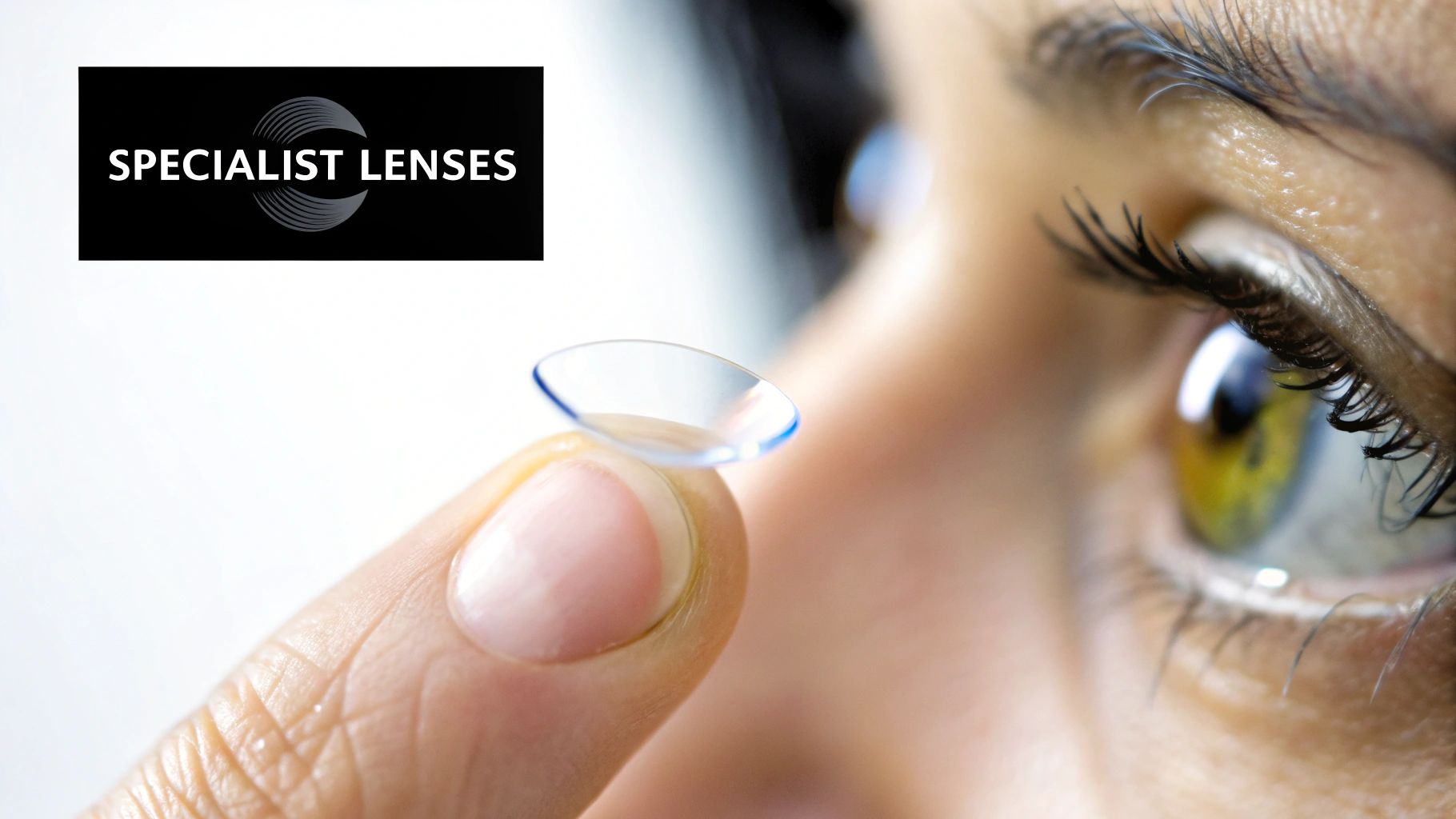
Most of us are used to mass-produced soft lenses, which work brilliantly for eyes with a regular, smooth corneal surface. Some eye conditions turn this smooth surface into something with hills and valleys instead of a gentle plain.
When the cornea—the eye's clear front window—is shaped irregularly, light scatters as it enters the eye instead of focusing neatly onto a single point. This causes distorted, blurry vision that even the most powerful glasses often fail to correct. Specialist lenses are designed to solve this problem.
Creating a New Optical Surface
So, how do they work? The core principle is ingenious. A specialist lens vaults over the irregular cornea, creating a brand new, perfectly smooth optical surface for light to pass through.
Imagine placing a pristine sheet of glass over a bumpy, uneven table. The glass creates a flawless new surface on top. In the same way, the lens allows light to bend correctly, bringing the world back into sharp focus.
For many people, these lenses aren't just a vision aid; they're a lifeline. They restore a quality of life that was lost, allowing people to drive, work, and simply enjoy daily activities with confidence and clarity.
This is a very different approach from standard vision correction. It's a necessity for specific eye conditions that alter the cornea's shape or health. Because every eye is unique, each lens must be custom-made, which means the fitting process is far more detailed than a routine contact lens check-up and requires a practitioner with dedicated expertise.
To help illustrate the differences, let's compare standard and specialist lenses side-by-side.
Standard vs Specialist Contact Lenses: A Quick Comparison
| Feature | Standard Contact Lenses | Specialist Contact Lenses |
|---|---|---|
| Design | Mass-produced, 'one-size-fits-most' | Custom-made to individual eye measurements |
| Purpose | Corrects common vision errors (nearsightedness, farsightedness) | Manages complex conditions (e.g., keratoconus, post-surgery) |
| Fitting | Simple and quick fitting process | In-depth assessment with multiple appointments |
| Material | Usually soft hydrogel or silicone hydrogel | Can be rigid gas permeable (RGP), hybrid, or scleral materials |
| Availability | Widely available 'off-the-shelf' | Ordered from specialist labs; requires a skilled fitter |
As you can see, specialist lenses are a completely different category of eye care, built from the ground up for complex needs.
A Growing Field in UK Vision Care
The need for more advanced vision solutions is on the rise. Analysis of the UK contact lens market growth on Grandviewresearch.com shows a clear trend towards lenses that can tackle more complex visual problems. This shift highlights just how significant specialist contact lenses have become in modern optometry.
The technology behind these lenses is constantly evolving. We're seeing new materials that let more oxygen reach the eye and new designs that improve both comfort and clarity. This continuous progress means that more people across the UK than ever before have a real chance at achieving clear, comfortable vision, even when faced with significant eye health challenges.
Common Types of Specialist Contact Lenses

When you hear "contact lenses," you probably picture the standard soft lenses most people wear. But beyond those lies a whole world of specialist lenses, each engineered to solve specific, often complex, vision problems.
Unlike a soft lens that simply drapes over the eye's surface, these advanced options create a brand-new, perfectly smooth optical surface. This allows us to achieve incredible clarity where standard options just wouldn't work. Let's look at the main types you're likely to come across: Rigid Gas Permeable (RGP), Scleral, Hybrid, and Orthokeratology (Ortho-K) lenses.
Rigid Gas Permeable Lenses
Often just called RGPs or even "hard lenses," these are crafted from a firm, durable material that’s excellent at letting oxygen reach your eye. The key to their magic is that very rigidity. Instead of conforming to the eye's shape, an RGP lens holds its own form.
This is what delivers such fantastic optical quality. By creating a smooth surface over any underlying corneal irregularities (like those from astigmatism or early-stage keratoconus), the lens effectively masks the problem. The tiny gap between the lens and your cornea fills with your own tears, creating a new, flawless surface for light to focus through. The result is exceptionally sharp and stable vision.
Modern RGPs are far more comfortable than their predecessors, but there's usually a short adaptation period while your eyelids get used to the sensation of the lens edge.
Scleral Lenses
Scleral lenses are a truly remarkable piece of technology. These are large-diameter lenses that do something quite clever: they vault completely over your cornea, resting gently on the sclera (the tough, white part of your eye). This design is a game-changer for several reasons.
By avoiding contact with the cornea—which can be sensitive or irregularly shaped—they offer incredible comfort, even for people who found other lenses intolerable. Second, that space between the lens and the eye creates a fluid-filled reservoir that constantly bathes the cornea in a preservative-free saline solution.
This fluid reservoir makes scleral lenses more than just a vision corrector; they're a therapeutic device. For people suffering from severe dry eye syndrome, they provide continuous hydration and can bring profound relief from painful symptoms.
Their large size also makes them incredibly stable, locking them in place. This makes them a first-class solution for complex conditions like advanced keratoconus, vision correction after a corneal transplant, and severe ocular surface disease.
Hybrid Lenses
What if you could get the pin-sharp vision of a rigid lens with the initial comfort of a soft one? That’s the thinking behind hybrid lenses. They really are the best of both worlds.
The centre of the lens is a rigid, gas-permeable zone that delivers the high-definition optics you'd expect from an RGP. This rigid centre is then fused to a soft outer "skirt" made from the same kind of material as regular soft lenses.
This clever design gives you a fantastic combination of benefits:
- Crisp Vision: The rigid centre does the heavy lifting, correcting astigmatism and corneal irregularities for clear, stable sight.
- Superb Comfort: The soft skirt provides that familiar, comfortable feel from the moment you put it in.
- A Stable Fit: The soft edge helps keep the lens centred and secure, avoiding the movement that some people notice with RGP lenses.
Hybrid lenses are often the perfect answer for someone who needs the optical power of a rigid lens but struggles with the adaptation period or wants that initial soft-lens comfort.
Orthokeratology Lenses
Orthokeratology, or Ortho-K, flips the script on vision correction entirely. Instead of wearing lenses during the day, you wear these specially designed rigid lenses only while you sleep.
Overnight, the Ortho-K lenses gently and safely reshape the very front surface of your cornea. You take them out when you wake up, and the cornea holds this new shape, giving you clear, natural vision all day long—with no need for glasses or contact lenses. The effect is temporary, so you need to wear the lenses each night to maintain the results.
Ortho-K is mainly used for correcting myopia (short-sightedness) and is becoming a hugely popular and effective method for slowing the progression of myopia in children and teenagers. For athletes, swimmers, or anyone who just wants total freedom from eyewear during the day, it's an amazing option.
Eye Conditions That Require Specialist Lenses
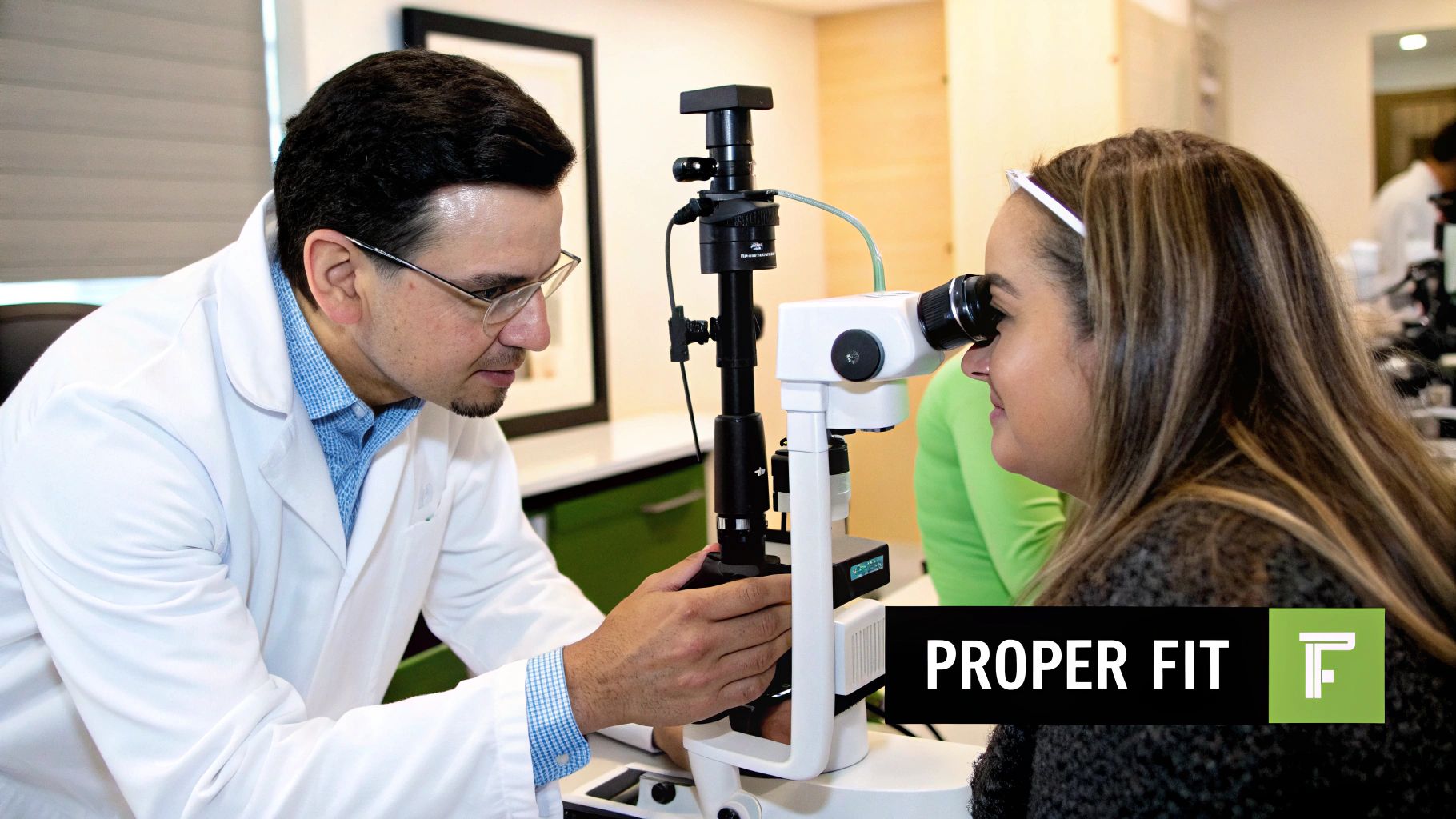
The technology behind different specialist lenses is remarkable, and their true value shines when we see them transform someone's vision. For many people, these aren't just an upgrade; they're a medical necessity that provides clarity and comfort where standard glasses and contacts cannot.
Certain eye conditions change the very shape or health of the cornea so dramatically that off-the-shelf solutions are no longer effective. In these complex cases, the custom-fit nature of specialist contact lenses becomes a requirement. Let's walk through some of the key conditions where these lenses really make a difference.
Keratoconus
Keratoconus is a progressive condition where the cornea, which should be a smooth, round dome, starts to thin and bulge outwards into a cone shape. Imagine a perfectly round football slowly developing a pointed, uneven bulge on one side. This irregular surface scatters light as it enters the eye, causing significant distortion, ghosting, and blurriness.
A standard soft lens just drapes over this cone, mimicking the problem rather than fixing it. Glasses might help in the very early stages, but their effectiveness quickly fades as the condition advances.
A rigid lens, like a Rigid Gas Permeable (RGP) or a scleral, vaults right over the cone-shaped cornea. This creates a brand-new, perfectly smooth surface. The space between the lens and the cornea fills with tears, which neutralises the optical chaos caused by the bulge. For many people with keratoconus, this is the only way to achieve clear, functional vision.
This condition affects around 1 in 2,000 people, and for them, these lenses can mean the difference between seeing clearly and struggling to drive, read, or work with confidence.
High or Irregular Astigmatism
Astigmatism is an incredibly common condition where the cornea is shaped more like a rugby ball than a football. This means light focuses on two points inside the eye instead of one, leading to blurry vision at all distances. Standard "toric" soft lenses do a decent job of correcting regular astigmatism, but they often fall short when dealing with high levels or irregular shapes.
Irregular astigmatism can be caused by keratoconus, scarring from an injury, or complications from past eye surgery. In these cases, the corneal surface isn't just oval—it's bumpy and unpredictable.
This is where specialist lenses like RGPs or hybrid lenses come into their own. Their firm structure doesn't just conform to the eye's irregular shape. Instead, it holds its own perfectly smooth curve, creating a "tear lens" that corrects the astigmatism with incredible precision. The result is vision that's much sharper and more stable than a soft toric lens could manage.
Post-Surgical Vision Correction
Sometimes, vision correction is needed after eye surgery. Procedures like corneal grafts (transplants) are often sight-saving, but the new tissue may not heal perfectly smoothly. This can leave a patient with significant astigmatism or other distortions that glasses struggle to correct.
In other instances, complications from laser eye surgery, such as ectasia (a condition that mimics keratoconus), can create an irregular corneal surface. For these patients, fitting scleral or RGP lenses that vault over the post-surgical cornea can create a new optical surface, restoring crisp vision with a comfortable, non-invasive solution.
Severe Dry Eye Syndrome
For millions of people, dry eye is a chronic and painful battle. When your eyes don't produce enough high-quality tears, the surface of the cornea becomes dry, inflamed, and easily irritated. This leads to that familiar gritty sensation, light sensitivity, and vision that fluctuates between blurry and clear. In severe cases, it can be truly debilitating.
Scleral lenses offer a unique therapeutic solution here. Their design creates a reservoir of preservative-free saline solution that sits between the lens and the eye, constantly bathing the cornea in moisture all day long.
This delivers two profound benefits:
- Continuous Hydration: The cornea is kept perfectly moist, bringing immense relief from the pain and irritation of severe dry eye.
- Surface Protection: The lens acts as a shield, protecting the sensitive cornea from the friction of blinking and direct exposure to air.
For anyone suffering from severe ocular surface disease, scleral lenses can be life-changing, dramatically improving their comfort and quality of life.
Your Specialist Contact Lens Fitting Explained
Getting fitted for specialist contact lenses is a whole different world compared to a standard check-up. A routine fitting can often be quite quick, but a specialist fitting is a more involved, multi-stage journey. It leans heavily on advanced technology and dedicated time with your practitioner to get the result just right.
Think of it like this: a standard fitting is like buying a great pair of off-the-shelf shoes in your size. A specialist fitting is like having orthopaedic footwear custom-moulded to your foot's unique contours to solve a specific medical issue. Let's walk through what the process actually looks like, step by step.
The Initial Consultation and Examination
The journey always kicks off with an in-depth consultation. This is so much more than a quick prescription check. Your optometrist will want to have a proper chat about your visual symptoms, your lifestyle, your eye health history, and what you’re hoping to get out of wearing these lenses. This conversation is critical for pointing us towards the best type of specialist lens for your specific needs.
After the chat, we move on to a comprehensive eye examination. We’ll assess the overall health of your eyes, measure your prescription, and check for any underlying conditions that might affect the fit. This initial groundwork lays the foundation for everything that comes next, making sure the lens we choose is both safe and right for you.
Creating a Precise 3D Map of Your Eye
This is where things get truly bespoke. To design a lens that fits your eye perfectly, your practitioner needs to understand the exact, unique shape of your cornea. For this, we use a sophisticated piece of kit called a corneal topographer.
The topographer takes thousands of measurements across the surface of your eye, building a highly detailed 3D map. This map shows us every tiny hill and valley on your cornea—details that are completely invisible to the naked eye. This precise digital blueprint is what we use to design a lens that will sit perfectly on your individual corneal shape.
The image below gives a general idea of the costs and steps involved.
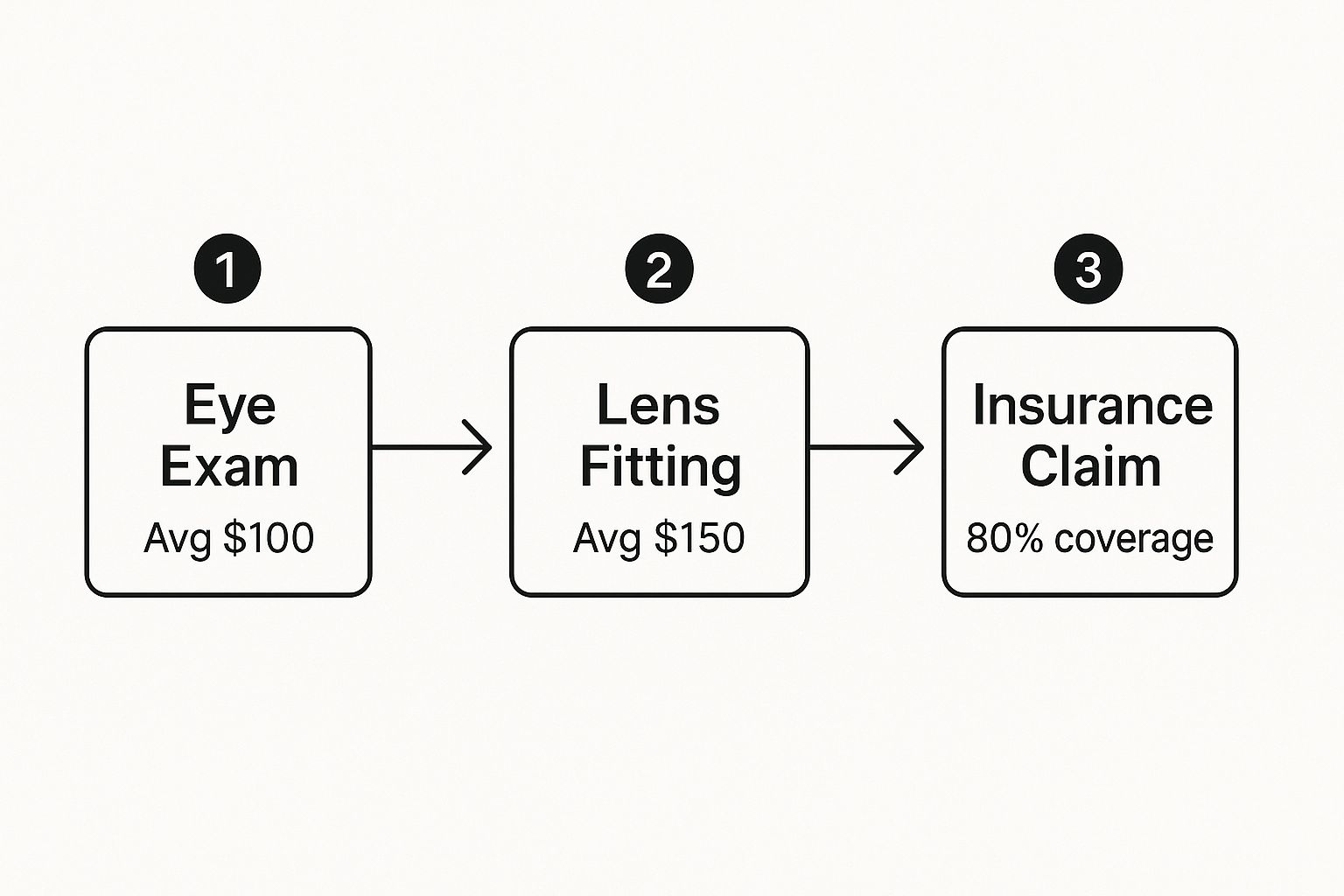
The process has separate costs for the examination and the lenses themselves, but many insurance plans offer good coverage for this.
The Trial Lens Fitting
Once we’ve taken the initial measurements and your custom lenses have been made by a specialist lab, the next stage is the trial fitting. This appointment is all about assessment. Your practitioner will place the trial lens on your eye and use a microscope to check a few key things.
They’ll be looking at:
- Positioning: Is the lens sitting correctly centred on your eye?
- Movement: Does it move just the right amount when you blink, allowing fresh tears to get underneath?
- Comfort: How does the lens actually feel? Your feedback here is incredibly valuable.
We’ll also check your vision with the trial lens in. This lets the optometrist make any necessary tweaks to the power and design to give you the clearest sight possible. For anyone new to this, our guide on how to choose contact lenses provides some great background information that complements this specialist process.
The goal of the trial fitting isn't just about sharp vision; it's about striking the perfect balance between clarity, comfort, and long-term eye health. It’s this meticulous attention to detail that really defines a successful specialist fit.
Follow-Up Appointments and Fine-Tuning
Getting the perfect fit often takes a bit of patience and a few follow-up visits. It's completely normal for your eyes to need some time to adapt to the new lenses, and making small adjustments is a standard part of the process. These appointments allow your optometrist to see how you’re getting on, listen to your experience, and fine-tune the lens parameters.
This collaborative approach continues until both you and your practitioner are happy that the fit is spot on. It might take more time than a standard fitting, but this dedication is what gets your specialist contact lenses to provide the life-changing vision and comfort they’re designed for.
The Pros and Cons of Specialist Lenses
Choosing specialist contact lenses is a big decision, and like any medical choice, it comes with its own set of advantages and challenges. Getting a clear picture of both sides helps you know what to expect and commit to the process, which is the key to getting fantastic results. These lenses can open up a world of vision that glasses or standard contacts simply can't reach.
For many people, the biggest win is a life-changing improvement in their sight. If you're dealing with a condition like keratoconus or a very high degree of astigmatism, specialist lenses might be the only path to clear, crisp vision. We're not talking about a small tweak here; for some, it's the difference between navigating a blurry, indistinct world and seeing everything with sharp detail.
The Clear Advantages
The benefits go far beyond just seeing better. Many of these lenses are designed with a therapeutic goal, offering comfort and promoting eye health in ways that off-the-shelf lenses can't. This is especially true when tackling more complex eye conditions.
A perfect example is what scleral lenses can do for someone with severe dry eye syndrome. These lenses vault over the cornea and create a reservoir of saline, constantly bathing the eye in soothing moisture. The relief from the persistent pain and grittiness can be immense.
Then you have Orthokeratology (Ortho-K). You wear these lenses overnight, and they gently reshape your cornea to correct short-sightedness. The result? Complete freedom from glasses and contacts all day long. It’s a great choice for athletes, swimmers, or anyone who just wants to live without visual aids. Studies have also shown that Ortho-K can significantly slow down the progression of myopia in children and teenagers, which is a huge benefit for their long-term eye health. If you'd like to read more about the general upsides, you can explore the benefits of contact lenses in our other guide.
The Practical Side: What to Expect
The visual rewards are incredible, but it helps to be realistic. These are sophisticated medical devices, not simple disposables. The journey with specialist lenses asks for more from you in terms of time, money, and daily effort.
The first thing most people notice is the higher cost. These aren't mass-produced lenses pulled from a shelf; each one is custom-made just for the unique shape of your eye. The fitting process itself is also far more involved, requiring multiple appointments and advanced equipment, all of which factors into the final price.
You'll also need a bit of patience during the adaptation period. Rigid lenses, in particular, can feel a little strange at first. You might be aware of the lens in your eye for the first few days or even a couple of weeks while your eyelids get used to it. Modern designs are much more comfortable than their predecessors, but a little perseverance at the start goes a long way.
The cleaning and care routines are stricter. You can't cut corners here. Excellent hygiene is non-negotiable to keep your eyes healthy and your lenses in top condition. This means following a precise cleaning and handling routine every single day, using specific solutions your optometrist recommends.
To give you a clearer idea, here’s a quick-reference table outlining what’s typically involved.
Summary of Specialist Lens Care Requirements
| Lens Type | Daily Cleaning | Special Handling Notes | Typical Replacement Schedule |
|---|---|---|---|
| RGP | Required daily with specific RGP solution | Can be fragile; avoid dropping | 1-2 Years |
| Scleral | Required daily with hydrogen peroxide or multi-purpose solution | Use insertion plunger and preservative-free saline for filling | 1-2 Years |
| Hybrid | Required daily with solutions safe for both rigid and soft materials | Handle by the soft skirt to avoid separating the materials | 6-12 Months |
| Ortho-K | Required daily after overnight wear | Strict hygiene is crucial because of overnight wear | 1 Year |
Wearing specialist contact lenses successfully is a team effort. It's a partnership between you and your optometrist, built on your commitment to looking after these amazing little devices.
How to Care for Your Specialist Lenses
Looking after your specialist contact lenses properly is about much more than just keeping them clean. It’s about safeguarding your vision and making sure you get the full benefit from these incredible medical devices. Their care routine is naturally more involved than for standard soft disposables, but once you master it, your lenses will stay comfortable, clear, and safe for a long time.
Good hygiene is the cornerstone of it all. Before your fingers go anywhere near your lenses or your eyes, wash your hands thoroughly with soap and water. Then, dry them on a lint-free towel. This one simple habit is the best defence you have against eye infections.
Handling, Insertion, and Removal
When you're handling specialist lenses—especially RGP or scleral types—a gentle, deliberate touch is key. They don't bend and fold like soft lenses, so a clumsy drop could easily lead to a chip or a crack. It’s a good idea to work over a clean, flat surface with a towel laid down to soften the blow if a lens does slip. Many find a small, flat-lying mirror on a table to be a great help.
Your optometrist will have walked you through the best techniques for your specific lenses, as the method can vary quite a bit.
- RGP and Ortho-K Lenses: These smaller lenses are usually placed directly onto the cornea. For removal, you might be given a small suction tool, often called a plunger, to gently lift the lens off the eye without having to pinch it.
- Scleral Lenses: These have a unique fitting process. You must fill the bowl of the lens to the brim with preservative-free saline. Then, you lean forward and bring your eye to the lens, applying it without spilling the saline. This creates the fluid reservoir that keeps your eye hydrated all day.
The secret here is simply practice and patience. It might feel awkward and clumsy for the first week or two, but it will soon become second nature. Don’t rush the process, and stick to the exact method your practitioner showed you.
Cleaning and Disinfecting Your Lenses
This part is non-negotiable: you absolutely must use the correct cleaning solutions. Never, ever use tap water, saliva, or any other liquid that hasn’t been specifically recommended by your optometrist. Doing so can introduce dangerous microorganisms and lead to serious eye infections.
Every type of specialist lens has its own approved cleaning system. For instance, many people with RGP and scleral lenses use a hydrogen peroxide-based system. It provides a fantastic deep clean, but you must follow the instructions to the letter. The solution needs to be neutralised in its special case for at least six hours before the lenses are safe to wear again. Other multi-purpose solutions are also available, so always double-check which one is compatible with your lens material.
If you’re experiencing itchy or red eyes, it could be a reaction to your solutions or something in the environment. We break down the potential causes in our guide on contact lens allergies and how to prevent them.
Caring for Your Lens Case
Don't forget about your lens case! It can quickly become a breeding ground for bacteria if you neglect it. Every morning after you put your lenses in, empty out the old solution, give the case a good rinse with fresh disinfecting solution (never water), and leave it to air dry upside down with the caps off.
Make it a habit to replace your case entirely at least every three months. Following these simple but important steps will help keep your specialist contact lenses—and your eyes—in fantastic shape.
Your Questions Answered
When you're considering specialist contact lenses, it’s natural to have questions about what to expect day-to-day. Let's tackle some of the most common queries we hear from patients about comfort, cost, and how long these lenses last.
Will Specialist Contact Lenses Feel Uncomfortable?
It’s true that some lenses have a brief getting-to-know-you period. This is most common with rigid gas permeable (RGP) designs, where you might feel the lens edge at first. Think of it like breaking in a new pair of quality shoes – it takes a little time.
Modern lenses are a world away from older designs. Scleral and hybrid lenses, for example, often feel incredibly comfortable right from the start. That’s because they either vault over the sensitive cornea entirely or feature a soft, cushioned edge for immediate comfort.
Why Are They More Expensive Than My Usual Lenses?
The simple answer is that these aren't off-the-shelf products. Each specialist lens is a bespoke piece of medical technology, crafted just for you. The price reflects a few key things:
- Custom Manufacturing: These lenses are made one at a time, based on precise 3D maps of your eye captured by instruments like a corneal topographer.
- Advanced Materials: The polymers and coatings used are more sophisticated to promote breathability and durability for complex eye conditions.
- Expert Time: The fitting process is far more involved, demanding significant chair time, specialised equipment, and the deep clinical expertise of your optometrist.
You're not just buying a product; you're investing in a customised medical device and the professional care required to design it for your long-term vision and eye health.
How Long Can I Expect My Lenses To Last?
Durability really depends on the type of lens you have. RGP and scleral lenses are built to be robust and, with the right care, can last for one to two years.
Hybrid lenses, with their combination of a hard centre and soft outer skirt, usually have a shorter lifespan. The soft part tends to wear down faster, so you’ll likely need to replace them annually. Your optometrist will always provide a clear replacement schedule tailored to your specific lenses.
If you run into any hitches while wearing your lenses, knowing what's causing them is the first step to a solution. We break this down in our guide to common contact lens problems.
At Northern Optical Company, our team is passionate about finding the perfect vision solution for your unique eyes. Book a consultation today to discover what specialist contact lenses can do for you at https://northernopticalcompany.com.