
Age-related macular degeneration (AMD) often creeps in quietly. The first signs can be subtle changes you might easily dismiss – your central vision getting a little blurry, straight lines looking a bit wavy, or finding it harder to see in low light. These are early warnings that something isn't right with your macula, the part of your eye that handles sharp, detailed sight.
What is Macular Degeneration and How Does it Affect Your Vision?
Every time you look directly at something—the face of a friend, the words in a book, or a street sign up ahead—you're relying on your macula. It's a tiny spot right in the centre of your retina, but it does the heavy lifting for your sharpest, most detailed vision.
Age-related macular degeneration, or AMD for short, is a condition that targets this area. As it wears down the macula, it causes a loss of central vision.
AMD is a leading cause of sight loss among older adults here in the UK. While it very rarely causes total blindness—your peripheral (side) vision is usually spared—losing that central clarity can make everyday tasks like reading, driving, or recognising faces incredibly challenging. For people in Newcastle and beyond, spotting the first symptoms is the critical first step in protecting your sight.
The condition comes in two main forms, and they affect your vision quite differently.
The Two Types of AMD
-
Dry AMD: This is by far the more common type, and it tends to be less severe. Think of it like a photograph slowly fading over many years. The macula thins out and deteriorates very gradually, leading to a slow, progressive decline in your central vision.
-
Wet AMD: This version is less common but much more aggressive and serious. Imagine a sudden ink spill on that same photograph. Abnormal blood vessels start growing under the macula and leak fluid, causing rapid and often severe damage to your vision. The change can feel very abrupt.
Understanding the difference is key, as how the condition progresses and the urgency for treatment are completely different. This is why paying close attention to any changes in your vision is so important. Regular check-ups are absolutely fundamental, which really highlights the importance of local opticians in managing your long-term eye health.
Age-related macular degeneration is a major cause of visual impairment in the UK, particularly affecting the elderly population. It is estimated that by age 75 and older, approximately 3.5% of people experience visual impairment directly attributable to AMD.
This statistic shows just how prevalent the condition becomes as we get older. Data from over a decade ago suggested that around 214,000 people in the UK had sight loss from AMD severe enough to be eligible for registration as visually impaired.
Common Signs of Macular Degeneration at a Glance
Recognising the symptoms early on can make a significant difference. Here’s a quick summary of what you might notice, from the subtle early signs to the more obvious later-stage changes.
| Symptom Category | What You Might Experience |
|---|---|
| Blurry or Dim Vision | Words on a page look fuzzy; a dim or blurry spot appears in the centre of your vision. |
| Distorted Lines | Straight lines, like a door frame or telephone pole, suddenly look wavy, bent, or crooked. |
| Difficulty in Low Light | You need much brighter light than before to read or do close-up tasks comfortably. |
| Faded Colours | Colours may seem less bright or washed out compared to how they used to look. |
| Trouble Recognising Faces | Faces become difficult to recognise because the central detail is missing. |
If any of these experiences sound familiar, it’s a clear signal that you should get your eyes checked by a professional without delay.
The Tell-Tale Signs of Macular Degeneration
Catching age-related macular degeneration (AMD) early comes down to spotting the changes in your vision. These symptoms almost always hit your central vision—the very part you rely on to see things straight ahead, like faces or the words on a page. The changes can creep up on you slowly or show up quite suddenly, but either way, they’re a clear signal that your macula needs a professional look.
AMD very rarely causes total blindness, but it can rob you of the sharp, direct sight you need for everyday tasks. Suddenly, simple things like reading a recipe or recognising a friend across the street can become a real struggle.
Blurry or Fuzzy Central Vision
One of the first things people often notice is a drop in the clarity of their central vision. This isn't your typical all-over blurriness that a new pair of specs might fix. It’s more like a smudge or a dim spot right in the centre of your focus.
You might be reading a newspaper, and the words in the middle of the sentence look like they’re running together, while the edges of the page are perfectly clear. Many people also find they suddenly need much brighter light for close-up work, like threading a needle or chopping vegetables. This central fuzziness makes picking out fine details incredibly difficult.
Distorted Vision: When Straight Lines Look Wavy
A hallmark symptom of AMD—and one that can be quite unnerving—is when straight lines start to look wavy or bent. The medical term for this is metamorphopsia, and it happens because the damage from AMD has made the surface of your macula uneven.
Think about looking at a set of blinds, the tiles on a floor, or even a lamppost. With this kind of distortion, those straight lines might appear to ripple or curve. If you notice this, it’s a very strong sign of a problem with your macula and a clear prompt to book an appointment with an optometrist.
A simple and effective way to check for this at home is with an Amsler grid. It's just a pattern of straight horizontal and vertical lines with a dot in the middle. Someone with AMD might look at the central dot and see that the surrounding lines are wavy, broken, or that some parts of the grid have vanished completely.
Dark or Empty Spots in Your Vision
Another key symptom is the appearance of dark, empty, or blank patches in your central line of sight. These blind spots are called scotomas. They often start out as small, hazy areas but can get bigger over time, feeling like a smudge on a lens that you just can’t wipe clean.
A scotoma can make it incredibly frustrating to recognise faces. You might see a person's hair and shoulders just fine, but the area where their nose and mouth should be is just a blur or an empty space. It's the same when looking at a clock; you might be able to see the numbers around the outside but not the hands in the centre.
Trouble Seeing in Low Light
People with AMD often find their vision takes a nosedive in dim light. That’s because the cells in the macula are crucial for helping our eyes adapt to different light levels. When they become damaged, moving from a bright room into a darker space becomes much more difficult.
You might feel the need to flick on every light just to read the TV guide, or find it hard to get around a dimly lit restaurant or cinema. This reduced contrast sensitivity makes it tough to tell objects apart from their background when the lighting isn't great.
Faded or Less Vibrant Colours
AMD can also wash the colour out of your world. As the macula deteriorates, colours may start to look dull or muted. That favourite red jumper might seem a bit lacklustre, or you might struggle to tell the difference between similar shades, like navy blue and black.
This happens because the cone cells—which are responsible for colour vision and packed densely in the macula—are being affected. It might be a more subtle symptom than a blind spot, but it’s another piece of the puzzle that contributes to a lower quality of vision.
When you add them all together, these symptoms can have a major impact on your independence and day-to-day life. From struggling to read medication labels to feeling unsafe behind the wheel, these visual changes are far more than minor frustrations. They’re important warnings from your eyes that need to be checked out by a professional.
Dry AMD vs Wet AMD: Understanding the Differences in Symptoms and Progression
We talk about age-related macular degeneration (AMD) as a single condition, but it’s really a tale of two very different experiences. The two forms, known as ‘dry’ and ‘wet’ AMD, affect your sight in dramatically different ways. Knowing how to spot the signs of each is crucial, as it tells you what’s happening and when you need to seek help urgently. The biggest difference boils down to the speed and severity of vision loss.
Imagine your central vision is like a high-definition photograph. With dry AMD, that photo slowly and gradually fades over many years, losing its sharpness and colour bit by bit. With wet AMD, it’s as if someone suddenly spills ink right in the middle of the picture, causing a dramatic and immediate blockage. Both ruin the view, but the way it happens couldn't be more different.
The image below gives a good sense of one of the most common symptoms: the central blurriness that can affect people with either form of the condition.
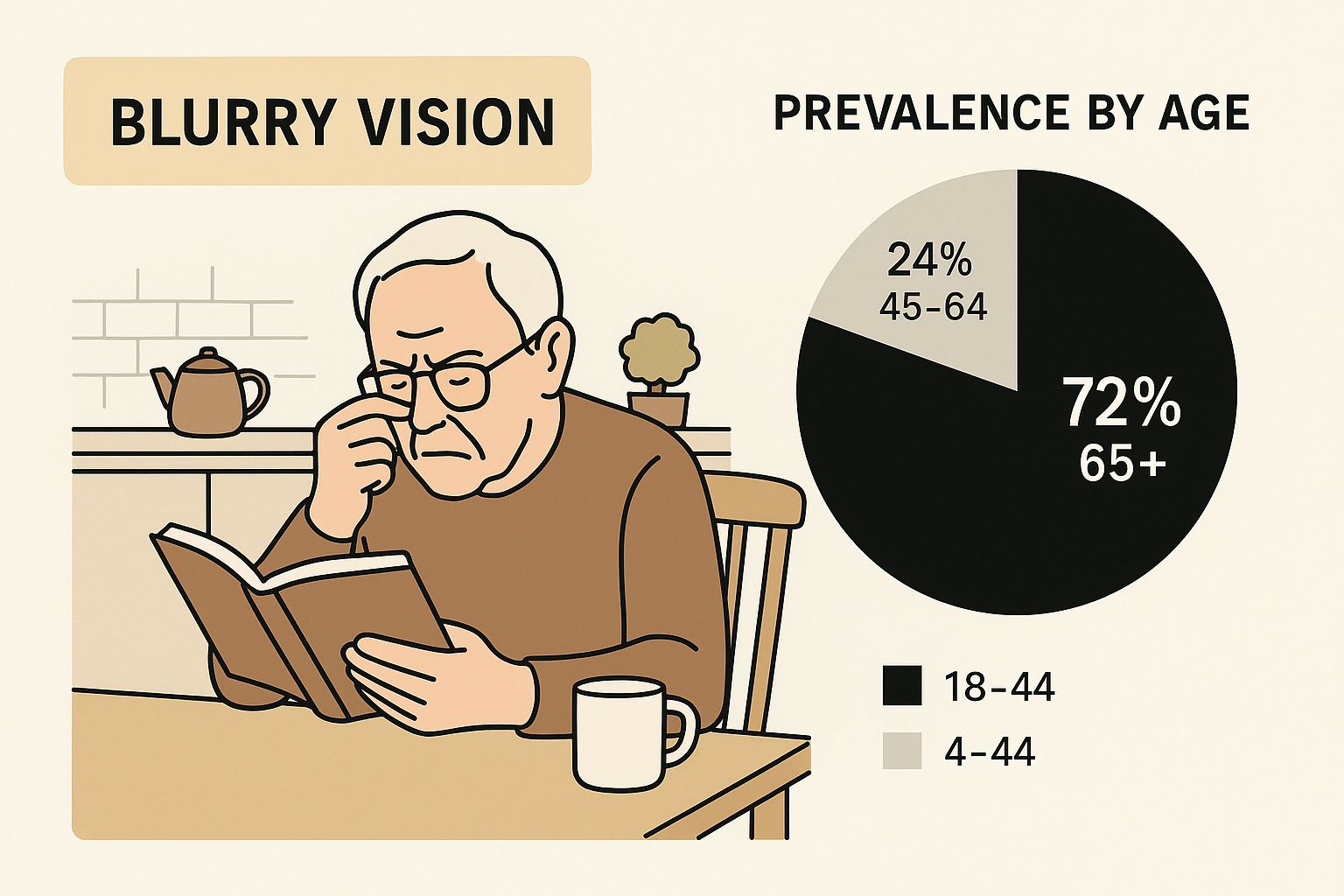
This captures that frustrating daily struggle of trying to focus on details when your macula is affected, a challenge that unites those with both dry and wet AMD.
The Slow Fade of Dry AMD
Dry AMD is by far the more common of the two, making up the vast majority of diagnoses. Its hallmark is its slow, gradual progression, often taking several years before you notice any meaningful changes to your vision. The early symptoms can be so subtle that it’s easy to dismiss them as just a normal part of getting older.
You might start to notice things like:
- A growing need for brighter light: Finding you need a reading lamp even on a bright day to see the words in a book or newspaper.
- Gradual central blurriness: Text might look a little fuzzy, or colours might seem less bright than they used to.
- Difficulty recognising faces: You might struggle to pick out the details of a friend’s face from across the room.
Because these changes creep up over such a long time, many people simply adapt without realising there’s an underlying problem. This stealthy progression is exactly why regular eye tests are so fundamental for catching it early.
Dry AMD is often thought of as the "milder" form, but it can eventually progress to an advanced stage called geographic atrophy. This is where patches of the macula thin and die off, creating significant and permanent blind spots in your central vision.
The Sudden Attack of Wet AMD
Wet AMD is a completely different beast. It’s less common but far more aggressive, and it’s the culprit behind most cases of severe, rapid vision loss from macular degeneration. This type happens when new, abnormal blood vessels start to grow underneath the macula. These vessels are weak and leaky, and they can cause swelling and scarring that damages your vision quickly.
The symptoms of wet AMD are impossible to ignore and often appear out of the blue. They include:
- Sudden distortion of vision: A classic sign is when straight lines, like a door frame or lamppost, suddenly appear wavy or bent.
- A rapid drop in central vision: You might wake up one morning to find a large blurry patch or a complete blind spot right in the middle of your sight.
- Noticeable dark spots (scotomas): These can appear seemingly overnight, blocking out a key part of what you’re trying to look at.
The onset of wet AMD symptoms is always considered an eye emergency. Any sudden changes like these require an immediate visit to an optometrist or ophthalmologist to get treatment started and prevent irreversible damage.
To help clarify these differences, here’s a table comparing how the symptoms typically develop in each type.
Symptom Progression in Dry AMD vs Wet AMD
| Symptom Aspect | Dry AMD (Atrophic) | Wet AMD (Neovascular) |
|---|---|---|
| Speed of Onset | Very slow and gradual, developing over many months or years. | Abrupt and rapid, often appearing over days or weeks. |
| Key Symptom | A slow, progressive blurring of central vision and a need for more light. | Sudden distortion (straight lines appearing wavy) and/or a dark spot. |
| Severity | Usually milder in the early stages, but can lead to significant vision loss later. | Severe from the outset and is responsible for 90% of severe AMD-related blindness. |
| Visual Changes | Faded colours, difficulty with fine details, and a slowly enlarging blurry spot. | A distinct dark or empty spot (scotoma) in the central vision that appears quickly. |
| Urgency | Requires regular monitoring to track progression. | An eye care emergency requiring immediate medical attention. |
As you can see, both conditions affect the same part of the eye, but their impact on your daily life and the urgency of care are worlds apart.
Across the UK, the numbers show just how significant both forms of this condition are. It's estimated there are around 172,000 people living with advanced dry AMD (geographic atrophy) and about 245,000 with wet AMD. These figures highlight the substantial impact AMD has on public eye health, and you can find more detail on this by reviewing the latest research on UK prevalence figures.
Who Is Most at Risk of Developing AMD?

AMD is directly caused by damage to the macula, but it doesn't happen in a vacuum. A number of factors can significantly increase your chances of developing the condition. Knowing what these are is the first step towards being proactive about your eye health.
The risks fall into two buckets. The first contains things you can't change, like your age and genetics. The second is all about lifestyle and health choices, giving you a very real opportunity to influence your long-term vision.
Non-Manageable Risk Factors
These are the factors you're born with or that come with getting older. You can't alter them, but being aware of them helps you understand your personal risk level and why regular eye checks are so crucial.
-
Age: This is, by far, the biggest risk factor. AMD is rarely seen in people under 50, but the odds of developing it climb higher with each decade. The clue is right there in the name: age-related macular degeneration.
-
Genetics and Family History: Your family tree plays a huge role. If a close relative—a parent, sibling, or child—has AMD, your own risk is considerably higher. Certain genes have been identified that make some people more predisposed to the condition.
-
Ethnicity: Research shows that AMD is more common in people of Caucasian (white) descent when compared to those of African or Hispanic heritage.
Manageable Risk Factors and Lifestyle Choices
This is where you have some control. The habits you form and your overall health can make a genuine difference, potentially lowering your risk or even slowing the progression of AMD if it has already begun.
Smoking
If there's one lifestyle change to make, this is it. Smoking is the single most significant manageable risk factor. Smokers are at a much higher risk of developing AMD than non-smokers. It’s thought that the thousands of chemicals in cigarette smoke harm the delicate blood vessels in the retina, starving the macula of oxygen and blood flow.
Diet and Nutrition
You really are what you eat, and your eyes are no exception. A diet packed with saturated fats and processed foods, but lacking in leafy greens and oily fish, can elevate your risk. On the other hand, antioxidants found in colourful fruits and vegetables are believed to help protect the macula's cells from wear and tear.
A UK study found that the prevalence of late-stage AMD—the kind that causes serious vision loss—is around 2.4% in people aged 50 and over. That figure nearly doubles to 4.8% for those aged 85 and above. It's a stark reminder of the link between age and AMD's impact. Women also account for more cases, partly because they generally live longer.
Cardiovascular Health
The health of your heart and blood vessels is directly tied to the health of your eyes. Any condition that affects your circulatory system can also damage the tiny blood vessels that feed the retina. Key risks include:
- High Blood Pressure: Over time, uncontrolled high blood pressure can inflict damage on the retina's blood vessels.
- High Cholesterol: High cholesterol can lead to deposits that restrict blood flow within the eye.
- Obesity: Being significantly overweight increases the risk of AMD, particularly the more aggressive "wet" form. This is likely related to increased inflammation and other stresses on the body.
Taking charge of these factors is more than just good for your general health; it's a direct investment in your future sight. Regular health check-ups and routine eye tests are the perfect opportunity to monitor not only your vision but also the health of your retinas. When you discuss your lifestyle and family history with your optometrist, you're helping them build a complete picture of your eye health and catch any early warning signs.
How We Diagnose Macular Degeneration
Catching macular degeneration starts with a comprehensive eye examination, something we strongly recommend for anyone over the age of 50. We use a mix of straightforward checks and more advanced technology to spot the tell-tale signs, helping us distinguish between normal, age-related eye changes and the early warnings of AMD.
The whole process is designed to be comfortable and stress-free. We'll start by having a chat about any changes you've noticed in your vision, like blurriness in the centre of your view or seeing straight lines as wavy. From there, we'll move on to a few painless tests. These initial checks are absolutely crucial for catching the condition early, often before it has a chance to seriously impact your sight.
What Happens During an Eye Test?
During a standard eye test, we conduct several key checks to get a good look at the health of your macula. Think of it as building a complete picture of what's happening at the back of your eye.
One of the first things we’ll do is use an ophthalmoscope. This is a small, handheld instrument with a light and magnifying lens that gives us a direct view of your retina and macula. We’re looking for drusen—tiny yellow deposits that are a key indicator of dry AMD—or any signs of fluid that might suggest wet AMD.
We also use the Amsler grid. It might look like a simple piece of graph paper, but it’s a remarkably effective way to check for distortions in your central vision. We’ll ask you to cover one eye and stare at the dot in the middle, letting us know if any of the lines look wavy, broken, or if any patches are missing. It’s a quick and simple test that tells us a lot.
A diagnosis isn't just about spotting a problem; it's about understanding it. By combining what you tell us with what we see, we can get a full picture of your eye health and decide on the best course of action.
A Deeper Look with Advanced Imaging
If our initial checks show potential signs of AMD, or if your symptoms are more pronounced, we might recommend more advanced imaging. These modern technologies give us an incredibly detailed, layered view of your retina, which is fundamental for making a precise diagnosis and telling the difference between dry and wet AMD.
-
Optical Coherence Tomography (OCT): An OCT scan is a bit like an ultrasound for your eye, but it uses light instead of sound waves. It’s completely non-invasive and creates a high-resolution, cross-sectional map of your retina. This allows us to see each individual layer, measure the retina's thickness, spot any swelling from leaky blood vessels (a sign of wet AMD), or identify thinning areas caused by advanced dry AMD. Many practices, including our own, offer services like digital retinal photography to get a detailed baseline of your retinal health.
-
Fluorescein Angiography: This is a more specialised test, usually done in a hospital by an ophthalmologist if wet AMD is the main concern. A safe, yellow dye is injected into your arm, and as it travels through the blood vessels in your retina, a special camera takes a rapid series of pictures. This process makes any abnormal, leaky vessels light up, giving a clear confirmation of wet AMD and helping to guide treatment decisions.
Technology is always moving forward, and new diagnostic approaches are emerging all the time. For example, the use of AI for medical diagnosis is becoming more common, helping specialists analyse scans with incredible speed and accuracy. These tools are fantastic for supporting clinicians, leading to earlier and more precise diagnoses—which is key for managing conditions like AMD.
Right, let's get this sorted. Hearing the words "macular degeneration" can certainly be a shock, but remember that a diagnosis is the first, crucial step toward protecting your sight. It's not the end of the road; it's the start of a new, proactive one.
There isn't a cure for AMD just yet, but there's a lot that can be done to slow it down and help you live well. The path forward depends on which type of AMD you have. For some, it's about careful monitoring and lifestyle adjustments. For others, medical treatment is needed to halt more aggressive changes.
What are the Treatment Options?
The approach we take is entirely different for dry versus wet AMD.
With dry AMD, the far more common form, the main goal is to pump the brakes on its progression. A major breakthrough came from research that identified a specific mix of vitamins and minerals, now known as the AREDS2 formula. For people with intermediate dry AMD, this supplement can significantly lower the risk of it advancing to the more serious late stage. Of course, you'll need to chat with your eye specialist to see if it's the right move for you.
Wet AMD is a different beast altogether. It involves rogue blood vessels leaking fluid into the macula, which can damage your vision very quickly. This calls for a more direct line of attack. The standard treatment is a course of injections into the eye, called anti-VEGF therapy. It sounds daunting, I know, but these injections are incredibly effective. They block the protein that causes these leaky vessels to grow, helping to dry up the retina and stop further vision loss.
Making Life at Home Easier
Beyond the clinic, simple changes around the house can make a world of difference. It's all about adapting your environment to help you maintain your independence and feel confident.
- Light It Up: Good lighting is your best friend. Use bright, focused task lights for reading, cooking, or hobbies. Try to position lamps to avoid glare and make sure your rooms are evenly lit so you can move around safely.
- Embrace Low Vision Aids: There's a fantastic range of tools designed to help you use your remaining vision. It could be something as simple as a handheld magnifier or large-print books, or you might find electronic readers and text-to-speech software on your phone or computer incredibly helpful.
- Boost the Contrast: Making key things stand out visually is a game-changer. Think dark plates for light-coloured food, brightly coloured tape on the edge of stairs, or using a chopping board that contrasts with whatever you're cutting.
"Finding a community and accessing expert resources can make a world of difference. UK-based charities like the Macular Society offer invaluable support, from practical advice and local support groups to the latest research news, helping you feel connected and informed."
Why Support and Regular Check-ups are Key
Living with a long-term condition like AMD isn't just about your eyes; it affects your whole life, and often your family and friends too. Don't be afraid to lean on them. Open conversations can help your loved ones understand what you're going through and how they can best support you.
Keeping your follow-up appointments with your optometrist or ophthalmologist is absolutely fundamental. These check-ups aren't just a formality. They allow your specialist to keep a close eye on your condition, spot any changes early, and tweak your management plan if needed.
AMD is a major health concern for the UK's ageing population. A detailed analysis estimated that around 513,000 people in the UK were living with late-stage AMD back in 2010, with that number expected to rise. The risk climbs sharply as we get older, affecting more than 1 in 5 people over the age of 85. If you'd like to look into the data, you can read the comprehensive study on AMD prevalence. Proactive care is truly our best defence.
Your AMD Questions, Answered
Hearing about a condition like age-related macular degeneration (AMD) naturally brings up a lot of questions. We've put together some straightforward answers to the queries we hear most often in our practice.
Can Macular Degeneration Cause Complete Blindness?
This is a common and understandable fear. The good news is that AMD does not lead to total, "lights-out" blindness.
What it does affect is your central vision – the sharp, detailed sight you use for reading, recognising faces, or driving. Your peripheral (side) vision almost always stays intact, which means you can still navigate your surroundings. The loss of central vision can be significant enough to be classified as legal blindness and will certainly make daily tasks much more difficult.
At What Age Do Symptoms Usually Start?
It has "age-related" in the name for a reason, but the very first signs can sometimes be spotted by an optometrist in people in their 40s and 50s.
It’s usually after the age of 60 that noticeable symptoms begin to show up. From there, the risk continues to increase as we get older.
Knowing your personal risk factors and understanding why eye tests matter is key to proactive eye care, especially as you get older. Regular examinations are the best way to catch any changes early on.
Is Macular Degeneration Hereditary?
Yes, genetics definitely play a big part. If you have a close relative—a parent or sibling—with AMD, your own risk is considerably higher than someone with no family history of the condition.
That's why it is so important to share your family's medical history with your optometrist. It gives them a clearer picture of your overall eye health and helps them watch for any early warning signs.
If you've noticed any changes in your vision or just want peace of mind, please don't hesitate to book a comprehensive examination. At Northern Optical Company, our friendly, professional team provides expert eye care for the Newcastle community. Schedule your appointment today by visiting us at https://northernopticalcompany.com.