
When people search for a "dyslexia eye test", they are usually hoping for a simple test that can confirm or rule out dyslexia. It is a completely understandable starting point, but the reality is a little more complex.
What is often called a dyslexia eye test does not actually diagnose dyslexia. Instead, it is a specialised assessment designed to investigate a separate, co-occurring condition known as visual stress. This condition can make reading incredibly difficult, causing text to look like it is moving, blurring, or even flickering on the page.
Understanding the Dyslexia Eye Test and Visual Stress
So, if it does not diagnose dyslexia, what is the point? Think of it this way: a standard eye test checks the physical health of your eyes – the 'hardware'. It is looking for common issues like short-sightedness, long-sightedness, or astigmatism.
A visual stress assessment, in another way, looks at how your brain processes the visual information your eyes are sending it – the 'software'. It is about the connection between the eyes and the brain, which is a very different thing.
What Is Visual Stress?
Visual stress, also known as Meares-Irlen Syndrome, is a condition related to visual processing. It creates discomfort and distortions when a person tries to read, especially when looking at patterns like black text on a bright white background. This is not a problem with eyesight itself, but with how the brain interprets what the eyes see.
Symptoms that might point towards visual stress include:
- Words or letters seeming to move, blur, or jump around the page.
- Getting headaches, tired eyes, or feeling fatigued after just a short time reading.
- Frequently losing your place on the page or skipping entire lines.
- Finding bright lights or white pages uncomfortably glaring.
These symptoms can turn reading from a simple task into an exhausting and frustrating ordeal. For a child or adult already navigating the challenges of dyslexia, visual stress can be an extra hurdle that gets in the way of building reading fluency and understanding.
The UK Context for Dyslexia and Vision
Here in the UK, the official stance is very clear: dyslexia is a neurological learning difficulty related to language, not a visual impairment.
It is true that many people with dyslexia also report experiencing visual disturbances, but the recommended path for a formal dyslexia diagnosis involves cognitive and educational assessments. Standard eye exams are always recommended to rule out any underlying vision problems, but a regular optician's appointment cannot identify dyslexia or visual stress.
You can find out more about the different types of examinations, including our comprehensive eye tests, on our website. Understanding this distinction is valuable for parents and adults trying to find the right kind of support.
Correcting Common Myths About Vision and Dyslexia

There is a lot of misinformation out there about dyslexia and vision. It is easy to see how these myths take hold, but they can send parents and adults down the wrong path, leading to real confusion and delaying the right kind of support. Let's clear the air and separate fact from fiction.
One of the most stubborn myths is that dyslexia is a visual problem where people literally see letters or words backwards. It is true that some young children with dyslexia might mix up letters like 'b' and 'd', but this is not from a fault with their eyes. It is actually linked to phonological processing—the brain's ability to hear and work with the sounds in language—and working memory.
Myth One: Seeing Words Backwards
Flipping letters is a completely normal part of learning to read and write for many young children. Most simply grow out of it. For a child with dyslexia, this confusion can stick around for longer, but it is necessary to understand this comes from how the brain processes language, not from a problem with their eyesight.
Dyslexia is, at its core, a language-based learning difference. This is not just an opinion; it is the consensus from leading organisations like the British Dyslexia Association. It is not caused by vision problems, and a standard eye test at a high-street optician will not diagnose it.
Myth Two: Special Glasses Can Cure Dyslexia
Another persistent myth is the idea that special glasses or coloured lenses can "cure" dyslexia. This is simply not true. Dyslexia is a lifelong, neurological difference, so there is no cure. What these tools can sometimes help with is a completely separate condition known as visual stress.
A dyslexia eye test is not about fixing dyslexia itself. It is about identifying and managing co-existing visual stress symptoms that can make reading even more difficult.
For some people, reading with coloured overlays or precision-tinted lenses can make a world of difference to their comfort. These tools help by reducing glare, stabilising text that seems to shimmer or move, and easing the eye strain and headaches that often come with visual stress. They treat the symptoms of visual stress, not the underlying cause of dyslexia.
It is best to think of them as supportive aids, not a magic bullet. By making the physical act of reading more comfortable, they can free up a person’s mental energy to engage with the proven educational strategies that tackle the core challenges of dyslexia. Finding the right support always starts with accurate information and a proper understanding of what a dyslexia eye test is actually looking for.
What to Expect During a Visual Stress Assessment

The idea of a visual stress assessment can feel a bit daunting, but it is actually a very calm and methodical process. We design the experience to be comfortable, working through a series of steps to see if vision might be playing a role in reading struggles. Knowing what is involved can help take the mystery out of it for you or your child.
The assessment always kicks off with a detailed chat. The optometrist will want to know all about reading habits, any physical symptoms like headaches or tired eyes, and the specific difficulties you have noticed with text. This initial conversation is valuable because it helps us shape the rest of the assessment around your unique situation.
Initial Steps and Coloured Overlays
After our discussion, we move on to the practical tests. A big part of this is checking how the eyes work together as a team—a skill we call binocular vision. We will also measure reading speed and accuracy, usually with a standard test, to get a clear starting point.
A common first step in checking for visual stress is to introduce coloured overlays. These are simply transparent sheets of coloured plastic that are placed over a page of text.
The optometrist will guide you through different coloured overlays, asking you to read a short passage with each one. The aim is to find out if a particular colour helps the text feel clearer, less jumbled, and generally more comfortable to look at.
If an overlay makes a real difference—say, if reading speed jumps by more than 5%—it is a strong sign that visual stress could be a factor. While overlays are a brilliant screening tool, they are just the start. If they help, we can then look at more precise, long-term solutions.
The Intuitive Colorimeter Assessment
When coloured overlays prove helpful, the next stage usually involves a specialist piece of equipment called the Intuitive Colorimeter. This clever device allows us to fine-tune the colour with far more precision than overlays, exploring thousands of subtle variations.
The process is quite simple: you will look at a page of text through the colorimeter’s eyepiece while the optometrist methodically adjusts three aspects of the light:
- Hue: The exact shade of colour (e.g., a specific blue, green, or yellow).
- Saturation: How deep or intense that colour is.
- Brightness: The overall amount of light coming through the filter.
You just need to give feedback on what makes the text look clearest and most stable. By carefully tweaking these elements, the optometrist can pinpoint the exact tint that calms your specific visual stress symptoms. This unique colour prescription can then be made into precision-tinted lenses for glasses. These offer the same relief as an overlay but are far more practical for everyday life, from reading books to looking at a computer screen.
Of course, it is also necessary to have had a recent standard eye examination to make sure there are no other vision problems at play. You can find out more about what we check for in our routine NHS sight tests, which are the foundation of good eye health.
Understanding Dyslexia as a Broader Condition

A visual stress assessment can be a real help for making reading more comfortable, but it is necessary to see it for what it is: one piece of a much larger puzzle. A dyslexia eye test does not actually diagnose dyslexia. What it does is identify and manage a separate condition that can make the physical act of reading uncomfortable.
To really get to grips with dyslexia, we have to look beyond the eyes and into the brain. Dyslexia is a neurobiological condition, meaning its origins are in how the brain is wired. Its impact goes far beyond just seeing words on a page, often creating challenges in daily life that a visual test simply cannot measure or fix.
Dyslexia is primarily a difficulty with language. It is not caused by poor vision or seeing things backwards. A formal diagnosis can only be made by a qualified specialist teacher or an educational psychologist following a comprehensive assessment.
The Neurological Roots of Dyslexia
So, why is an eye test not enough? Because the core challenges of dyslexia are not visual. They are rooted in how the brain processes language-based information.
Think of it this way. The primary areas affected usually include:
- Phonological Awareness: This is the knack for hearing and playing with the sounds in spoken words. If this is tricky, connecting letters to their sounds—the very foundation of reading and spelling—becomes a huge hurdle.
- Processing Speed: This is all about how quickly someone can absorb, make sense of, and react to information. When this is slower, it can be tough to keep up in a fast-paced conversation or get notes down in a lecture.
- Working Memory: Imagine your brain has a mental "sticky note" for holding information temporarily. For people with dyslexia, that sticky note can be less effective, making it hard to remember instructions, follow multi-step directions, or organise thoughts for writing.
How Common Is Dyslexia in the UK?
Dyslexia is far from rare. It is a widespread learning difference that affects a significant slice of the UK population. Estimates suggest that around 10% of people have the condition, with about 4% experiencing it severely.
That means millions of children and adults navigate daily hurdles with reading, writing, and spelling. Naturally, this can knock their confidence and affect their progress, both in the classroom and in their careers. For more on this, check out the latest findings from researchers at Dyslexia UK.
All this shows why a full diagnostic assessment is a world away from a visual one. While a dyslexia eye test targets visual stress, a proper dyslexia assessment from a specialist digs into a person’s entire cognitive profile of strengths and weaknesses. Understanding the bigger picture also means looking at other forms of support, like the incredible ways assistive technology for dyslexia can help people thrive.
Choosing the Right Assessment for Your Situation
When you suspect dyslexia or a vision issue is at play, figuring out the next steps can feel overwhelming. It is easy to get lost in the terminology. The most necessary thing to realise is that different tests are designed to answer different questions. The choice between a visual stress assessment and a full diagnostic dyslexia assessment really boils down to the specific challenges you or your child are experiencing.
Think of it like this: if you have a persistent headache every time you drive, you might start by checking your car's tyre pressure or wheel alignment. But if the car will not start at all, you would know you need a full engine diagnostic. The symptoms you are seeing are your guide, pointing you toward the right professional.
When to Start with a Visual Stress Assessment
If the problems seem mostly physical and visual, a visual stress assessment is the most logical starting point. This is the path to take when the main complaints centre on discomfort while reading.
For instance, picture a child who understands stories perfectly well but complains that the words "go fuzzy" or "jiggle about" after just a few minutes. They might rub their eyes a lot, get headaches, or seem completely wiped out after homework. These are classic tell-tale signs of visual stress.
A visual stress test is the ideal tool here because it directly investigates things like:
- Physical Discomfort: Are headaches, tired eyes, or general fatigue linked directly to reading?
- Textual Distortions: Are there complaints of words moving, blurring, shimmering, or even doubling on the page?
- Light Sensitivity: Do bright white pages or harsh screens feel glaring and uncomfortable?
If this sounds familiar, an optometrist who specialises in this area can perform what is often called a dyslexia eye test. This is not a test for dyslexia, but rather an assessment for visual stress to see if coloured overlays or precision-tinted lenses might help. Many people find that an enhanced eye examination is an excellent first step, giving a thorough look at overall eye health before zeroing in on more specific issues.
When a Full Dyslexia Assessment is Needed
If the difficulties seem much broader than just reading comfort, then a full diagnostic assessment for dyslexia is the way to go. This comprehensive evaluation is necessary when you spot a pattern of challenges affecting multiple areas of learning and day-to-day organisation.
Imagine a student who struggles to spell even simple, common words. They find it hard to follow a list of instructions, have trouble organising their thoughts for an essay, and read slowly and reluctantly. These issues point more towards the core language-processing and memory difficulties associated with dyslexia itself.
This image shows how the physical act of reading can be different for some individuals, which can cause fatigue but is not a diagnosis of dyslexia in itself.
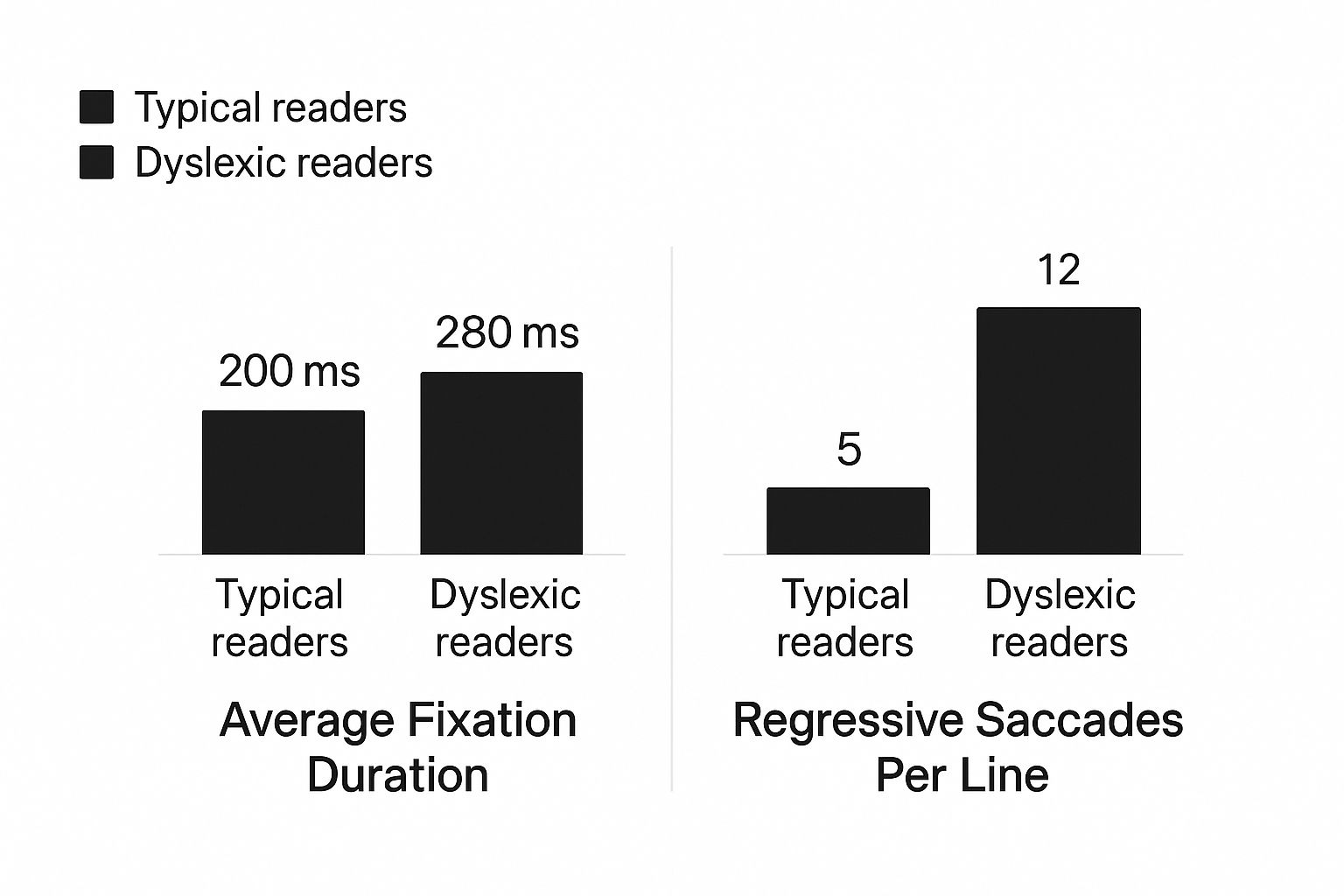
Some readers may experience longer pauses (fixations) and more backward glances (regressions) along a line of text, which means their brain is working harder just to decode the words.
A full diagnostic assessment is carried out by a specialist teacher or an educational psychologist, not an optometrist. Their investigation is much wider and looks at:
- Phonological Skills: How the brain processes the sounds in language.
- Working Memory: The ability to hold and work with information in the short term.
- Processing Speed: The pace at which information is taken in and understood.
- Spelling and Writing: Looking for consistent patterns of difficulty with written words.
Visual Stress Test vs Full Dyslexia Assessment
To make the choice clearer, this table breaks down the key differences between the two paths.
| Feature | Visual Stress Assessment | Full Diagnostic Dyslexia Assessment |
|---|---|---|
| Primary Focus | Visual discomfort and distortions when reading | Underlying cognitive processing and language skills |
| Conducted By | Specialist Optometrist | Educational Psychologist or Specialist Teacher (with an APC) |
| What It Investigates | Eye strain, headaches, text stability, light sensitivity | Phonological awareness, memory, processing speed, literacy |
| Potential Outcome | Prescription for coloured overlays or precision-tinted lenses | Formal diagnosis of dyslexia, report for educational support |
| Best For | Symptoms like words "moving" or "blurring," eye fatigue | Difficulties with spelling, memory, and language processing |
A visual stress test is about making the physical act of reading more comfortable, whereas a full dyslexia assessment identifies a specific learning difference to unlock the right educational support.
Frequently Asked Questions About Dyslexia and Vision
When you are trying to understand the link between dyslexia and vision, it is natural for a lot of questions to pop up. We have gathered some of the most common ones we hear from families and individuals to give you the clear, straightforward answers you need to find the right path forward.
Can an Optician Diagnose Dyslexia?
This is a really common point of confusion, but the short answer is no, an optician cannot diagnose dyslexia.
Dyslexia is recognised as a language-based learning difference. A formal diagnosis requires a study into cognitive skills like phonological awareness (how you process sounds in language), working memory, and processing speed. That kind of assessment can only be carried out by a qualified specialist teacher or an educational psychologist.
So, where do we come in? Our role as optometrists is to look after your eye health and vision. A comprehensive eye exam is a critical first step. We can rule out common sight issues and also check for visual stress, a separate condition that often co-exists with dyslexia and can make reading a real struggle.
Are Coloured Overlays Scientifically Proven?
Coloured overlays are a tool for managing the symptoms of visual stress, not a treatment for dyslexia itself. For some people, looking at black text on a white page causes visual distortion—words might seem to shimmer, blur, or jump around. A specific colour of overlay can sometimes calm this effect, making reading much more comfortable and reducing eye strain.
While some individuals find them genuinely life-changing, the scientific community remains divided on their universal effectiveness. Think of them as a supportive aid for the right person—a way to manage the physical symptoms of visual stress—rather than a "cure" for the underlying neurological differences of dyslexia.
What Does a Visual Stress Test Cost in the UK?
The cost for a visual stress assessment in the UK is not fixed; it can vary quite a bit depending on the practice and how in-depth the testing is.
An initial screening using a set of coloured overlays to find a helpful tint will typically cost less than a full assessment with an Intuitive Colorimeter, which is a specialised instrument used to prescribe precision-tinted lenses. It is always best to get in touch with a specialist practice directly to ask about their fees for a dyslexia eye test or visual stress assessment.
What Should I Do After an Assessment?
What you do next really hinges on the results of the assessment.
- If visual stress is identified: The optometrist might suggest trying coloured overlays for reading or prescribe precision-tinted glasses. If the primary challenges were visual, these tools can make a world of difference.
- If vision is fine, but difficulties persist: If the eye exam shows everything is healthy and working as it should, but struggles with reading, spelling, and memory continue, it is time to explore other avenues. The next logical step would be to pursue a full diagnostic assessment for dyslexia with an educational psychologist or a specialist teacher. They can provide a formal diagnosis and, more significantly, recommend tailored educational support.
It all starts with getting to the root of the problem.
At Northern Optical Company, we are committed to giving your family clear, honest advice and expert eye care. If you have any concerns about visual stress or just want to book a thorough eye examination in Newcastle, we are here to help.
Contact us today to schedule your appointment