

When your glasses take a tumble, that sinking feeling is all too familiar. But do not despair just yet. Many common issues are surprisingly easy to sort out yourself, saving you a trip to the optician. The first step, before you reach for any tools, is to play detective and figure out exactly what has gone wrong.
Assessing Common Types of Frame Damage
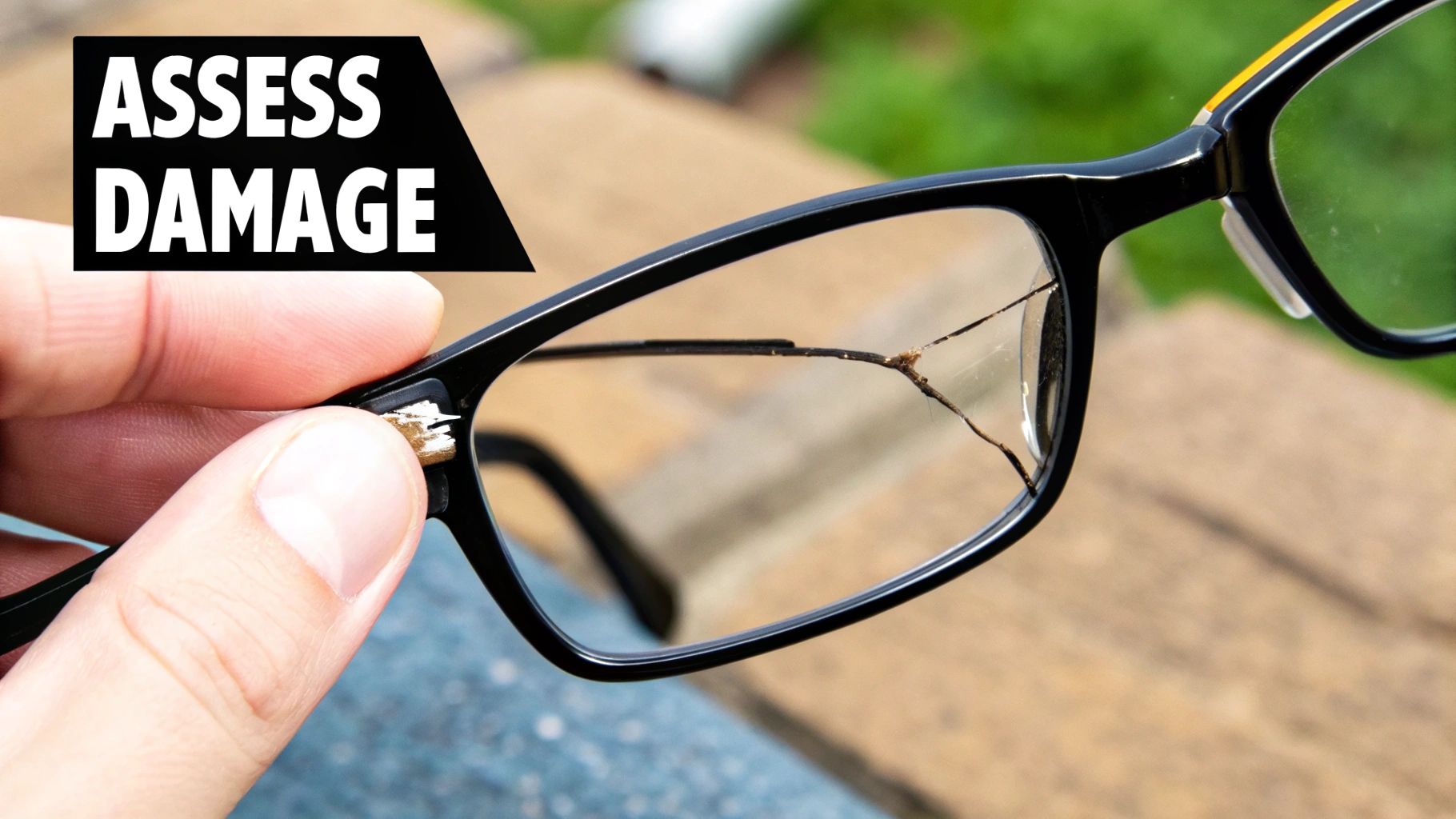
That heart-stopping moment when your specs bend, snap, or just feel 'off' is frustrating. A calm, clear-eyed look will tell you whether you are dealing with a five-minute fix or a job for the pros. Most of the time, it is the little things—a loose screw, a wobbly nose pad—that can be handled with a steady hand and a bit of patience.
Start by laying your glasses on a flat table. Do they sit level? If one arm hovers in the air, you have a bent frame. This is probably the most common glasses-related mishap, and it is often something you can gently correct at home.
Next, get up close and personal with the smaller components. Check the tiny screws holding the arms to the frame front. Are they loose, or has one made a bid for freedom? What about the nose pads? Are they secure, or have they gone missing in action? These are classic DIY repair scenarios.
Knowing When to DIY and When to Call the Pros
The secret to successful home repair is knowing where to draw the line. Minor tweaks and simple part swaps are fair game. Significant structural damage, particularly near the lenses or involving complex hinges, is best left to someone with experience.
Key Takeaway: A clean break in a plastic frame might be fixable, but a snap right at the hinge or a crack in a metal frame almost always needs professional tools and skills. Forcing a repair on these can turn a fixable problem into a permanent one.
To make things simpler, here is a quick rundown to help you decide on your next move.
DIY vs Professional Repair: A Quick Comparison
Use this table to quickly decide if your glasses issue is something you can fix at home or if it requires an expert.
| Type of Damage | DIY Feasibility | Required Tools or Materials | When to Call a Professional |
|---|---|---|---|
| Loose or Missing Screw | High | Eyeglass repair kit (mini screwdriver, screws) | If the screw thread is stripped and will not tighten. |
| Bent Metal Arm | Medium | Pliers with padded tips, steady hands | If the bend is severe, close to the lens, or if the metal shows signs of stress cracking. |
| Detached Nose Pad | High | Replacement nose pads, mini screwdriver | If the small metal post that holds the pad is broken off the frame itself. |
| Snapped Plastic Frame | Low to Medium | Super glue (for a temporary fix), frame bonding agent | If the break is on the hinge, near the lens groove, or if the plastic is brittle. |
A DIY repair is for simple, mechanical issues. For anything involving the structural integrity of the frame, particularly with premium materials, an expert eye is invaluable.
Check Your Lenses and Frame Health
Before you start fiddling, give your lenses a once-over. Are there any new chips or scratches from whatever caused the damage? A broken frame is a nuisance, but a compromised lens can actively harm your vision.
It is also a great idea to give them a proper clean. Following our guide on how to clean glasses properly will help you spot any sneaky hairline cracks or stress marks on the frame you might have missed at first glance.
If your frames are made from fancy materials like titanium or have intricate spring hinges, think twice before attempting a repair. These often require special tools and a delicate touch. In these situations, making a call to your optician is always the smartest, safest choice.
Setting Up Your At-Home Repair Kit
Trying to fix your glasses without the right tools is almost guaranteed to end in frustration, and you might even make the problem worse. You do not need a full-blown professional setup, but having a few key items on hand makes all the difference for tackling those common little mishaps.
The absolute cornerstone of your kit is a precision screwdriver set. Eyewear screws are tiny, and using that chunky screwdriver from your kitchen drawer is a sure-fire way to strip the head. Once that happens, a simple fix becomes a major headache. Get a set with a variety of small Phillips and flathead tips.
Next up, you will want a good pair of needle-nose pliers. They are perfect for gently nudging a bent metal frame back into shape. Here is a pro tip: wrap the tips of the pliers with a bit of electrical tape or a small piece of soft cloth. This simple step gives you a cushioned, non-slip grip that protects your frames from scratches.
Getting Things to Stick
When it comes to glues and adhesives, one size definitely does not fit all. The right choice depends entirely on what your frames are made of. Before you even think about glueing, you need to know your eyewear frame materials to pick a bonding agent that will actually work.
- Plastic Frames: Your everyday super glue is often too brittle for plastics and can eat away at the finish. A specialised plastic cement or bonding agent is what you need for a much stronger and more flexible join.
- Metal Frames: You might get away with a two-part epoxy for a temporary fix, but it is often messy and will not hold forever. A proper, permanent repair on metal frames almost always needs professional soldering.
Here's a little trick I've relied on for years: keep a small, powerful magnet in your kit. When you inevitably drop one of those minuscule screws, the magnet will save you from crawling around on the floor and make finding it a breeze.
A Few More Handy Items
Beyond the main tools, a couple of other things will make any repair job go much more smoothly. Always have a soft microfibre cloth nearby. You will need it to clean the area before you start and to wipe away any fingerprints when you are done.
I would also recommend adding a magnifying glass. The parts you are dealing with are incredibly small, and a bit of magnification can make the difference between a successful fix and a failed attempt. With these items ready to go, you can confidently handle minor issues and keep your glasses looking and feeling great.
A Practical Guide to Fixing Metal and Plastic Frames
Now that you have your tools ready, let's get down to the actual repair work. The key thing to remember is that metal and plastic frames behave very differently. You cannot use the same technique on both, and each requires a delicate hand to avoid making things worse.
I know the idea of fixing your own glasses can feel a bit intimidating. It is a precise job, and it is no surprise that the professional repair sector in the UK has seen its revenue dip by 2.7% annually over the last five years. Still, it is a market worth around £725.4 million, which tells you that people really do want to keep their favourite frames going. You can see the full details in the UK optical equipment repair market report on ibisworld.com.
This image breaks down the core differences in a really clear way.
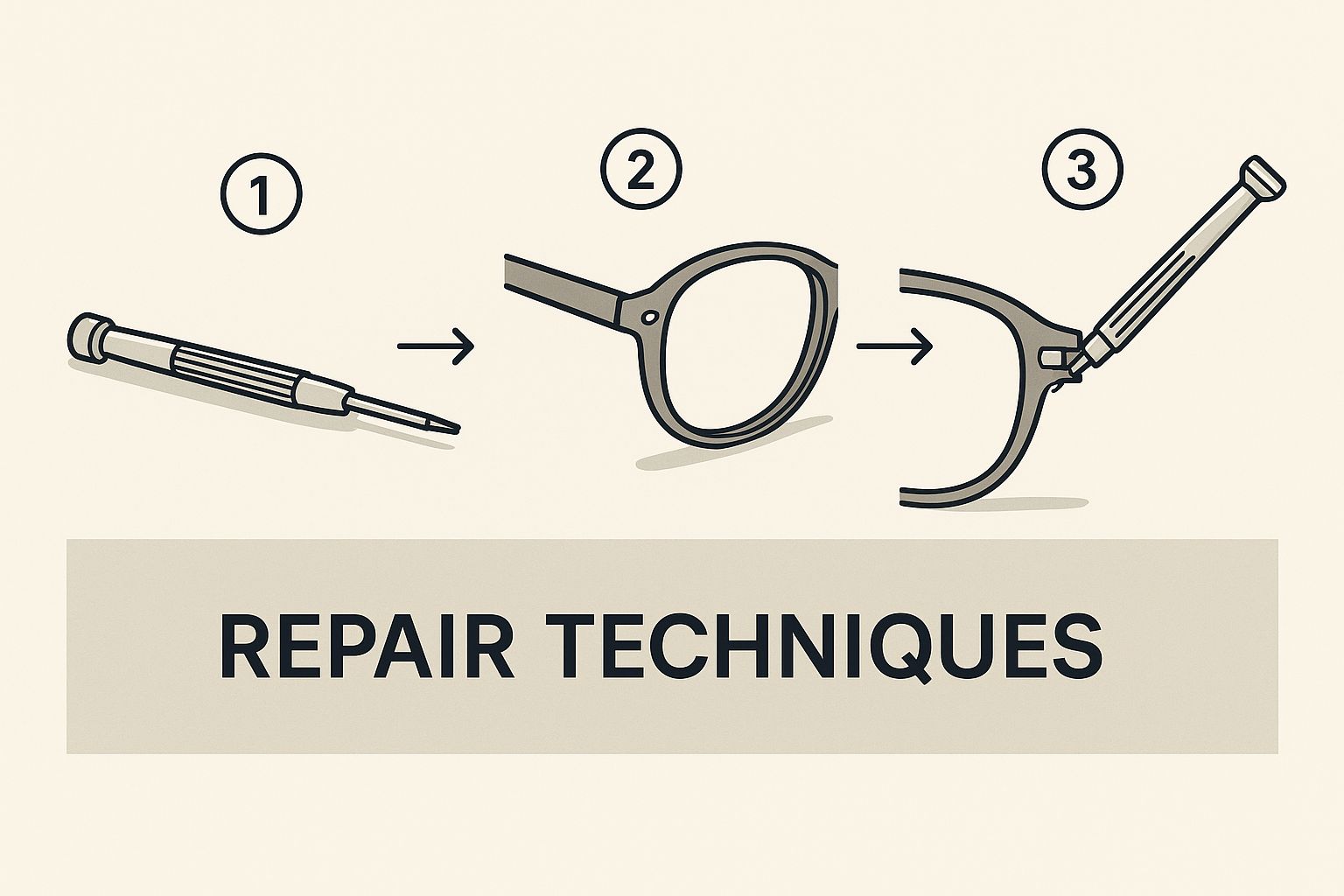
As you can see, a successful fix comes down to using the right method for the material in your hands—gently bending for metal, and carefully applying heat for plastic.
Fixing Common Issues with Metal Frames
Metal frames are generally quite sturdy, but they still need to be handled with care. A bent arm is probably the most common complaint, leaving your glasses sitting wonky on your face. It is an easy fix.
Hold the frame steady and pinpoint the bend. If it is just a slight warp, you can often use your thumbs to gently nudge it back into shape. For a more stubborn bend, grab your tape-wrapped needle-nose pliers. Grip the arm carefully and make tiny, slow adjustments. The golden rule here is to avoid brute force. It is far better to make several small tweaks than one big one that could snap the metal.
Another classic problem is a popped-out lens, which usually happens when the frame gets twisted. Before trying to put the lens back, check the frame for any bends and straighten them out first. Then, gently guide the lens back into its groove, starting at one corner and working your way around until it satisfyingly clicks into place.
A Crucial Tip: If the lens does not seat easily, stop. Do not force it. It means the frame is probably still bent. A forced lens can chip or crack under the pressure, turning a simple fix into a much bigger headache.
Mending and Reshaping Plastic Frames
Plastic frames bring their own unique set of challenges. A clean snap in an arm or the front might look like a total disaster, but it can often be rescued with the right technique. Your first thought might be to grab the super glue, but trust me, that is usually a mistake. Standard glues create a brittle bond that will not hold up to daily use and can ruin the plastic's finish.
For a durable, long-lasting repair, you will want to use a specialised plastic bonding agent or cement.
- Clean the Surfaces: First, make sure both sides of the break are perfectly clean and free from any dust or oils from your fingers.
- Apply the Bonding Agent: Use a tiny amount of the agent on both broken edges. If you use too much, it will just ooze out and create a mess.
- Press and Hold: Firmly press the two pieces together and hold them exactly as the product instructions tell you—this could be for several minutes.
- Let It Cure: Be patient. You need to let the bond fully cure for at least 24 hours before you even think about wearing the glasses.
Warping is another frequent issue with plastic, particularly if you have accidentally left your specs in a hot car. You can reshape them using gentle heat. A hairdryer on its lowest setting is perfect for this. Hold it several inches away from the frame, moving it back and forth to warm the plastic evenly until it feels pliable. Then, carefully adjust the frame to the right shape and hold it there until it cools down completely, which will lock the new shape in place.
Handling Tricky Repairs on Hinges and Nose Pads
Sometimes the problem is not a simple bend or a clean snap. More often, it is one of those tiny, fiddly components that decides to give up. Hinges and nose pads are the usual suspects here. They are under constant stress, so a loose screw or a lost pad can quickly make your glasses totally unwearable. This is where glasses frame repairs get a bit more technical.
The good news? With the right parts and a bit of focus, you can often solve these problems yourself. These repairs demand more precision than just bending an arm back into shape, but they are definitely achievable with a steady hand at home.
Economic pressures are also changing how we in the UK look after our eyewear. Research from the Association of Optometrists points out that while more people need glasses, many are now actively seeking durable, long-lasting options. This shift towards value makes knowing how to perform these small repairs more useful than ever, helping you get the most out of a quality frame. You can find more details on these eyewear consumer trends at aop.org.uk.
Dealing with Hinge Issues
The hinge is the mechanical heart of your glasses, and it is a surprisingly complex part. Before you even think about starting a repair, you need to know what you are working with. A standard barrel hinge is what you will see most often—it looks like small, interlocking rings held together by a single screw. The other common type is a spring hinge, which is more complex as it has a small spring inside that allows the arms to flex outwards without breaking.
-
For a Standard Hinge: If the arm just feels wobbly, you have likely just got a loose screw. Grab your precision screwdriver and give it a gentle clockwise turn. If the screw has vanished entirely, your eyeglass repair kit should have a suitable replacement.
-
For a Spring Hinge: These are much trickier to fix yourself. If the spring mechanism inside has failed, it almost always needs professional tools and expertise. Trying to force it can destroy the hinge for good.
Here is a little trick I have used in a pinch: if a screw is stripped and just will not tighten, you can place a tiny sliver from a wooden toothpick into the screw hole before putting the screw back in. This can provide just enough purchase to hold things together temporarily.
A Quick Word of Warning: Never, ever force a screw. If it will not turn easily, it is either the wrong size or the thread is damaged. Cross-threading a hinge screw will completely ruin the frame.
Replacing Lost Nose Pads and Screws
A missing nose pad is not just uncomfortable; it throws off the entire alignment of your glasses, which can seriously affect your vision. Luckily, replacing them is one of the easier fixes. Most nose pads are either a screw-in type or a push-in (snap-on) variety.
You can find replacement nose pads and universal screw kits at most chemists or online. These kits are incredibly handy to have around, as they usually contain a good selection of pad shapes and tiny screw sizes to match most frames.
To replace a screw-in nose pad:
- Gently unscrew and remove the old pad or whatever is left of it.
- Line up the new pad with the small mount on the frame.
- Insert the new, tiny screw and tighten it gently until it is secure. Do not go overboard, as it is very easy to overtighten and strip the screw.
For anyone who plays sports, keeping your eyewear secure is absolutely critical. If you are an athlete constantly dealing with glasses issues, you might want to look at more robust options. Our guide on how to choose sports glasses for better performance is a great place to start.
Knowing When to See a Professional
While getting your glasses back in working order with a bit of DIY can be a real lifesaver, knowing your limits is just as important. I have seen it countless times: a well-intentioned fix that accidentally causes permanent damage. Recognising when to put down the pliers and head to an optician is the best way to protect both your frames and your vision.
Some breaks are immediate red flags. For instance, if your frame has snapped right beside the lens groove, trying to fix it yourself is a huge gamble. You could easily chip the lens or, worse, compromise the frame’s ability to hold it securely. A wobbly or misaligned lens is not just an annoyance; it can lead to some serious eye strain and headaches.
This is particularly true if you have invested in designer or high-value frames. The global eyewear market is massive—valued at around USD 200.46 billion and still growing, according to some eyewear market trend reports. A big part of that growth comes from people choosing to repair their favourite fashion frames instead of replacing them. A professional has the right tools and, crucially, the experience to handle delicate or expensive materials without voiding a warranty or ruining their value.
When Professional Expertise Is Non-Negotiable
Some materials and complex parts are just not meant for at-home repairs. If you are dealing with any of these issues, your best bet is to find a professional.
- Cracked Titanium or Memory Metal Frames: These are not your average materials. You cannot just glue them or bend them back. They need specialised techniques like laser welding to create a repair that is both safe and strong.
- Broken Spring Hinges: The mechanism inside a spring hinge is surprisingly complex. If it breaks, simply replacing a screw will not cut it. The entire hinge component usually needs to be professionally repaired or replaced.
- Damage Affecting Lens Alignment: Any break or significant bend that changes how the lenses sit in front of your eyes needs an expert. Incorrect alignment can make your prescription useless and even cause visual discomfort.
A Quick Tip from Experience: An optician does not just patch up the break. They restore the frame's entire geometry. This is what guarantees your lenses are perfectly aligned for crisp, comfortable vision—something a DIY fix rarely accomplishes.
At the end of the day, tackling a complex repair yourself is a bit of a gamble. You risk turning a fixable problem into a "buy a whole new pair of glasses" problem. If you are ever in doubt, getting a professional opinion is always the smarter, safer move. We have seen countless well-meaning repairs go wrong, and we can give you clear advice on when to visit an optician to save you a lot of time, money, and frustration.
Got Questions About Fixing Your Glasses Frames?
Even with a step-by-step guide, you might still have a few lingering questions. It is completely normal. Sometimes your situation feels unique, or you just want that last bit of reassurance before you begin. I have pulled together some of the most common questions I hear, drawing from years of sorting out every kind of eyewear mishap imaginable.
Think of this as a quick chat over the counter, giving you the confidence to get the job done right.
Can I Just Use Super Glue on My Plastic Frames?
Ah, the super glue question. This is probably the most frequent mistake people make, and it almost never ends well. Standard super glue creates a rigid, brittle bond that is just waiting to snap again with the slightest bit of flex.
Worse yet, the harsh chemicals can wreak havoc on your frame's material. You can end up with cloudy patches, discolouration, or even melted plastic, which is damage you simply cannot undo.
For a proper, lasting fix on plastic, you really need a specialised bonding agent for plastics. These are formulated to create a much stronger, more flexible join that can actually handle the rigours of daily wear. It is the difference between a temporary patch and a real repair.
How Do I Straighten Bent Glasses Without Breaking Them?
The one-word answer here is: gently. Patience is your best friend when trying to coax a frame back into alignment. For slight bends in metal frames, you can often use just your thumbs to carefully apply slow, steady pressure and guide them back into shape.
If the bend is a bit more stubborn, or if you are dealing with plastic, you will need to introduce a bit of warmth.
- For metal frames: I always recommend using pliers that have padded or taped tips. This prevents scratching. Make tiny, gradual adjustments rather than trying to force it all at once.
- For plastic frames: Grab a hairdryer and set it to low. Hold it a good few inches away from the frame, moving it constantly to warm the plastic evenly. Once it feels a little pliable to the touch, you can gently reshape it. Just remember to hold it in the correct position until it cools down and sets.
Is It Really Worth Repairing My Cheap Glasses?
This is a classic 'time versus money' dilemma. If the frames themselves did not cost much, you might think it is not worth the effort or the price of repair materials.
But the real value is not always in the frame – it is in the lenses. If you have prescription lenses, repairing the frame is almost certainly cheaper than buying new frames and paying to have your existing lenses cut and fitted into them. And sometimes, you just love the fit and style of those particular glasses. If that is the case, a simple repair is a brilliant way to keep a favourite pair going.
Where on Earth Do I Find Those Tiny Replacement Screws?
It is a rite of passage for every glasses-wearer to lose one of those microscopic screws. The easiest solution is to grab a small glasses repair kit, which you can find in most chemists or easily online. They are fantastic value and usually come with a tiny multi-head screwdriver and an assortment of common screw sizes.
If you have a particularly unusual frame or just cannot find the right size, your best bet is to pop into a local optical shop. An optician will have a whole workshop's worth of screws and can find a perfect match in minutes.
If you have taken a look and decided the job is a bit beyond your comfort zone, or you would simply rather a professional handled it, the team at Northern Optical Company is here to help. We offer professional glasses frame repairs in Newcastle to get your favourite specs looking and feeling like new again. Visit us or get in touch today for expert advice and service.